4.3.2.1 - Internal Energy
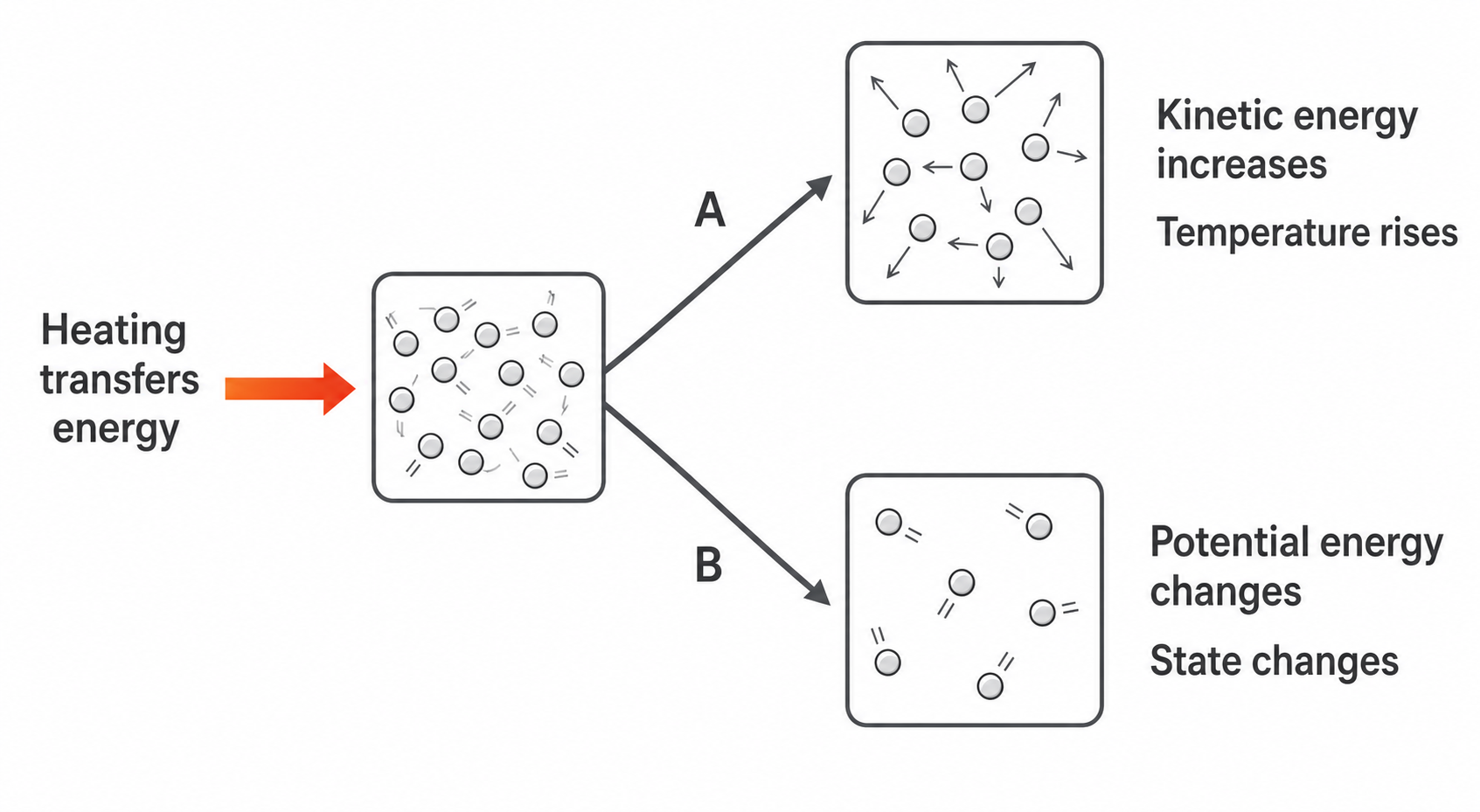
Internal energy is the energy stored inside a system by the particles that make up that system. At GCSE, the key idea is simple but easy to mix up: internal energy is about the particles inside the material, not just the movement of the whole object. Heating transfers energy to those particles, and the result is either a temperature rise or a change of state.
What internal energy means
A system is the object or substance being considered, such as a block of metal, a beaker of water, or a sample of gas. The system is made from particles: atoms and molecules.
Internal energy
Internal energy is the total kinetic energy and potential energy of all the particles that make up a system.
The word total matters. A cup of water contains a huge number of particles, and each particle contributes to the internal energy. Some of that energy is kinetic energy because particles move or vibrate. Some is potential energy because particles have positions relative to each other and there are forces between them.
Internal energy is not the same as the kinetic energy of the whole object. A stationary beaker of hot water has no kinetic energy as a whole object, but the particles inside it are moving randomly, so the water has internal energy.
Particle kinetic and potential energy
Particle kinetic energy is linked to particle motion. In a solid, particles vibrate about fixed positions. In a liquid or gas, particles can move around more freely. In all three states, if the particles move or vibrate faster on average, their kinetic energy has increased.
Particle potential energy is linked to the positions of particles relative to one another. It is not gravitational potential energy in this lesson. It is energy associated with the arrangement and separation of particles and the forces between them.
This distinction explains why two different changes can both increase internal energy:
- if particles move faster on average, their kinetic energy increases
- if particles move further apart or rearrange during a change of state, their potential energy changes
The exam habit is to name the particle energy, then link it to the observation. For example, "temperature rises because the average kinetic energy of the particles increases" is stronger than "it gets hotter because it has more heat."
Heating and temperature rise
Heating a system transfers energy to the particles in that system. This increases the energy stored within the system, so the internal energy increases.
One possible outcome is a temperature rise. When a material is heated and does not change state, the particles move or vibrate faster on average. Their kinetic energy increases, so the temperature of the system rises.
Imagine a metal spoon in hot water. The spoon is the system. Energy is transferred to the spoon by heating. Its particles vibrate more strongly, so their average kinetic energy increases and the spoon's temperature rises.
[DIAGRAM: asset_name: Internal Energy - diagram 1; asset_slug: 032_4_3_2_1_internal_energy_diagram1; file: diagram_assets/032_4_3_2_1_internal_energy_diagram1.png; recommended_method: image_gen; description: Conceptual two-path diagram showing energy transfer by heating into a particle system. Left path: same state, particles have larger motion arrows, labelled kinetic energy increases and temperature rises. Right path: change of state, particles become more separated/rearranged, labelled potential energy changes and state changes. Nearby prose gives all required explanation.]
Continue this lesson.
You’re previewing NovaLearn without an account. Create a free account to read the rest.
Create free account