4.5.6.2.2b - Inertial Mass and Required Practical 7
Newton's Second Law links resultant force, mass and acceleration. In this lesson you will use that link to understand inertial mass, then apply it to required practical 7: investigating how changing force or mass changes the acceleration of a trolley or toy car.
Prerequisite link for the practical
The acceleration of an object depends on the resultant force acting on it and on its mass. A larger resultant force gives a larger acceleration. A larger mass gives a smaller acceleration for the same resultant force. Required practical 7 uses this link as evidence: change the force or mass, then measure how the acceleration changes.
Newton's Second Law
In this equation:
Fis the resultant force in newtons,Nmis the mass in kilograms,kgais the acceleration in metres per second squared,m/s^2
The word resultant matters. If several forces act on the object, use the overall force after the forces have been combined. A trolley pulled forwards by a string but resisted by friction accelerates because of the resultant force, not just because a forward pull exists.
The proportionality symbol ∝ is useful for describing the two relationships:
Use the approximate-value symbol ≈ when the value is an estimate or a practical result. For example, a trolley system in required practical 7 has a total moving mass of 0.80 kg and a pulling force of about 1.2 N. If friction is small, the predicted acceleration is:
That answer is approximate because the pulling force is a school-practical value and friction in the trolley and pulley reduces the acceleration in a real run.
Inertial mass (HT only)
Inertial mass is about how difficult it is to change an object's velocity. A large inertial mass means the object's velocity is harder to change: for the same resultant force, it has a smaller acceleration.
Inertial mass
Inertial mass is a measure of how difficult it is to change the velocity of an object. It is defined as the ratio of force over acceleration.
Rearranging Newton's Second Law gives the Higher Tier definition:
Inertial mass
The units work out as kilograms:
Worked example: a resultant force of 12 N gives an object an acceleration of 3.0 m/s^2.
So the object's inertial mass is 4.0 kg.
Inertial mass is not the same as weight. Weight is a force caused by gravity, measured in newtons. Inertial mass is measured in kilograms and tells you how strongly the object resists acceleration.
Required practical setup
Required practical 7 investigates two effects:
- the effect of varying the force on the acceleration of an object of constant mass
- the effect of varying the mass of an object on the acceleration produced by a constant force
A common school method uses a trolley or toy car on a bench. A string passes over a bench pulley and is attached to a weight stack. When the weight stack falls, it pulls the trolley along the bench. The trolley is timed as it travels measured distances.
[DIAGRAM: asset_name: Inertial Mass and Required Practical 7 - diagram 1; asset_slug: 074_4_5_6_2_2b_inertial_mass_and_required_practical_7_diagram1; file: diagram_assets/074_4_5_6_2_2b_inertial_mass_and_required_practical_7_diagram1.png; recommended_method: image_gen; description: Exact required-practical apparatus layout for AQA required practical 7. Shows a trolley or toy car on a bench, string over a clamped bench pulley, a hanging weight stack providing the pulling force, marked distance intervals measured with a metre ruler or tape, masses fixed to the trolley, and stopwatch/video timing. It teaches the assessed setup and the quantities recorded: force, mass, distance, time and calculated acceleration. Deterministic drawing is required because apparatus labels, force direction and measurement positions are assessed.]
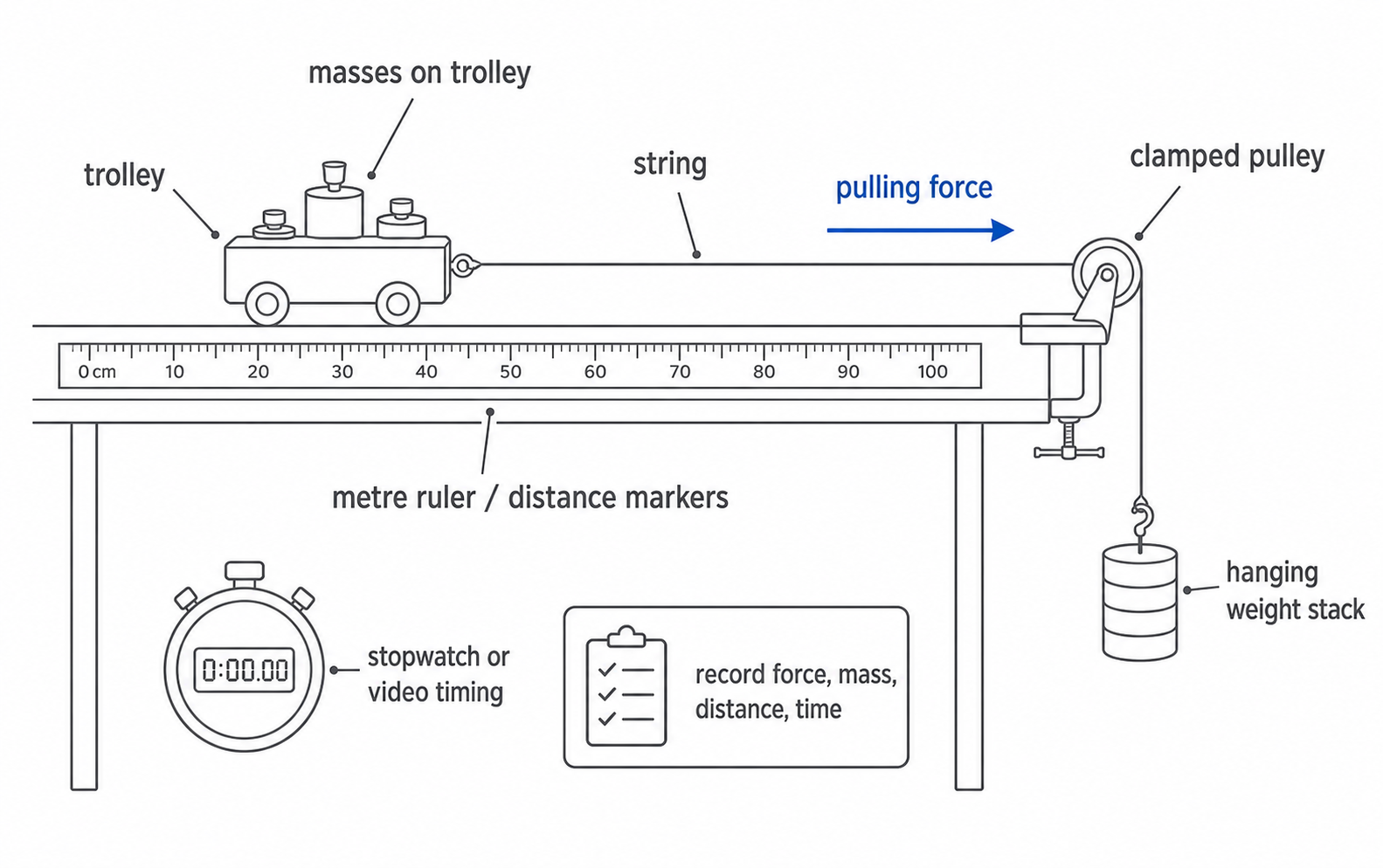
Core apparatus:
- trolley or toy car
- bench pulley, string and small weight stack
- metre ruler, chalk or masking tape for marked distance intervals
- stopwatch, lap timer or video timing
- balance if masses need to be measured
- Blu Tack or tape to secure masses to the trolley
- clamp stand, boss and clamp if needed to secure the pulley
Before taking readings, make sure the string is horizontal and in line with the trolley. Release the trolley from the same start point each time without pushing it. The weight stack should fall freely, but it must not hit the floor before the trolley reaches the final timing mark.
One simple method is to record lap times as the trolley passes several marked distances, such as 20 cm, 40 cm, 60 cm, 80 cm and 100 cm. You can also use one fixed final distance for a simpler calculation, provided the same distance is used for every run.
Safety controls include clamping the pulley securely, keeping the run clear, catching or stopping the trolley safely, using modest hanging weights, and keeping feet clear of falling masses.
Changing force at constant mass
To investigate how force affects acceleration, change the pulling force but keep the total moving mass constant.
The independent variable is the pulling force from the hanging weight stack. The dependent variable is the acceleration of the trolley. The main control variable is the total moving mass of the system.
[DIAGRAM: asset_name: Inertial Mass and Required Practical 7 - diagram 2; asset_slug: 074_4_5_6_2_2b_inertial_mass_and_required_practical_7_diagram2; file: diagram_assets/074_4_5_6_2_2b_inertial_mass_and_required_practical_7_diagram2.png; recommended_method: image_gen; description: Exact assessed variable-control diagram for required practical 7. Two panels show how to vary force while keeping total mass constant by transferring masses from the hanger to the trolley, and how to vary mass while keeping the hanging force constant by adding masses to the trolley. It teaches independent, dependent and control variable choices. Deterministic drawing is required because the variable-control method is assessed.]
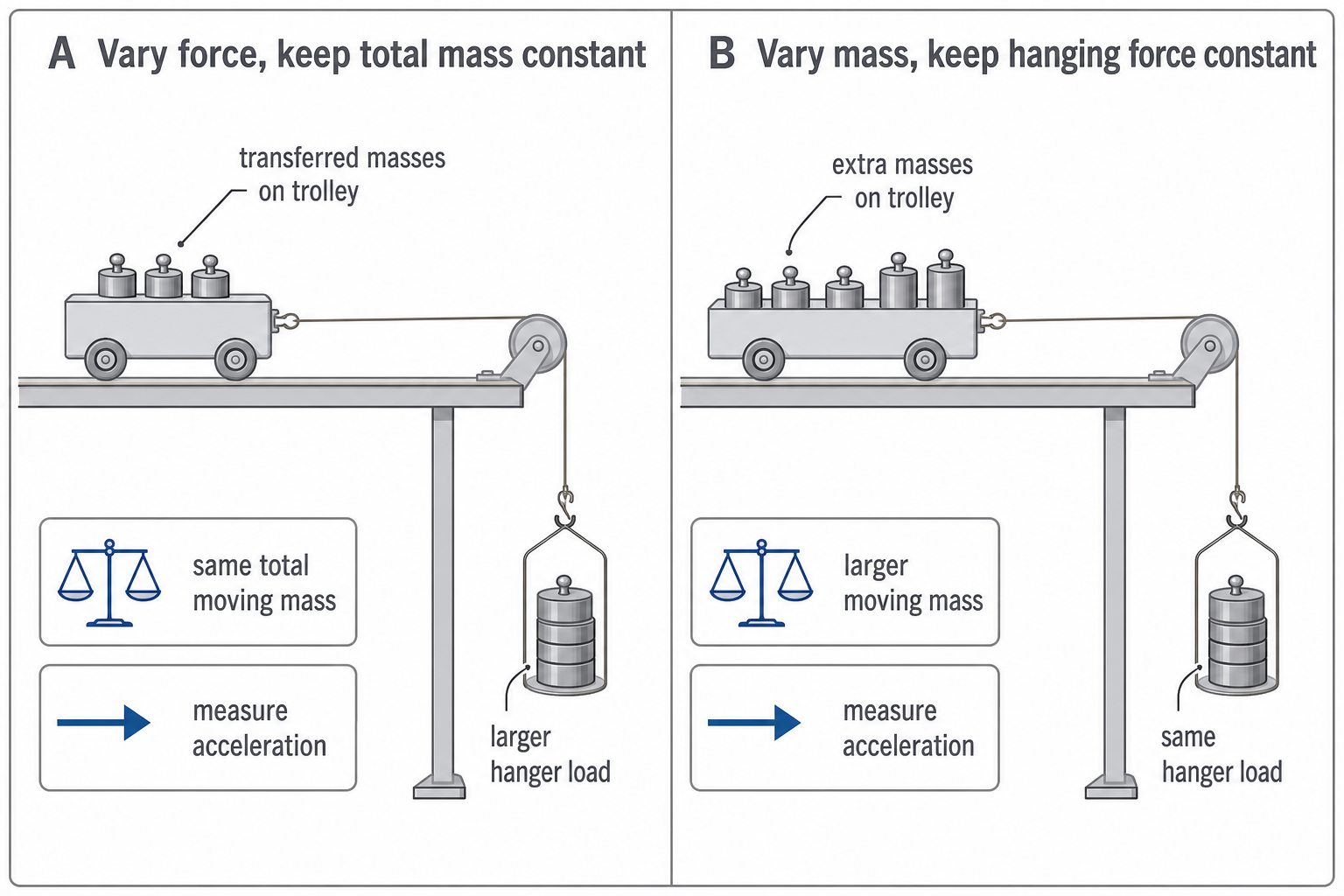
Method for changing force:
- Set up the trolley, string, bench pulley and weight stack.
- Choose a fixed final distance, such as
1.00 m, and mark the start and finish. - Measure or record the total moving mass. This includes the trolley and any masses that move with it.
- Put a chosen weight on the hanger to provide the pulling force.
- Release the trolley from rest and time how long it takes to reach the final distance.
- Repeat at least three times for the same force, calculate an acceleration for each repeat, then calculate a mean acceleration.
- Change the hanging weight to change the pulling force.
- When mass is removed from the hanger, place that removed mass on the trolley so that the total moving mass stays constant.
- Repeat the timing and acceleration calculation for each force.
Continue this lesson.
You’re previewing NovaLearn without an account. Create a free account to read the rest.
Create free account