4.5.7.1 - Momentum
Momentum is a property of moving objects. In this Higher Tier lesson, you will define momentum, calculate it using p = mv, use the correct unit kg m/s, and keep track of direction when velocity is given as positive or negative.
Momentum is a property of moving objects
An object has momentum when it has mass and is moving. A stationary object has no momentum because its velocity is zero.
Momentum
Momentum is the product of an object's mass and velocity.
Momentum depends on two quantities at the same time:
- the object's mass
- the object's velocity
A heavy object can have a large momentum even if it is moving slowly. A lighter object can also have a large momentum if it is moving quickly. You must use both values, not just choose the object with the larger mass or the larger velocity.
This lesson covers the definition and equation for the momentum of one object. Conservation of momentum, collisions, forces changing momentum, and safety features belong to later specification points.
Equation and units
For Higher Tier exams in 2026 and 2027, this equation is supplied on the Physics Equations Sheet. You still need to recognise and apply it:
Momentum
In words:
momentum = mass x velocity
The quantities and units are:
| Quantity | Symbol | Unit |
|---|---|---|
| momentum | kilogram metre per second, kg m/s | |
| mass | kilogram, kg | |
| velocity | metre per second, m/s |
The unit for momentum comes from the units in the equation:
You may also see the same unit written as kg m s^-1. For GCSE answers, kg m/s is clear and acceptable.
[DIAGRAM: asset_name: mass_velocity_product_comparison - diagram 1; asset_slug: 080_4_5_7_1_momentum_diagram1; file: diagram_assets/080_4_5_7_1_momentum_diagram1.png; recommended_method: image_gen; description: Image-generated schematic showing three carts. Object A has mass 2.0 kg and velocity +3.0 m/s, so p = +6.0 kg m/s. Object B has mass 3.0 kg and velocity +2.0 m/s, so p = +6.0 kg m/s. Object C has mass 2.0 kg and velocity -3.0 m/s, so p = -6.0 kg m/s. The visual shows that momentum depends on mass and velocity together, and that the sign records direction in a one-dimensional model.]
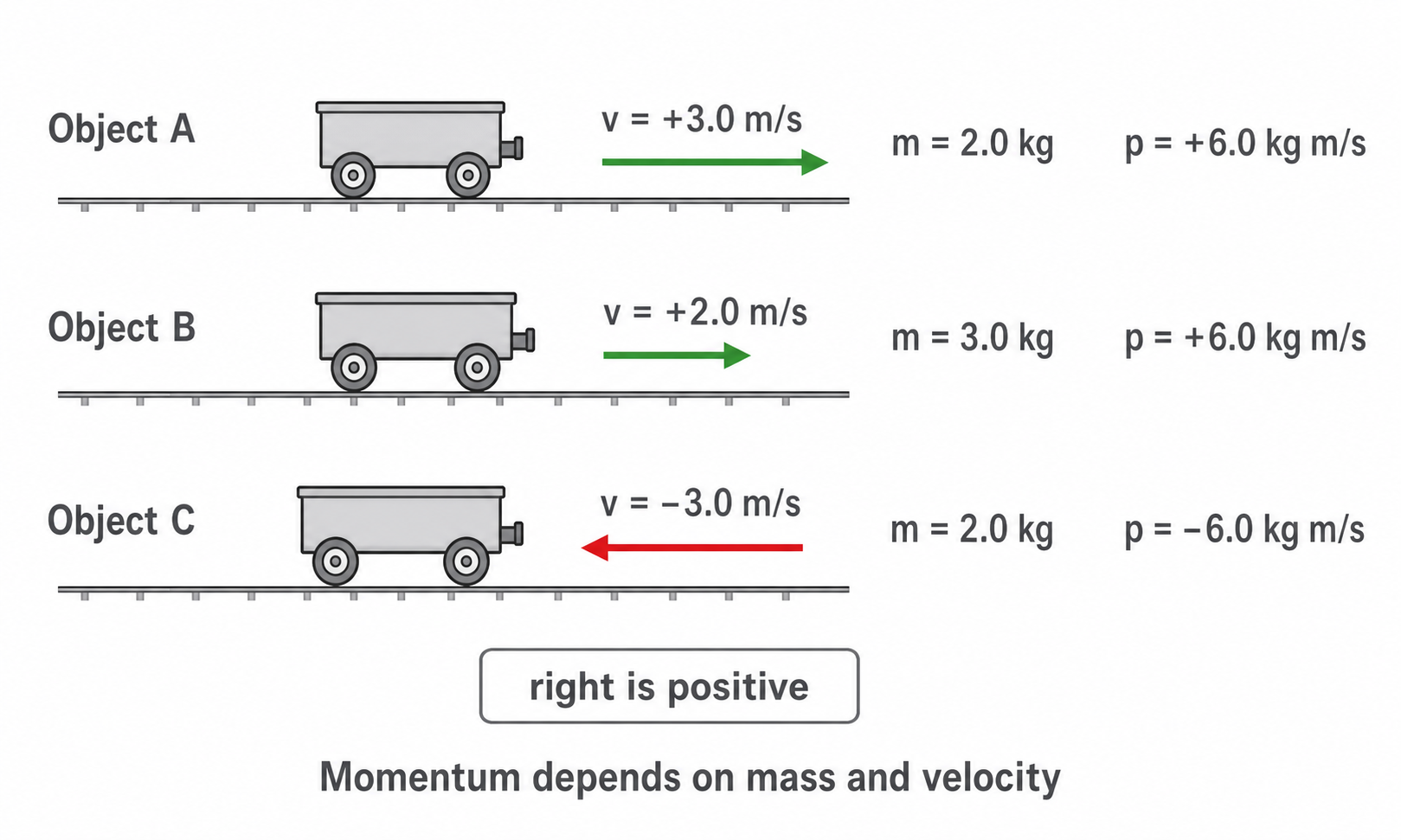
In the diagram, Objects A and B have the same momentum even though their masses and velocities are different. Object C has the same size of momentum as Object A, but it is moving in the opposite direction.
Use with mass in kilograms and velocity in metres per second. The momentum unit is kg m/s.
Calculating momentum
For a calculation, write the equation first, substitute the values, then give the answer with the correct unit.
Worked example: a cyclist and bicycle have a combined mass of 75 kg and move at 6.0 m/s. Calculate their momentum.
The momentum is 450 kg m/s.
You can also rearrange the equation:
Example: an object has a momentum of 28 kg m/s and a velocity of 7.0 m/s. Its mass is:
The unit tells you what kind of answer you have found. If the answer is a mass, use kg. If the answer is a velocity, use m/s. If the answer is a momentum, use kg m/s.
Continue this lesson.
You’re previewing NovaLearn without an account. Create a free account to read the rest.
Create free account