Core practical 8 - Tensile strength of plant fibres
A plant fibre can carry a load because its cell walls resist being pulled apart. Core practical 8 investigates how much pulling force prepared fibres withstand, then accounts for their thickness to estimate tensile strength. You will learn how to make the comparison fair and how measurement uncertainty limits the conclusion.
Breaking load, tensile strength and stiffness
The force needed to break a specimen depends on both its material and its dimensions.
Cellulose chains are organised into microfibrils in plant cell walls. Many bonds and interactions act across this structure, helping walls resist tension. Extracted plant strands may contain several cells and tissues, so their behaviour also depends on how those cells are joined, their wall thicknesses and any damage introduced during preparation.
Tension is a pulling force along a specimen. In this practical, a slowly loaded vertical fibre is pulled by the weight of suspended masses. Its breaking mass is the total suspended mass at the failure step, measured in kilograms or grams. The corresponding breaking load is a force, measured in newtons. A mass in grams is not a force in newtons.
Tensile strength
The maximum tensile force a specimen withstands per unit of its original cross-sectional area. In a simple fibre test, estimate this from the force at failure divided by the initial cross-sectional area.
The relevant area is the cut face perpendicular to the pulling direction. For example, two specimens made of the same material may have different breaking loads because the thicker one has more material sharing the force. Dividing force by area makes the comparison more useful. The result is still an estimate for the tested specimen under the stated conditions, particularly when its cross-section is irregular.
For the original illustrative specimens below, P has a breaking force of and area ; Q has and . Their force-per-area values are and , respectively. Q carries twice the force but has four times the area, so its estimated tensile strength is half P's. Here .
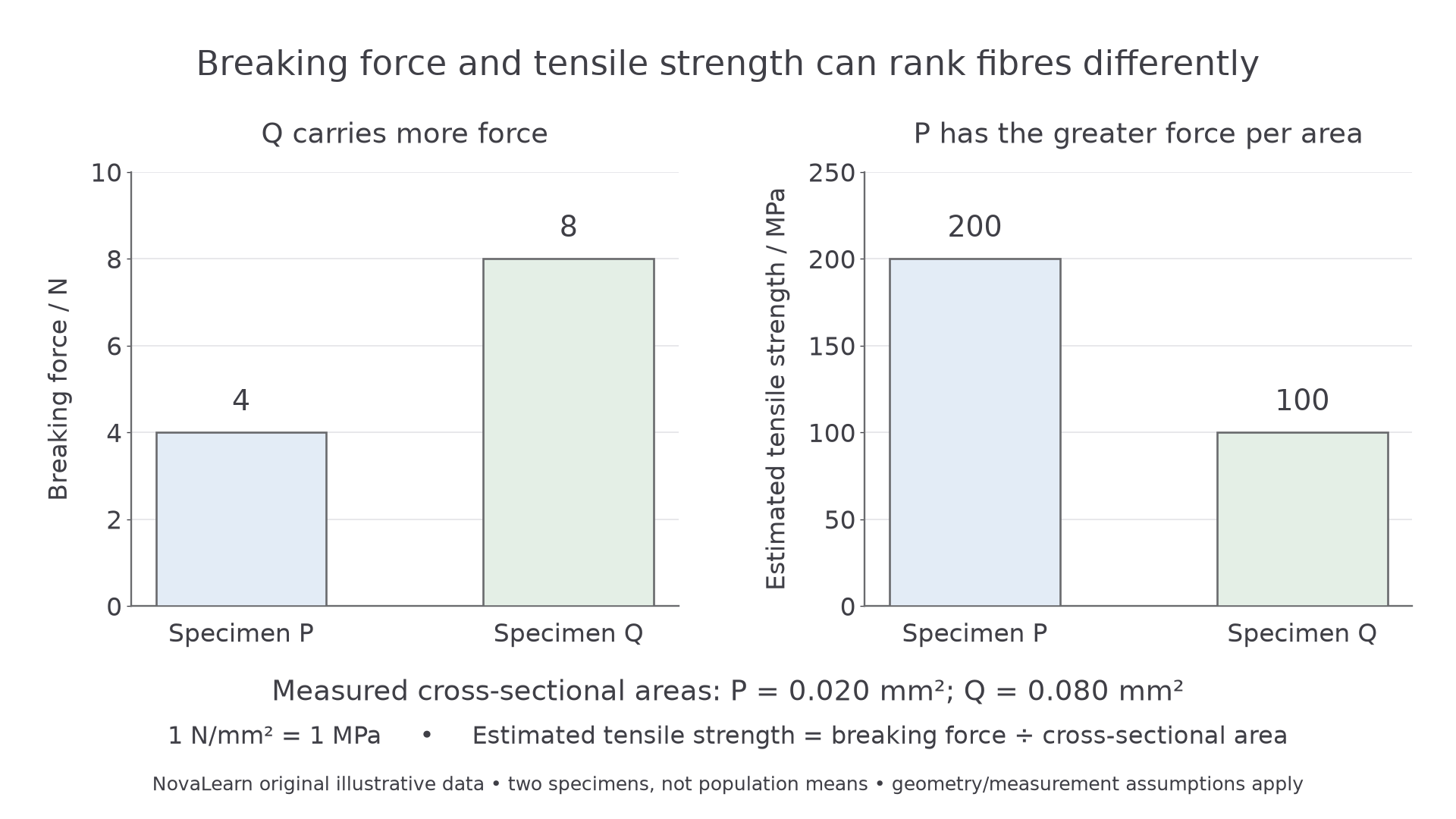
The two specimens rank differently for breaking force and force per area; these are original illustrative data, not population means.
Stiffness concerns how much a specimen stretches for an applied force before failure. A specimen that extends little under a given small load is stiff in that comparison, but it may still break at a modest load. Extension is the increase in length; it is not itself a measure of tensile strength. To compare material stiffness properly, length and cross-section also matter. Recording only the failure load cannot determine stiffness or the whole stretching behaviour.
Preparing comparable fibre specimens
A useful result starts with a defined specimen and a reproducible preparation procedure.
One school version uses long strands peeled from fresh celery petioles, the stalks supporting its leaves. Use similar petiole regions and record the plant source, age or maturity where known, and preparation date. Under supervision, cut approximately pieces on a cutting tile, directing the blade down onto the tile and away from fingers. Use forceps to separate strands lengthwise, rinse off loose soft tissue gently, and avoid scraping, stretching or nicking the strands. Celery “strings” include collenchyma strands as well as vascular bundles, so sample the same identified kind of strand consistently. These are tissue specimens, not isolated cellulose molecules or necessarily single sclerenchyma cells.
Commercial unspun plant fibres or teacher-prepared retted stems provide alternatives. Retting loosens the tissues binding fibres together, often through microbial breakdown during soaking. Its duration and conditions can alter the specimen, so record and standardise extraction rather than treating all “plant fibres” as identical. Teacher-managed preparation and disposal are needed for retted material; do not improvise microbial cultures. Comparing a freshly peeled strand with a chemically processed commercial fibre changes more than plant species.
For a defined conditioning procedure, place the prepared strands in labelled glass beakers with water measured using a measuring cylinder. An example is minutes at , followed by gentle blotting for seconds and starting the test within minutes. These are chosen protocol conditions, not universal optimum values: a pilot establishes whether the specimens can be handled and loaded, then the same feasible conditions are used throughout. Wetting and drying can change fibre properties, so keep temperature, soaking, blotting and the delay before testing consistent.
Measure an initial free length, such as , between the inside edges of the grips. The cut specimen must be longer to leave material inside each grip. Equal cut lengths do not ensure equal free lengths. Longer test lengths can include more potential weak points, so changing free length may change failure behaviour even after dividing by area.
Measure each specimen's thickness before loading. A zero-checked micrometer with a gentle, consistent closing force may suit sufficiently thick strands; excessive pressure compresses them. For finer specimens, use a microscope calibrated with a stage micrometer. Record the instrument resolution and calibration. Take diameter readings at several positions along the free length and, where possible, in two perpendicular orientations. Record the variation as well as a representative value. A single width is a poor estimate for a flattened or tapered bundle.
| Investigation choice | What is changed or measured? | What must be kept comparable? |
|---|---|---|
| Determine strength of one batch | Measure failure load and each specimen's initial area | Preparation, free length, moisture, grip arrangement and loading schedule |
| Compare two plant batches or species | Independent variable: named batch or species; calculated dependent variable: tensile strength | Match preparation, plant part and maturity as far as feasible; use similar thicknesses and measure each area |
| Investigate free length | Independent variable: free length | Same source and preparation, measured cross-section, conditioning and loading |
Use fresh specimens for destructive tests, with several independent stems and plants where the intended conclusion concerns plants generally. For a school comparison, aim initially for at least five valid specimens per group and increase sampling if variation is large. Many strands from one stem reveal variation within that stem; they do not supply the same evidence as sampling several plants. Use readily available cultivated material and only the quantity needed, rather than damaging scarce wild plants.
Calibrated loading and a safe failure endpoint
The load must pull along the fibre and increase in known steps without a sudden jerk.
Use a stable clamp stand, padded grips, a light mass hanger, known slotted masses, ruler, timer, balance and a padded catch tray. Secure the stand against tipping and keep within its safe load limit. Clamp the fibre vertically with the chosen initial free length. Attach the lower grip and hanger gently, initially supporting them by hand so they do not shock-load the specimen. Avoid knots and sharp jaw edges that concentrate force. Mark the grip positions so that slippage can be recognised.
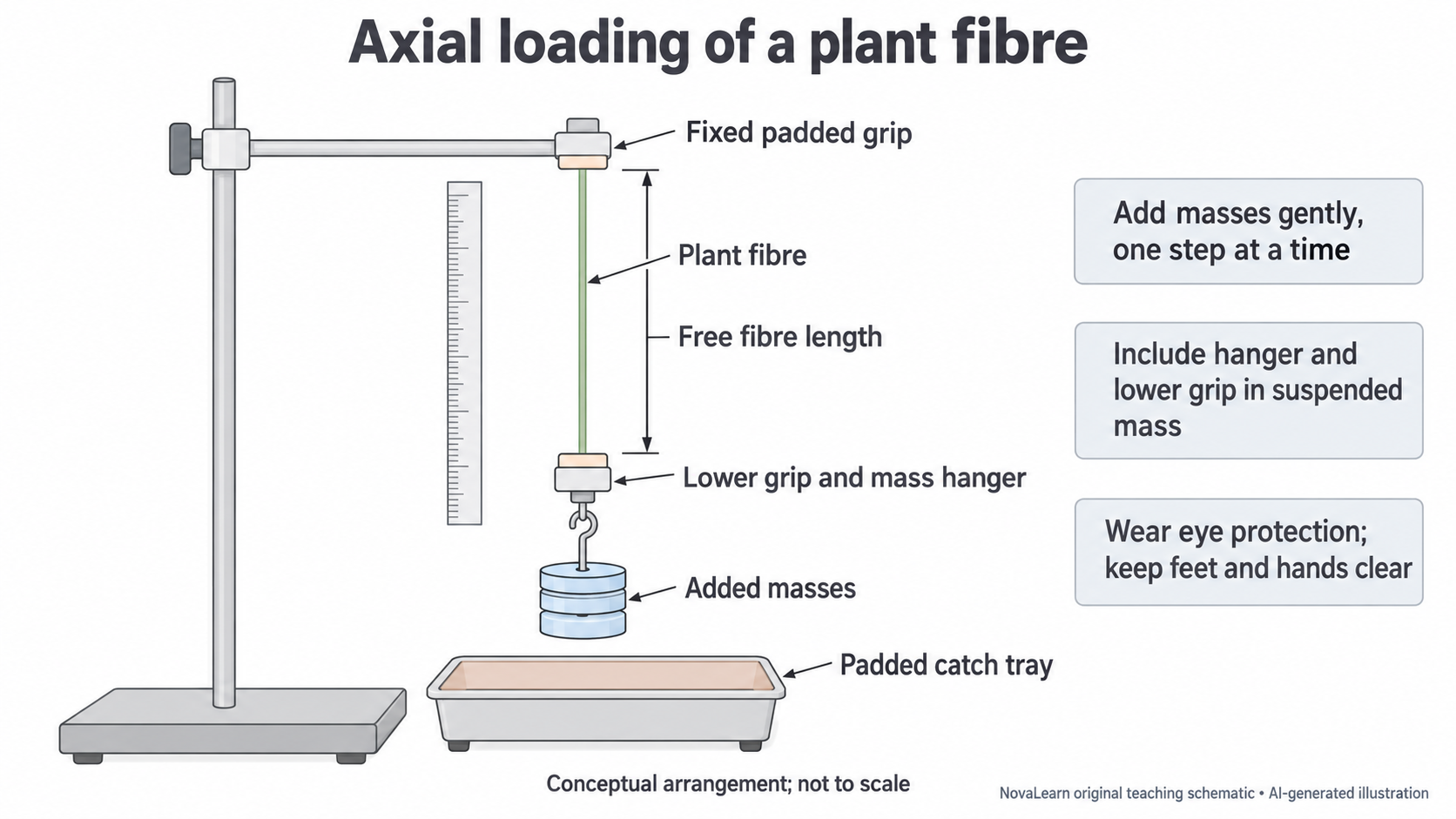
Conceptual axial-loading arrangement, not to scale. The hanger is clear of the tray during measurement; its mass and the lower grip's mass contribute to the load. NovaLearn original AI-generated illustration.
Zero the balance and check it with a suitable known mass. Measure the combined mass of the empty hanger, lower grip and any suspended attachments; include this in every total. Check the added masses rather than relying on an unlabelled stack. A force sensor is an alternative: zero it in the required orientation, check it against known forces and record its range and resolution.
Run a pilot using spare specimens to choose a safe load range and suitably small increments. For example, add at a time and hold each step for seconds, using the same schedule for every specimen. Add each mass gently, let motion settle, and record whether the fibre survives. Never drop masses onto the hanger. Keep the hanger above the tray throughout: contact with the tray would support part of the load.
Record both the last total mass sustained and the first total mass causing failure, together with failure location and any slippage. For example, suppose a specimen survives but fails after the next step at , both totals including a hanger/grip assembly. Using the supplied :
For this settled, incremental test, the failure threshold is bracketed between those forces. The first failing load is an upper estimate, not an exactly measured threshold. If the reporting convention uses the midpoint of the bracket, its mass estimate is , giving , with a half-interval of . State that convention. Do not label the midpoint as an observed mass at which the fibre actually broke.
A balance displaying does not make this failure test resolve : the loading interval is much larger. Smaller safe increments narrow the bracket; they also require a consistent loading schedule because prolonged loading can affect failure.
Wear eye protection against recoiling fibres or displaced pieces. Place the padded tray close below the hanger to limit falling distance, keep hands and feet clear, and use only the teacher-approved maximum load. Handle blades on a tile and wash hands after handling plant or soaked material. Record risk controls in the practical record, not simply “be careful”.
From diameter and mass to tensile strength
The strength calculation combines an estimated failure force with the specimen's original cross-sectional area.
For an approximately circular, uniform fibre of diameter , radius and initial free length :
is cross-sectional area and is estimated tensile strength. Use metres and newtons for , or millimetres and newtons for . The circumference is , and the cylindrical volume is .
Consider an original illustrative specimen of diameter . Its radius is , not . Using diameter directly as radius would make the calculated area four times too large.
Continue this lesson.
You’re previewing NovaLearn without an account. Create a free account to read the rest.
Create free account