8.6 - Phytochrome, IAA and plant responses
Plants use environmental information to change their growth and development. Learn how phytochrome detects light conditions, how IAA directs unequal growth, and how both signals can change transcription without changing the plant's DNA sequence.
Phytochrome detects light conditions
A plant can respond to light as information as well as use it as an energy source for photosynthesis.
An environmental cue is a detectable feature of the surroundings, such as light direction or the balance of red and far-red light. A photoreceptor detects light and initiates a signal. Phytochrome is a photoreceptor consisting of a protein with a light-absorbing pigment attached. It can exist in two interconvertible forms, Pr and Pfr.
Pr and Pfr
Pr is the relatively inactive, red-light-absorbing form of phytochrome; absorbing red light converts it towards Pfr. Pfr is the far-red-light-absorbing form; absorbing far-red light converts it towards Pr. Pfr is the signalling-active form in the simplified model used here.
The names describe the light each form absorbs, not the light that produces it. Red light, most effective around 660 nm, increases the proportion of Pfr. Far-red light, most effective around 730 nm, increases the proportion of Pr. Plants contain several phytochromes; the familiar reversible switch is especially useful for understanding phytochrome B, or phyB, responses.
In darkness, Pfr can return to Pr by dark reversion, a temperature-dependent change that does not require far-red light. Protein breakdown can also reduce the active phytochrome pool. Do not treat darkness as a source of far-red radiation, or assume that every Pfr molecule switches back instantly at sunset. The rate and importance of these processes differ between phytochromes and conditions.
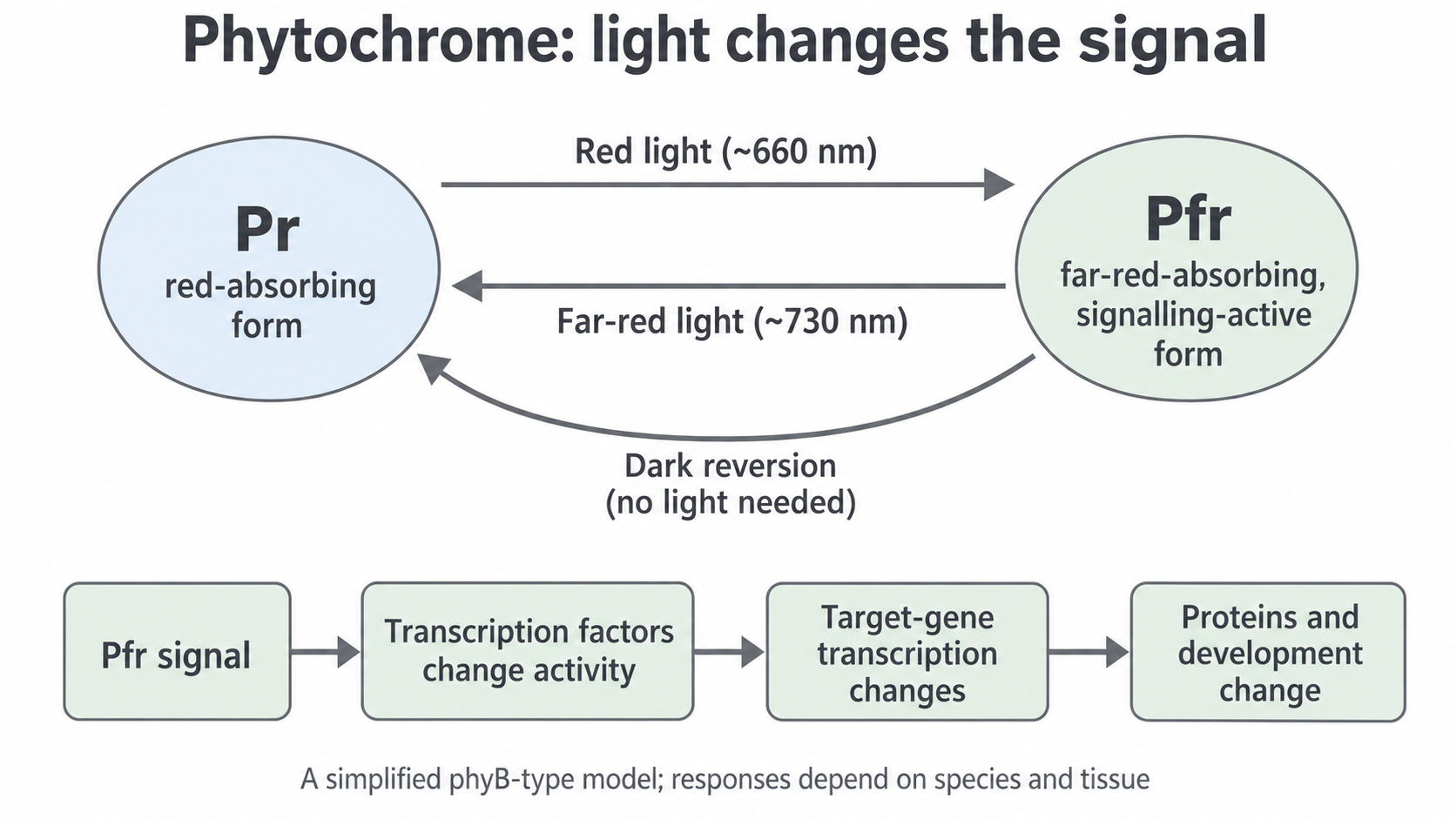
Red and far-red light shift the balance between phytochrome forms. The lower chain shows how a receptor state can influence development through transcription; this is a qualitative phyB-type model, not measured data.
Both forms have overlapping absorption spectra, so normal light establishes a mixture rather than converting every receptor into one form. Leaves absorb much red light for photosynthesis but transmit or reflect proportionally more far-red light. A low red:far-red ratio beneath neighbouring vegetation can therefore lower the proportion of active phyB. The plant gains information about neighbouring plants, even before it is heavily shaded.
For brief, closely spaced light pulses in a reversible response, the last effective pulse can dominate the immediate receptor balance. This prediction concerns the early signal; once later development is committed, a new pulse need not reverse the completed response.
Light signals change transcription and development
A light-induced change in phytochrome shape becomes a developmental response when it changes the activity of proteins inside the cell.
Recall that a transcription factor regulates transcription of particular target genes. In a plant cell, transcription of nuclear protein-coding genes produces RNA that is processed into mRNA; ribosomes then translate the mRNA into protein. Altering this sequence can change the cell's enzymes, structural proteins and regulatory proteins.
Photoactivated phytochrome such as phyB accumulates in the nucleus and interacts with transcriptional regulators. One important group is the phytochrome-interacting factors, or PIFs. In dark-grown seedlings, these transcription factors help maintain the pattern of gene expression associated with growth in darkness. Active phytochrome can promote the inactivation and breakdown of particular PIF proteins. Removing their activity changes transcription of their target genes and of further genes controlled by the resulting regulatory network. Some genes become more active and others less active: light does not simply switch on all transcription.
Follow the mechanism across scales:
- Red light changes the Pr/Pfr balance, increasing the active signal.
- The receptor signal changes transcription-factor activity in the nucleus.
- Target-gene transcription changes, altering the supply of particular mRNAs.
- Translation can change the amounts of particular proteins, provided other controls do not offset the RNA change.
- Changed protein activity alters cell behaviour and hence development of the seedling.
For example, a seedling emerging into light can reduce rapid stem elongation, expand its seed leaves and develop its photosynthetic apparatus. This transition from growth in darkness to growth in light is called de-etiolation. Increased production of proteins needed for chlorophyll synthesis and photosynthesis helps prepare the seedling to capture light; reduced elongation avoids continuing the dark-grown pattern of a long, pale shoot. The receptor detects the cue, while downstream proteins bring about the response.
The same signalling system can give different outcomes in another context. Under a low red:far-red ratio, reduced active phyB allows some PIF activities to persist, promoting expression associated with stem elongation and shade avoidance. Thus, “active phytochrome always makes a plant grow faster” is an unreliable rule: the relevant gene, tissue and response must be specified.
Phytochrome also contributes to photoperiodism, responses to the duration and timing of light and darkness. In flowering plants, light signals interact with the plant's internal daily clock and regulators of flowering-gene expression. In many short-day plants, a sufficiently long uninterrupted night favours flowering and a red-light night break can inhibit it. In some long-day plants, a night break can instead promote flowering. These are response patterns of particular species, not a universal rule that falling Pfr triggers flowering in every plant. Use a species' supplied evidence to predict its response; dark reversion alone is not a complete flowering clock.
Environmental cue → receptor state → transcriptional regulation → altered proteins → cell and plant response. Neither a change in DNA sequence nor the hormone-like transport of phytochrome between organs is needed for this chain.
The pathway changes how existing genetic information is used. A plant does not acquire a new chlorophyll gene each time it enters light.
IAA redistributes growth in a shoot
A shoot bends towards light because cells on its two sides elongate at different rates.
Indole-3-acetic acid, or IAA, is an auxin, a plant growth regulator. It is produced in growing tissues, including shoot tips and young leaves, and transported to other cells. Membrane transport proteins help give IAA transport a direction and can change its distribution within a tissue. The response depends on cells detecting IAA, rather than IAA simply stretching them physically.
Tropism
A directional growth response to a directional stimulus. Growth towards the stimulus is positive; growth away from it is negative.
In positive shoot phototropism, one-sided blue light is detected by phototropins, blue-light photoreceptors. Their signalling changes auxin transport so that a higher IAA concentration develops on the shaded side of the growing shoot. In responsive shoot tissue, over the relevant concentration range, this promotes greater cell elongation on the shaded side than on the illuminated side. The shaded side becomes the longer, outer side of the curve, bending the shoot towards the light. Reaching more favourable light can improve light capture for photosynthesis.
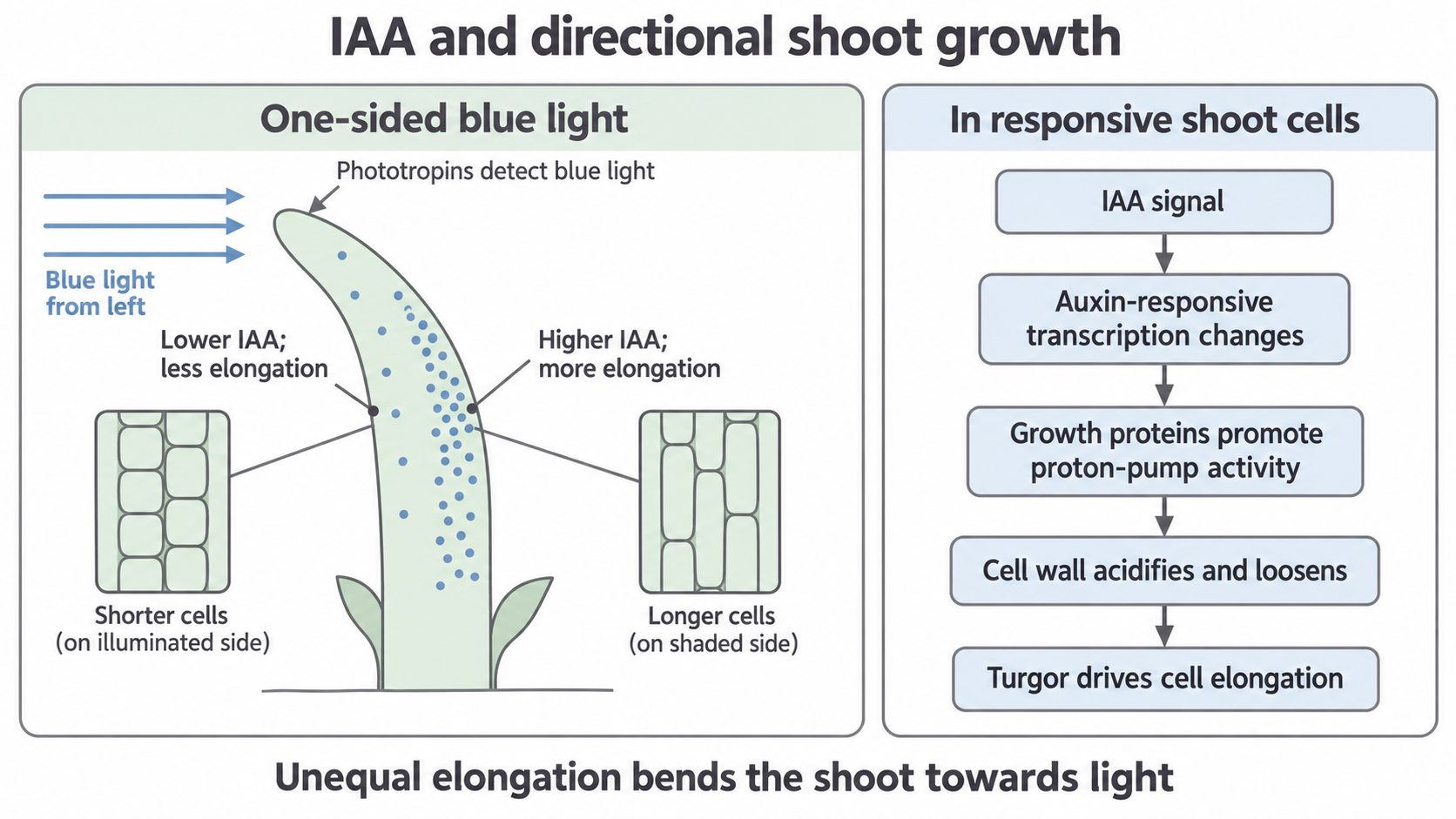
The shaded side elongates more and forms the outside of the bend. The right panel previews the cellular response developed in the next section; the dots and cells are schematic, not IAA measurements or a calibrated micrograph.
Continue this lesson.
You’re previewing NovaLearn without an account. Create a free account to read the rest.
Create free account