5.5, 5.6 - Photosynthesis and ATP
A growing plant needs both materials and energy to make new cells. In 5.5, you will follow these through the overall reaction of photosynthesis; in 5.6, you will see how ATP transfers usable energy to the cell processes that need it.
Photosynthesis transfers energy and rearranges matter
A green plant can make carbohydrate from small inorganic molecules because it captures energy from light. In plant cells, photosynthesis takes place in chloroplasts, where pigments including chlorophyll absorb light.
Photosynthesis
The process that uses light energy to make organic compounds from carbon dioxide. In plants, water supplies hydrogen and electrons, and oxygen is released.
For the overall reaction, glucose is a useful way of representing the carbohydrate fuel produced. The familiar net equation is:
Carbon dioxide + water → glucose + oxygen, using light energy.
The equation conserves atoms: each side has six carbon atoms, twelve hydrogen atoms and eighteen oxygen atoms. These atoms are rearranged into different molecules. The equation summarises many reactions; it does not show their sequence or tell us which reactant supplies each atom in each product. Glucose is an overall fuel product, not the first direct product of the carbon-fixing pathway.
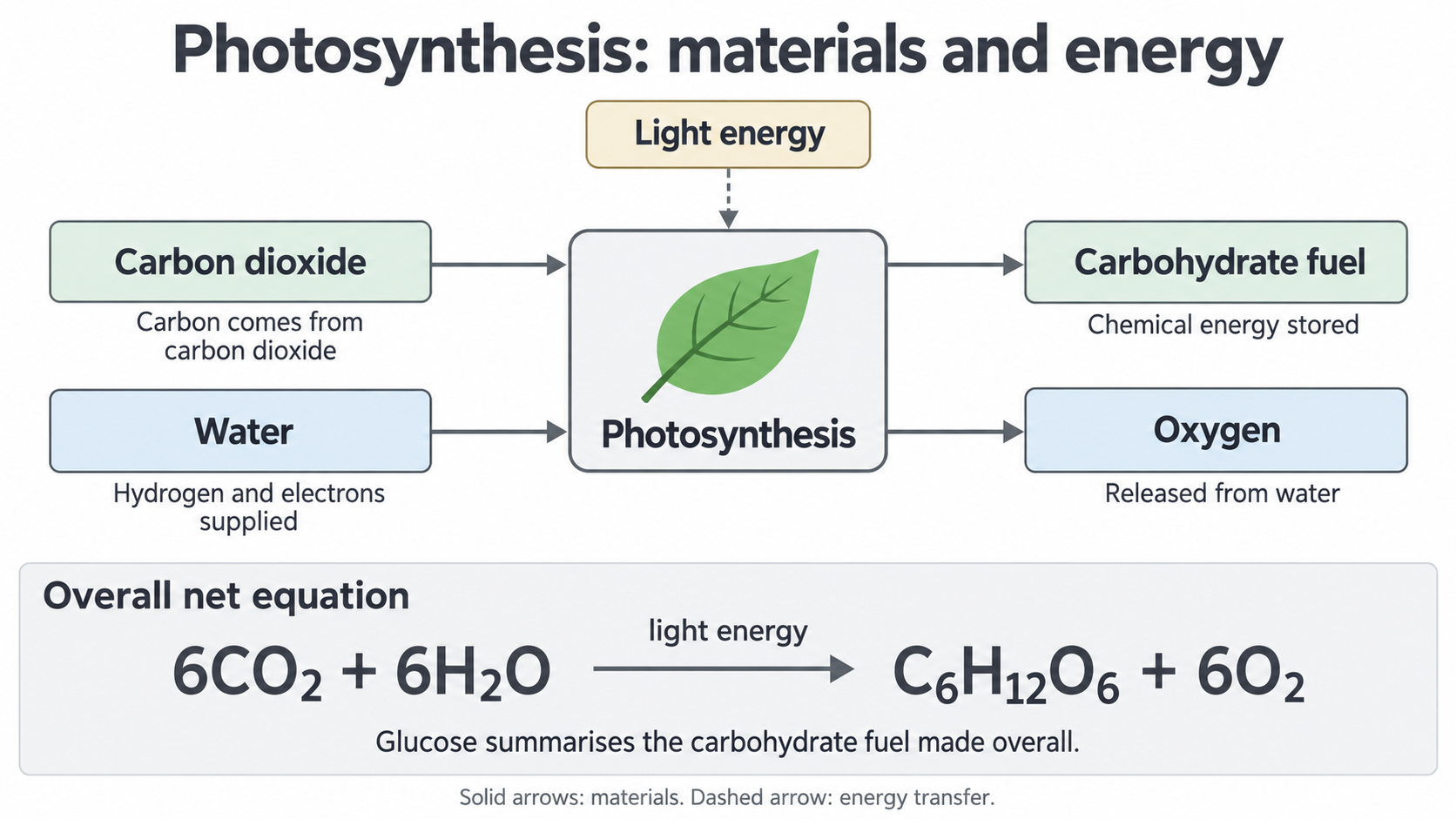
Carbon dioxide and water supply matter; light supplies energy. Oxygen gas is released from water, while chemical energy is stored in carbohydrate fuel.
There are two different accounts to keep. The material account follows carbon dioxide and water into carbohydrate and oxygen. Carbon dioxide supplies the carbon incorporated into the plant's organic molecules. Light is not a source of carbon or other atoms. The energy account follows energy from light into chemical energy associated with the carbohydrate fuel. Photosynthesis transfers energy; it does not create it.
For example, carbon in newly made starch can be traced back to carbon dioxide taken up by the plant. The energy that enabled its production came from absorbed light. Soil minerals are essential for growth, but they are not the source of the carbohydrate's carbon.
Water splitting supplies reducing input and releases oxygen
Water is a stable molecule with strong covalent bonds between its oxygen and hydrogen atoms. Breaking these bonds requires energy. Absorbed light provides the energy that enables the photosynthetic machinery to split water; water does not simply fall apart and supply energy by itself.
The splitting of water using light energy is called photolysis. It supplies hydrogen ions and electrons, which contribute to the conversion of carbon dioxide into carbohydrate. Gaining electrons is reduction: carbon dioxide is reduced as carbohydrate is formed. Hydrogen becomes incorporated into the carbohydrate fuel through these reactions; the plant does not store it as hydrogen gas.
Oxygen from the water forms oxygen gas, which can be released into the atmosphere. It is a by-product of this water-splitting process. The oxygen gas is not made by simply removing oxygen from carbon dioxide. The more detailed electron carriers and reaction steps will be developed in the following lessons.
A balanced overall equation alone cannot establish an atom's route. A tracer can: it is a distinguishable label followed through a process. Oxygen-18 is a stable, non-radioactive isotope of oxygen, so water enriched in oxygen-18 can be used to trace water's oxygen. If the oxygen gas released during photosynthesis becomes enriched in the same label, that is evidence that its oxygen came from water. A short experiment avoids confusing this inference with later exchange of oxygen atoms between substances.
Light energy is needed to split water. Water supplies hydrogen and electrons for the formation of fuel carbohydrate and supplies the oxygen released as oxygen gas.
The newly formed carbohydrate has chemical energy available for later energy-releasing reactions, such as respiration. This is an overall difference between reactants and products; it does not mean that breaking a carbohydrate bond on its own releases energy.
Phosphorylating ADP requires an energy input
Carbohydrate can serve as a fuel, but cells need a way to transfer energy promptly to particular reactions and proteins. ATP, adenosine triphosphate, is the immediate energy-transfer molecule used for this purpose.
Continue this lesson.
You’re previewing NovaLearn without an account. Create a free account to read the rest.
Create free account