6.4 - Amplifying DNA with PCR
A small DNA sample may contain too little of a particular sequence to analyse. The polymerase chain reaction makes many copies of a selected region by repeating DNA synthesis in a tube. You will learn how primers select that region, why the temperature changes, and how to calculate an ideal yield without mistaking it for a guaranteed experimental result.
Selecting the DNA target
PCR copies a selected DNA region outside living cells, using complementary base pairing and DNA polymerase.
Polymerase chain reaction
The polymerase chain reaction (PCR) is a laboratory method that amplifies a selected DNA region through repeated cycles of strand separation, primer binding and DNA synthesis.
Amplification means increasing the number of copies of the sequence. It does not mean making each molecule longer or enlarging its bases. PCR can provide enough DNA for further analysis when a forensic sample is small. It supplies material for DNA profiling; amplification alone does not establish whose DNA was present.
The reaction mixture needs several components with different jobs.
| Component | Role |
|---|---|
| Template DNA | Contains the sequence to be copied; each separated strand can specify a complementary strand. |
| Two DNA primers | Short, synthetic single strands complementary to sequences at opposite flanks of the selected region. They select the target and provide starting ends for synthesis. |
| Free DNA nucleotides, supplied as dNTPs | Supply the A, T, C and G building blocks incorporated into new strands. |
| A thermostable DNA polymerase, such as Taq | Catalyses formation of the new DNA backbone as complementary nucleotides are added. |
| Suitable buffer, magnesium ions and water | Provide the chemical conditions and solution in which the polymerase can work. |
DNA polymerase cannot start a new strand from nothing. It extends an existing primer by adding nucleotides to its 3′ end. The new strand therefore grows 5′ to 3′, while the template is read 3′ to 5′. A and T pair; C and G pair. PCR uses DNA primers, whereas the primers made during cellular DNA replication are RNA.
The two primers bind to opposite template strands with their extendable 3′ ends facing into the target region. For two templates laid horizontally, the arrangement is:
| Template orientation, left to right | Primer position and orientation, left to right | Direction of extension |
|---|---|---|
| Upper template: 3′ → 5′ | At the left flank: 5′ → 3′ | Rightwards, into the region |
| Lower template: 5′ → 3′ | At the right flank: 3′ → 5′ | Leftwards, into the region |
The known flanking sequences allow suitable primers to be chosen even if the sequence between them is being investigated. The primers' positions define the ends of the accumulating target fragment, including the primer sequences. If they bind in the wrong places, a different fragment may be amplified. A pair facing outwards would not produce the intended bounded fragment by ordinary PCR.
The three temperature stages
A thermal cycler automatically changes the temperature of the same reaction tube so that different molecular events can occur in sequence.
Denaturation
Heating to about 95 °C disrupts hydrogen bonding between complementary bases, separating the two DNA strands. Their sugar–phosphate backbones remain intact. Both single strands can now act as templates. Unlike cellular replication, standard PCR uses heat to separate the strands rather than relying on helicase.
Annealing
Cooling to a suitable temperature, commonly about 50–65 °C, allows the primers to anneal: their bases pair with complementary bases on the templates. Primers are supplied in excess so that primer binding is favoured. The chosen temperature depends on the primer sequences. If it is too high, little primer may bind; if too low, binding at poorly matched sites can increase unwanted products. The aim is suitable binding to the intended target sites.
Extension
Raising the temperature to about 72 °C allows Taq polymerase to extend the bound primers efficiently. It adds complementary DNA nucleotides to each primer's 3′ end, forming phosphodiester bonds in the new backbone. Synthesis is 5′ to 3′ on both new strands, although their directions across a diagram are opposite. Each template becomes paired with a newly synthesised strand.
Taq polymerase was obtained from the heat-adapted bacterium Thermus aquaticus. It is thermostable: it tolerates the repeated high-temperature denaturation steps sufficiently to catalyse later extension steps. It does not have to be replaced after every cycle. This does not mean that it synthesises DNA fastest at 95 °C or is indestructible at every temperature.
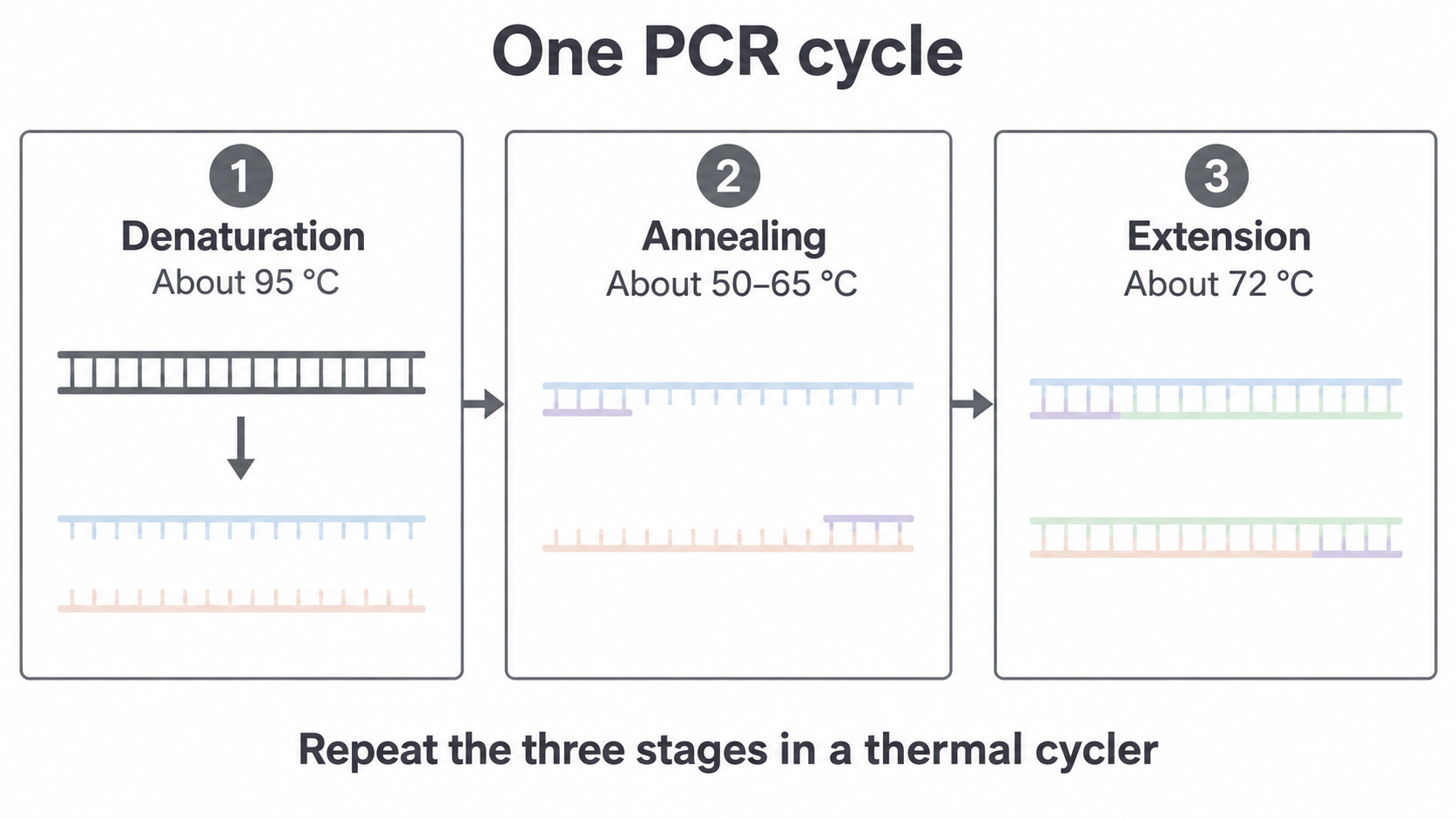
The schematic shows the sequence of events and two resulting duplexes. Lavender segments are primers; the blue and clay strands are templates and sage segments are newly synthesised DNA. It represents a target-sized starting molecule; it is not a measured DNA-length diagram.
Newly made strands can serve as templates after the next denaturation step. Fresh primers bind, extension happens again, and both original and newly made DNA contribute to further amplification. With a long starting DNA molecule, early extension products may continue beyond the far primer-binding site: polymerase does not stop simply because it passes that site. As those products are copied in later cycles, fragments bounded at both ends by the primer sites accumulate and become predominant.
Continue this lesson.
You’re previewing NovaLearn without an account. Create a free account to read the rest.
Create free account