6.10 - Alternative splicing and protein diversity
A gene does not always lead to just one protein product. You will follow how an initial RNA transcript is processed, how different splicing patterns can change its message, and how to deduce the resulting polypeptides without assuming that the DNA has changed.
From initial RNA to mature mRNA
The initial RNA copied from a eukaryotic protein-coding gene may contain sequences that will be removed before the message is translated.
Recall that transcription uses a DNA template to make RNA, whereas translation reads mRNA codons to assemble amino acids. For many nuclear genes, the initial transcript is precursor mRNA, usually shortened to pre-mRNA. It includes RNA copies of both exons and introns.
Exons and introns
Exons are regions retained in a mature RNA transcript. Introns are intervening regions transcribed into the precursor RNA but removed during its splicing. In a protein-coding transcript, introns removed by splicing do not supply amino-acid instructions to the ribosome.
An exon is not necessarily all protein-coding sequence: exons can also contain untranslated regions, which remain in mRNA but are not translated into amino acids. The examples below state which sequence is translated, so an exon block should never automatically be counted as one amino acid.
During RNA splicing, introns are removed from pre-mRNA and the retained exons are joined into a continuous RNA sequence. A molecular complex called a spliceosome, containing RNA and proteins, carries out much eukaryotic pre-mRNA splicing. This processing takes place in the nucleus before the mature message is exported for translation in the cytoplasm. It acts on RNA: the corresponding introns are not cut out of the cell's DNA.
For example, an initial transcript containing exon L, an intron, exon M, another intron and exon N can be processed into mature mRNA containing L–M–N. The gaps are removed and the retained sequences joined; translation is a later, different operation. This is a post-transcriptional change because it changes the RNA message made by transcription, rather than changing the DNA template or modifying a completed protein.
Different exon combinations from one gene
Separate RNA copies made from the same gene can be spliced in different ways, producing different mature messages.
Alternative splicing
Processing precursor RNA from one gene by joining different combinations of exons, producing different mature RNA transcripts that can encode different protein variants.
In the simplified example below, the initial transcript includes exons A, B, C and D. One splicing pattern retains A–B–D; another retains A–C–D. In both patterns, the introns are removed. The difference is that one mature mRNA includes B and omits C, while the other includes C and omits B. An exon can therefore be retained in one mature transcript and skipped in another.
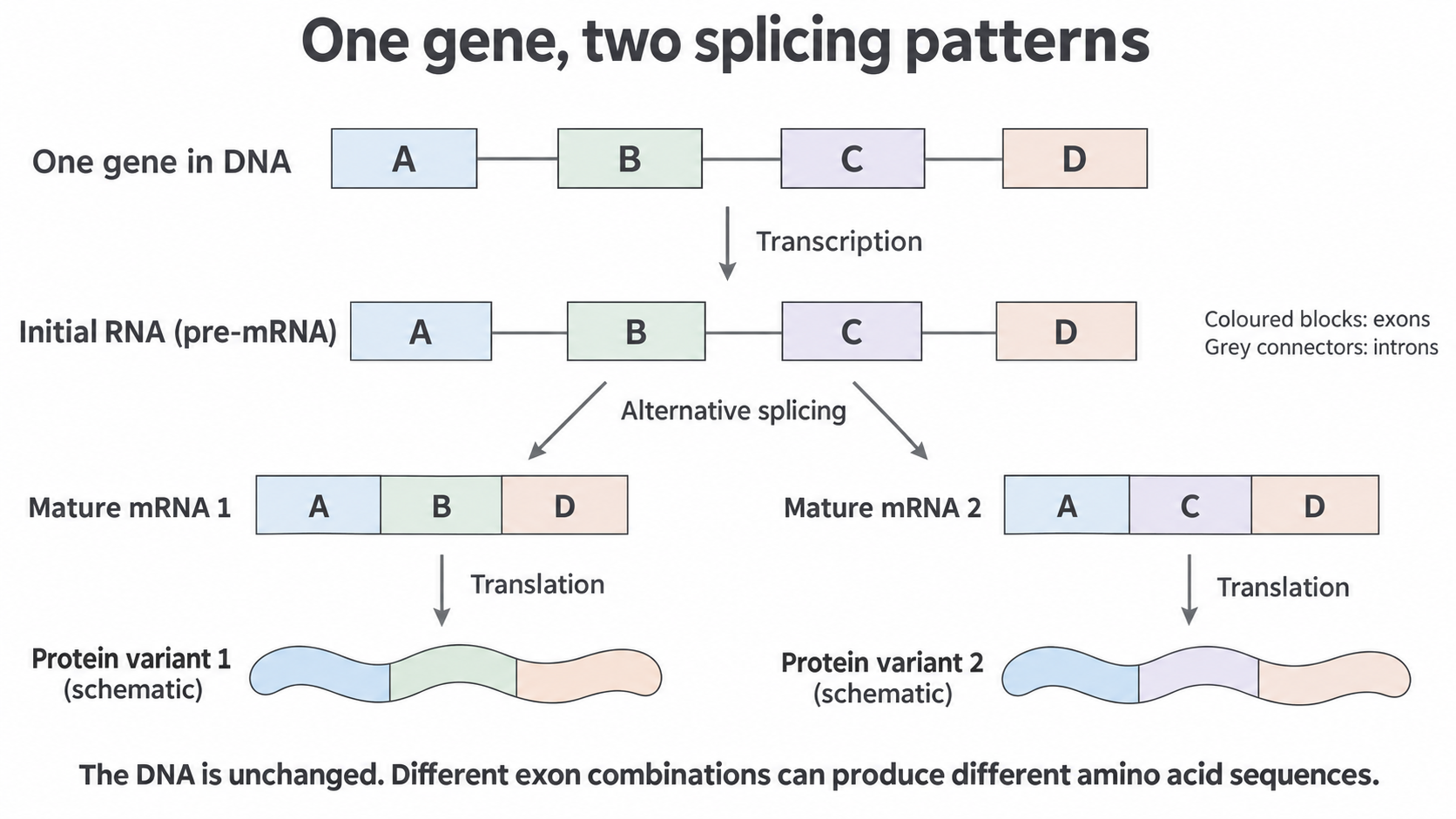
Alternative splicing changes which exons are retained in the message while leaving the DNA unchanged. Colours track corresponding sequence regions; the protein strips are schematics, not predicted folds, domains or individual amino acids. The rows are not drawn to scale, and the example omits untranslated regions.
The two messages represent different RNA molecules. A single RNA molecule is not simultaneously split into two complete messages. Repeated transcription supplies precursor copies that can follow the different processing pathways. Nor is the ordinary mechanism a random rearrangement of exons: in this example their order is preserved, with A before B or C and D last.
Splicing is regulated by the cell's molecular machinery. Different cell types or developmental conditions can favour different patterns. This extends the idea of differential gene expression: cells can differ in which genes they transcribe, but they can also process transcripts of the same gene differently. There is no need to acquire a new allele or alter the DNA base sequence for each protein variant. Not every imaginable exon combination will produce a stable, functional message or protein.
One gene can supply several mature mRNA sequences through alternative splicing. Different translated sequences can then produce different polypeptides, increasing protein diversity without increasing the number of genes.
Deducing the translated products
To explain protein diversity, connect the retained RNA sequence to the amino acids that a ribosome will assemble.
Read each mature mRNA in the 5′ → 3′ direction from the stated start codon, using the supplied codon meanings. A change in the translated base sequence can change the codons and therefore the amino-acid sequence, or primary structure, of the polypeptide. Changed primary structure can alter folding, binding or activity. It does not guarantee a particular functional change: that depends on the actual sequence and its role in the protein.
Consider this original, deliberately short model. All sequences are RNA written 5′ → 3′. Introns between the exons are omitted from the table. Translation begins at the AUG in A, and these chosen exon boundaries preserve the reading frame in either mature message.
Continue this lesson.
You’re previewing NovaLearn without an account. Create a free account to read the rest.
Create free account