4.14 - Bacterial growth and logarithmic scales
Bacterial populations can change enormously while their surroundings appear unchanged. You will connect the conditions needed for growth to the phases of a culture, calculate population changes and use graphs that keep small and large counts readable.
Conditions for bacterial growth
A bacterium needs suitable resources and physical conditions to make new cell material and reproduce. A favourable condition is species dependent: there is no single temperature, pH or oxygen supply that suits all bacteria.
Nutrients supply both material and energy. A usable carbon source provides carbon for organic molecules; many familiar bacteria also release energy from organic compounds such as sugars. Other bacteria use different energy and carbon sources. Nitrogen is needed for amino acids and nucleotides, phosphorus for nucleotides and phospholipids, and mineral ions support cell processes. A species unable to synthesise a particular essential organic compound must obtain it from its surroundings. Adding more sugar cannot overcome a shortage of an essential nitrogen source.
Water provides the medium for dissolved substances and metabolic reactions. Drying reduces available water and usually inhibits multiplication. A concentrated salt or sugar solution can also reduce water availability and draw water from cells by osmosis. Some species tolerate these conditions better than others. Inhibition of growth does not necessarily mean every cell has been killed.
Temperature affects enzyme-controlled reactions and membrane function. Below a species' optimum, reactions are generally slower and division takes longer. Above its tolerated range, damage to proteins and membranes can prevent growth or kill cells. Some bacteria are adapted to cold habitats, some to moderate conditions and others to hot environments; 37 °C is not a universal bacterial optimum. Cooling often slows multiplication, rather than sterilising a sample.
pH affects protein structure, enzyme activity and transport across membranes. Many bacteria grow well around neutral pH, but acid-adapted and alkaline-adapted species have different optima. A buffer helps keep a laboratory medium's pH near the chosen value even when metabolism produces acidic or alkaline products.
The appropriate oxygen condition also differs:
| Type | Growth in relation to oxygen |
|---|---|
| Obligate aerobe | Requires oxygen for its energy metabolism. |
| Obligate anaerobe | Cannot grow in oxygen; oxygen can be toxic to it. |
| Facultative anaerobe | Can grow with or without oxygen, often growing faster when oxygen is available. |
Oxygen is therefore not a nutrient that must simply be maximised for every culture. A comparison of two nutrient treatments is valid only if temperature, pH, water availability and the appropriate oxygen conditions are also controlled. These principles explain laboratory observations; any real culturing belongs in a supervised school laboratory with an approved teaching strain. Core practical 9 teaches the aseptic handling method separately.
Binary fission and batch-culture phases
Growth of a bacterial population usually means an increase in the number of cells. In binary fission, a cell copies its DNA, grows and partitions the copies as its membrane and wall divide the cytoplasm into two daughter cells. One cell becomes two; two can become four. This is asexual reproduction, not mitosis.
Generation time
The time taken for a bacterial population to double under the stated growth conditions; also called its doubling time.
A batch culture starts with a fixed supply of medium: nutrients are not continually replenished and accumulated wastes are not continually removed. Its population does not keep doubling indefinitely. The following complete original dataset is an idealised illustration of viable cell numbers, meaning cells capable of further growth under suitable conditions. It is not a record of an experiment.
| Time / h | Number of viable cells, N |
|---|---|
| 0 | 1,000 |
| 2 | 1,000 |
| 4 | 4,000 |
| 6 | 16,000 |
| 8 | 64,000 |
| 10 | 256,000 |
| 12 | 1,024,000 |
| 14 | 1,024,000 |
| 16 | 1,024,000 |
| 18 | 128,000 |
| 20 | 16,000 |
Lag phase, 0–2 h: little net increase occurs as cells adjust to the medium and synthesise needed cell components. Cells can be metabolically active while the population count remains nearly constant. Exponential or log phase, 2–12 h: a roughly constant doubling time produces repeated multiplication; the count here increases fourfold every two hours, equivalent to two doublings and a generation time of one hour.
Stationary phase, 12–16 h: nutrient limitation and accumulated wastes restrict further increase; oxygen shortage may also limit aerobes. Division and death can approximately balance, giving no net change in viable numbers. Death or decline phase, 16–20 h: death exceeds production of new cells, so viable numbers fall. Actual cultures need not have such sharp phase boundaries or perfectly straight segments.
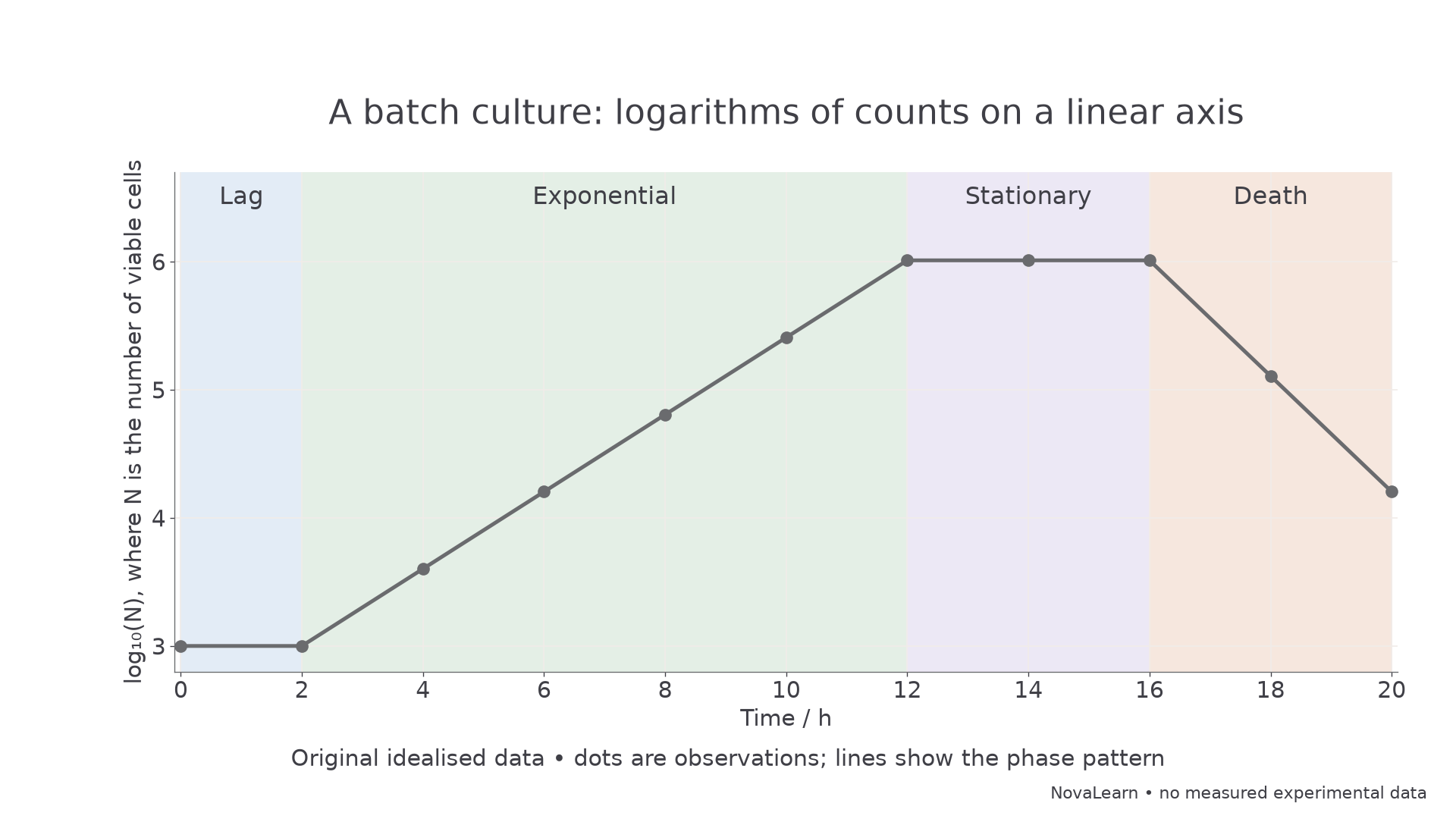
The vertical values are the logarithms of the counts on an ordinary linear axis: 3 means N = 1,000; 6 means N = 1,000,000. The count 1,024,000 has a logarithm just above 6. The downward segment concerns viable cells, not necessarily all visible cell bodies.
A constant doubling model applies to a stated exponential-growth interval. Do not extend it across lag, stationary or death phases.
Predicting population size
Repeated doubling multiplies the starting population by powers of two. If 1,250 cells double every 30 minutes during exponential growth, the complete sequence below follows.
| Elapsed time / min | Number of doublings, n | Number of cells, N | N in standard form |
|---|---|---|---|
| 0 | 0 | 1,250 | 1.25 × 10³ |
| 30 | 1 | 2,500 | 2.50 × 10³ |
| 60 | 2 | 5,000 | 5.00 × 10³ |
| 90 | 3 | 10,000 | 1.00 × 10⁴ |
| 120 | 4 | 20,000 | 2.00 × 10⁴ |
| 150 | 5 | 40,000 | 4.00 × 10⁴ |
| 180 | 6 | 80,000 | 8.00 × 10⁴ |
Standard form writes a number as a × 10ᵏ, with 1 ≤ a < 10 and integer k. Thus 80,000 = 8 × 10⁴, while 3.20 × 10⁵ = 320,000. Writing 3.20 retains three significant figures; changing the notation does not improve a measurement's precision. The extra zeroes in the table show a consistent three-significant-figure representation of idealised counts.
N₀ is the starting count, N the later count, t elapsed time and g generation time. Use the same time unit for t and g, so the exponent t/g has no unit. Assume constant doubling time and negligible cell death throughout this interval.
For the same starting population, after 3.5 hours first convert t = 210 min. Then n = 210/30 = 7 and N = 1,250 × 2⁷ = 160,000 = 1.60 × 10⁵ cells. Enter the exponent with brackets on a calculator: multiply 1,250 by 2 raised to (210/30), rather than dividing the final population by 30. A sense-check is that another 30 minutes after the table's last entry doubles 80,000 once more.
An exponential function has the changing quantity in its exponent. The equivalent expression N = N₀ exp[(ln 2)t/g] uses exp(x) = eˣ and ln, the logarithm to base e. Here ln 2 ≈ 0.6931. Either expression gives the same prediction; e is not another biological growth factor. Calculator power and exponential keys are alternative ways of evaluating this same model.
For times between complete generation intervals, the equation is a smooth population approximation; it does not mean part of an individual bacterium exists. Real cells do not all divide simultaneously, and measured counts have uncertainty. Report a predicted population sensibly, without spurious decimal cells.
Finding doublings and elapsed time
A logarithm finds an unknown exponent. For example, log₁₀(1,000) = 3 because 10³ = 1,000. Similarly, finding how many doublings turn N₀ into N means finding n in 2ⁿ = N/N₀.
If a count rises from 5,000 to 80,000, the ratio is 80,000/5,000 = 16. As 2⁴ = 16, there have been four doublings. If each takes 25 min, t = ng = 4 × 25 = 100 min. Dividing N by N₀ gives a multiplication factor, not the number of doublings: the answer is four, not sixteen.
Continue this lesson.
You’re previewing NovaLearn without an account. Create a free account to read the rest.
Create free account