6.12 - Active and passive immunity
An individual can gain protection by making an immune response or by receiving antibodies made elsewhere. You will distinguish these mechanisms from the way they are acquired, then use antibody-response data to explain the importance of immune memory.
Two independent classifications
The words natural, artificial, active and passive answer two different questions about acquired immunity.
Immunity is the body's ability to resist infection or its harmful effects. Here the focus is antigen-specific protection acquired through an immune response or antibody transfer.
Active and passive immunity
Active immunity develops through the recipient's own antigen-specific immune response. Passive immunity is supplied by ready-made antibodies transferred to the recipient.
First ask who makes the response that supplies the protection. In active immunity, the person's lymphocytes respond to antigen, and their plasma cells produce specific antibodies. In passive immunity, the antibodies have already been produced elsewhere: receiving them does not itself require the recipient to activate matching B cells.
Then ask how the antigen or antibodies were acquired. In this classification, natural means through infection or normal maternal transfer; artificial means through a medical intervention such as vaccination or an antibody injection. Artificial does not mean that the recipient's immune cells behave unnaturally. It identifies the route by which immunity is acquired.
| Acquisition | Active: own immune response | Passive: antibodies received |
|---|---|---|
| Natural | Infection stimulates an individual's own response | Maternal antibodies cross the placenta or are supplied in breast milk |
| Artificial | Vaccination stimulates an individual's own response | A prepared antibody product is injected |
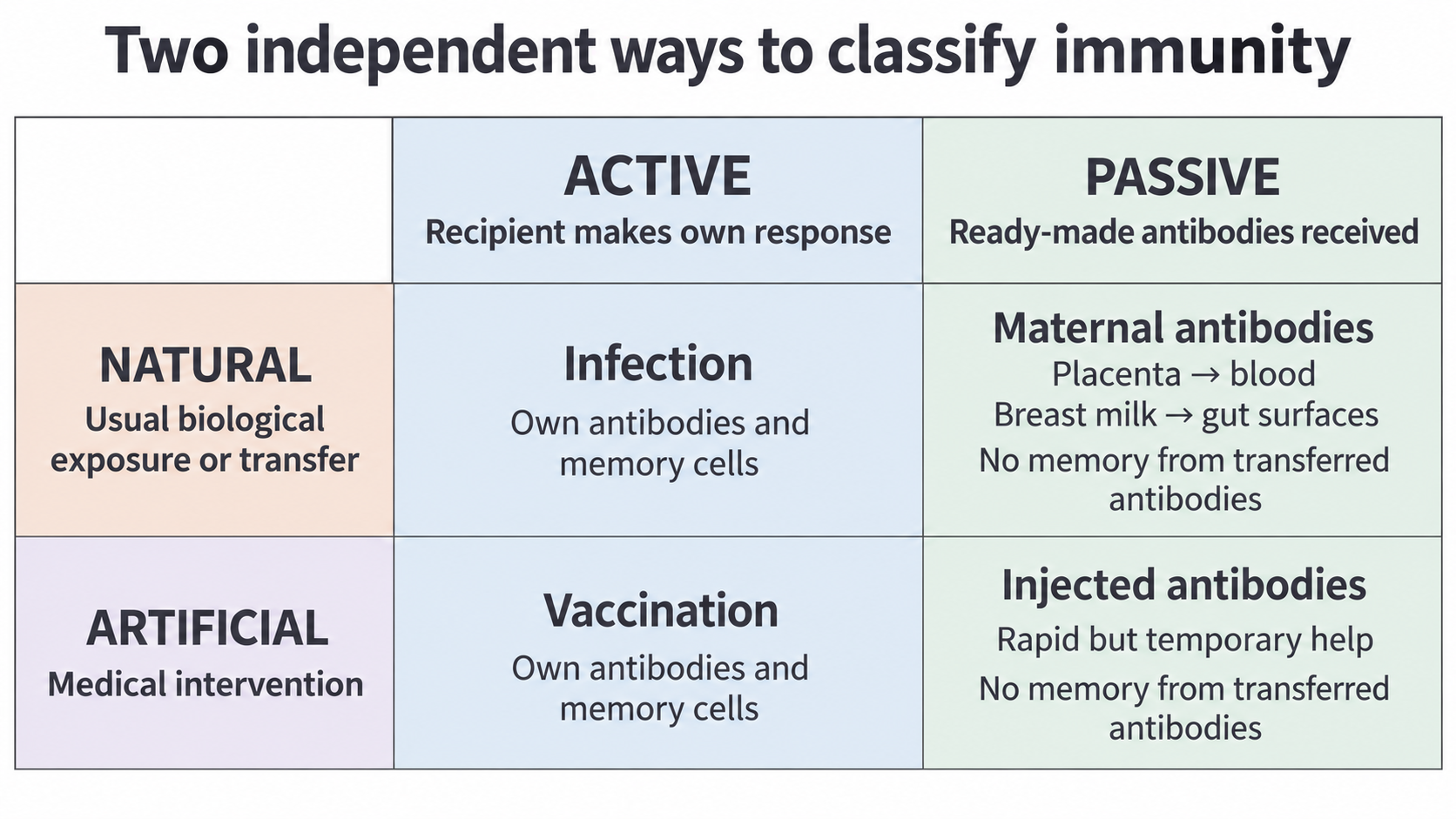
The two axes produce four combinations. Reading across either row shows that the same acquisition route can supply active or passive immunity.
For example, an injected vaccine is artificial active immunity: an injection alone does not make immunity passive. Conversely, a fetus receiving antibodies across the placenta gains natural passive immunity even if its mother originally produced those antibodies following vaccination. Classify the process in the individual named in the question.
Active immunity and memory
Infection and vaccination can activate the same basic antigen-specific mechanisms, although they expose the body to different risks.
During a primary response, the first response to a particular antigen, the small population of lymphocytes with complementary receptors must be activated and multiply by mitosis. For many protein antigens, T helper cells help activate the matching B cells. Some descendants differentiate into plasma cells that secrete antibodies; others become memory B cells. Memory T cells can also remain after a response. These are the cell roles introduced in the preceding lesson, now linked to protection over time.
Activation, multiplication and differentiation take time. The first antibody response therefore has a delay before a substantial concentration appears. Following removal of antigen, antibody concentration can fall as many plasma cells die and antibodies are broken down. Some long-lived plasma cells can continue secreting antibody. Memory cells are living cells, not stored antibody molecules, so a low measured antibody concentration does not by itself show that immune memory has disappeared.
When the same antigen is encountered again, a larger population of suitable memory cells can respond rapidly. Memory B cells proliferate and give rise to antibody-secreting plasma cells. The resulting secondary response is generally faster and produces a higher antibody concentration than the primary response. A rapid response can limit pathogen multiplication or toxin action before serious disease develops. This is antigen-specific: memory for one antigen does not automatically provide the same response to an unrelated antigen.
In natural active immunity, antigens encountered during infection stimulate the response. The infection can cause disease before sufficient protection develops; acquiring an infection is not a harmless way to acquire memory. In artificial active immunity, a vaccine presents relevant antigens in a controlled way. Depending on the vaccine, these may be supplied as an inactivated pathogen, an attenuated pathogen, a purified component, an inactivated toxin called a toxoid, or genetic instructions that allow cells to produce an antigen. A vaccine's purpose is to stimulate the recipient's response, rather than supply a stock of protective antibodies.
An additional vaccine dose can re-expose the immune system to antigen and reinforce the response. This explains the biological idea of a booster, without implying that every vaccine has the same schedule. Active protection is often longer-lasting than protection supplied by transferred antibodies, but it is not necessarily lifelong or complete. Outcomes depend on the antigen and the response established. UKHSA's explanation of vaccine-induced memory distinguishes memory from the amount of antibody currently detectable.
Passive transfer and its limits
Transferred antibodies can act against their matching targets without waiting for the recipient to complete a primary immune response.
The relevant antibody molecules must reach the place where they can act. Their antigen-binding sites can bind a matching pathogen or toxin, for example preventing a virus from entering a cell or neutralising a toxin. Their specificity still matters: receiving antibodies against one target is not general protection against every infection.
Natural passive transfer occurs in two important human contexts:
Continue this lesson.
You’re previewing NovaLearn without an account. Create a free account to read the rest.
Create free account