1.1 - Why animals need mass transport
A cell needs a continuous supply of materials and a way to remove its wastes. Learn why diffusion can meet these needs over short distances, and how a heart and circulation help many animals supply cells deep inside the body.
Diffusion and cell needs
Animal cells use nutrients in their chemical reactions, and cells carrying out aerobic respiration use oxygen to release usable energy from substances such as glucose. They also produce wastes, including carbon dioxide. These materials must enter or leave cells fast enough to match their use or production.
Diffusion
The net movement of particles from a region of higher concentration to a region of lower concentration, as a result of their random movement.
A concentration gradient is a difference in concentration between regions. Particles move randomly in both directions, but more leave the higher-concentration region, so there is net movement down the gradient. Diffusion itself does not require the cell to supply energy. At equal concentrations, random movement continues but there is no net movement between the regions.
For oxygen to diffuse into a cell, its concentration must be higher in the surrounding fluid than inside the cell. Respiration uses oxygen inside the cell, helping keep that concentration low. Carbon dioxide produced inside a cell can diffuse out when its concentration is higher inside than outside. The direction therefore depends on the gradient for each substance.
Diffusion works well when the path is short and the available exchange surface can provide enough material per unit time. A small organism may have all its cells close to its environment. Cells deep inside a large animal face a different delivery problem.
Surface area and volume
For similarly shaped bodies, volume increases faster than surface area as linear size increases.
The outer surface is a potential site of exchange with the environment. Volume represents the amount of living tissue that must be supplied, if cell density is similar. The surface-area-to-volume ratio, or SA:V, compares these quantities. A high ratio gives more external surface per unit of tissue volume; a low ratio gives less.
A cube model
A cube makes the size relationship easy to calculate. It is a model of shape, not a claim that animals are cubes.
For a cube with side length :
is total surface area and is volume. If is measured in millimetres, is in , is in , and is in .
There are six square faces, each with area . Multiplying length, width and height gives .
| Cube side length | Surface area | Volume | SA:V using the stated units |
|---|---|---|---|
To reduce the second ratio, divide both numbers by 27. Equivalently, : there are two square millimetres of surface per cubic millimetre of volume.
Tripling side length has multiplied surface area by 9 but volume by 27. The larger cube has more total surface area, yet only one-third as much surface area per unit volume. This is the useful biological comparison. With similar demand per unit volume and similar exchange conditions, the potential supply across the outer surface does not increase as fast as the tissue's total demand.
Use the same length unit for both bodies before comparing their ratios. These cube values are exact model dimensions; they do not establish a measured threshold at which a real animal needs circulation.
Distance and metabolic demand
An internal cell may be far from the outside of the body even though the cell itself is small.
For the cube models, the shortest distance from the centre to an outer face is half the side length. It is in the smaller cube and in the larger one: a threefold increase. In a thick body, oxygen entering across the outer surface must travel through more tissue to reach the deepest cells.
Random movement can carry particles over a long distance eventually, but it is too slow to supply many animals' internal cells at the rate required. A longer diffusion path takes longer to traverse. With other exchange conditions held constant, increasing the path length reduces the rate of net transfer across it. This limitation is separate from having too little surface area per unit volume.
Metabolic demand is the requirement for materials to support the body's chemical activity. Active tissues may use oxygen and nutrients rapidly and produce wastes rapidly. For example, contracting muscle can require a greater oxygen supply per unit time than the same muscle at rest. A supply that meets resting demand may be inadequate when demand increases.
Body shape also matters. A thin, flattened body keeps cells close to a surface even if the animal is relatively long. Small diffusion distances and modest demand can allow some animals to exchange gases without a heart-driven circulation. The question is whether delivery and removal can keep pace with the cells' requirements, rather than whether an animal has passed one universal size limit.
Circulation and local diffusion
Circulation moves a transport fluid through the body so that exchange surfaces and internal cells can be connected over long distances.
Mass transport
The movement of many substances together in the bulk flow of a fluid, rather than relying on each substance to diffuse along the entire route.
In a mammal, the heart contracts to generate pressure differences that drive the bulk flow of blood. Oxygen enters blood by diffusion at a respiratory exchange surface. Flowing blood then carries oxygen over long distances to tissues. Small exchange vessels, called capillaries, pass close to the cells, so oxygen has only a short final diffusion path through the vessel wall, the fluid around the cells and the cell membrane.
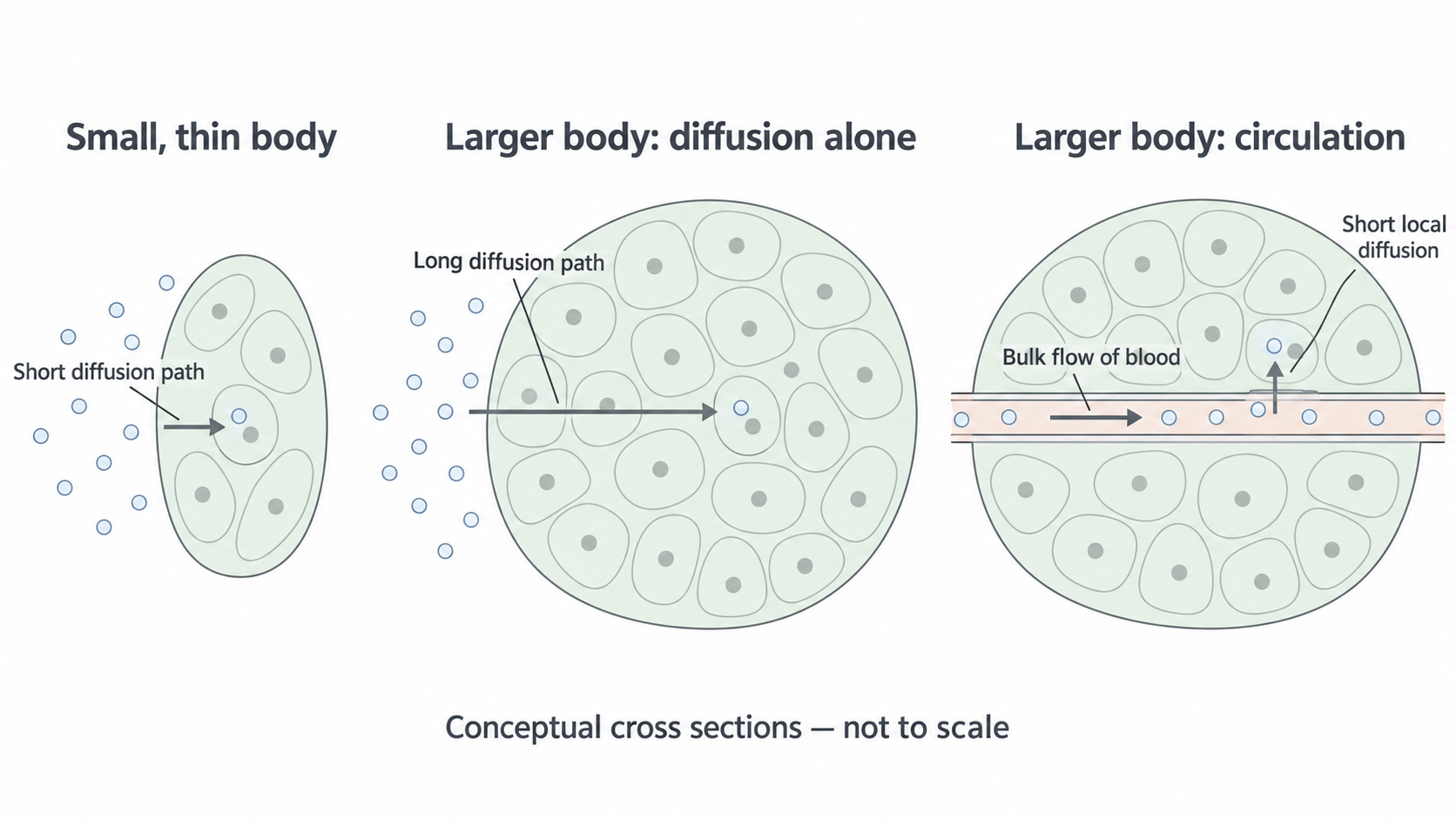
Small, thin bodies can have short diffusion paths from their surroundings. In a larger body, circulation carries material close to internal cells, leaving a short local diffusion step. These cross sections are conceptual and not to scale.
The diagram's blood-flow arrow represents the fluid and its carried materials moving together. Its short arrow from blood to a cell represents oxygen's net diffusion down its gradient. A pump does not make oxygen diffuse against its gradient.
Circulation also helps sustain exchange. At the respiratory surface, blood flow carries away oxygen that has entered and brings further blood for oxygen uptake. At a tissue, it replenishes oxygen near cells while respiration uses oxygen inside them. These processes help preserve the differences needed for continued diffusion. Carbon dioxide moves from respiring cells into blood down its own gradient and is transported to a surface where it can be removed from the body.
Blood also distributes absorbed nutrients and carries metabolic wastes to sites of removal. Increasing delivery and removal as activity rises helps meet greater demand. Detailed heart and vessel structures explain how this flow is achieved in later lessons.
Many animals need a heart and circulation because a low external SA:V, long distances to internal cells and substantial metabolic demand make diffusion alone inadequate. Mass transport handles the long journey; diffusion still completes short-distance exchange.
The two transport processes therefore work together throughout a large animal's body.