5.8 - The Calvin cycle and biosynthesis
How does carbon dioxide become material for a growing organism? You will follow carbon through the Calvin cycle, then connect its sugar products to respiration and the construction of new biological molecules in plants, animals and other organisms.
The Calvin cycle depends on light-dependent products
The Calvin cycle is a sequence of enzyme-controlled reactions in the stroma, the fluid surrounding the thylakoids inside a chloroplast. It incorporates carbon dioxide into organic molecules and uses ATP and reduced NADP supplied by the light-dependent reactions.
The two supplies have different roles. ATP provides an immediate energy input for coupled reactions. Reduced NADP, also called NADPH, supplies electrons and hydrogen for reduction. Their production at the thylakoid membranes was explained in the previous lesson; here the question is how the stroma uses them to make carbohydrate.
These reactions are called light-independent because their individual steps do not directly absorb light. That name does not mean that they happen only at night. In an illuminated leaf, the light-dependent reactions and Calvin cycle normally operate together. Without a continuing supply of their products, the Calvin cycle cannot sustain its normal rate. Existing supplies may allow reactions to continue briefly after light is removed, but they are finite; changes in enzyme activity also help regulate the cycle.
As the Calvin cycle uses ATP and reduced NADP, it forms ADP and oxidised NADP. ADP, inorganic phosphate and NADP can be reused by the light-dependent reactions. This is a recycling of carrier molecules, with a continuing energy input from light, rather than the creation of energy by cycling matter.
RUBISCO fixes carbon dioxide into GP
Carbon first enters the cycle when a carbon dioxide molecule combines with a five-carbon compound already present in the stroma. This carbon dioxide acceptor is ribulose bisphosphate, abbreviated RuBP. Its name refers to a five-carbon sugar with two phosphate groups.
Carbon fixation
The incorporation of inorganic carbon, such as carbon dioxide, into an organic compound.
The enzyme RUBISCO catalyses the reaction between carbon dioxide and RuBP. Each one-carbon carbon dioxide molecule combines with a five-carbon RuBP molecule to form an unstable six-carbon intermediate. This immediately splits into two three-carbon molecules of glycerate 3-phosphate, abbreviated GP. GP is also called 3-phosphoglycerate; it is not the same molecule as GALP, the sugar phosphate made in the next stage.
The carbon count makes the sequence clear:
The six carbons in the two GP molecules are not all newly supplied by carbon dioxide: five were already in RuBP. If three carbon dioxide molecules are fixed by three RuBP molecules, six GP molecules result, containing eighteen carbons in total. Only three of those eighteen carbons represent the net addition from outside the cycle.
RUBISCO is the catalyst, RuBP is the carbon dioxide acceptor and GP is the first stable product of this fixation step. Giving each a distinct role avoids the mistaken idea that the enzyme is used up as part of the sugar or that carbon dioxide is attached directly to glucose.
ATP and reduced NADP convert GP into GALP
GP must be converted into a more reduced molecule before the fixed carbon can supply sugar synthesis. The product is glyceraldehyde 3-phosphate, abbreviated GALP, a three-carbon sugar phosphate also called a triose phosphate. Some sources abbreviate this same molecule as G3P.
ATP and reduced NADP drive different aspects of the conversion. ATP transfers phosphate in the reaction sequence and supplies energy through coupled reactions. Reduced NADP donates electrons and hydrogen, reducing the intermediate to GALP and becoming oxidised NADP. The net effect is the reduction of the carbon originally supplied as carbon dioxide. ATP is not the electron donor, and NADP that has already been oxidised cannot replace reduced NADP in this role.
For the six GP molecules made when three carbon dioxide molecules are fixed, this stage uses six ATP and six reduced NADP and forms six GALP. ATP is converted to ADP as it is used, and inorganic phosphate is released during the reaction sequence. Both GP and GALP have three carbon atoms: the change is in their chemical form, rather than a gain of extra carbon at the reduction stage.
Remember that usable energy comes from the overall coupled reaction involving ATP, not from bond breaking alone. Similarly, describing reduced NADP as a hydrogen donor must not hide its role in transferring electrons. These transfers help turn relatively oxidised carbon dioxide into carbohydrate fuel.
Regeneration allows a net sugar output
Most GALP must stay in the cycle to replace the RuBP used in carbon fixation. If every GALP molecule left for sugar synthesis, the supply of carbon dioxide acceptor would run out and further fixation would stop.
Consider the six GALP molecules produced after three carbon dioxide molecules have been fixed. One GALP is the net three-carbon output available for the synthesis of sugars and other organic molecules. The other five GALP, containing fifteen carbon atoms, pass through enzyme-controlled rearrangements that regenerate three RuBP, also containing fifteen carbon atoms. Regeneration uses three more ATP. The cycle therefore recovers its carbon dioxide acceptor while retaining a net carbon gain.
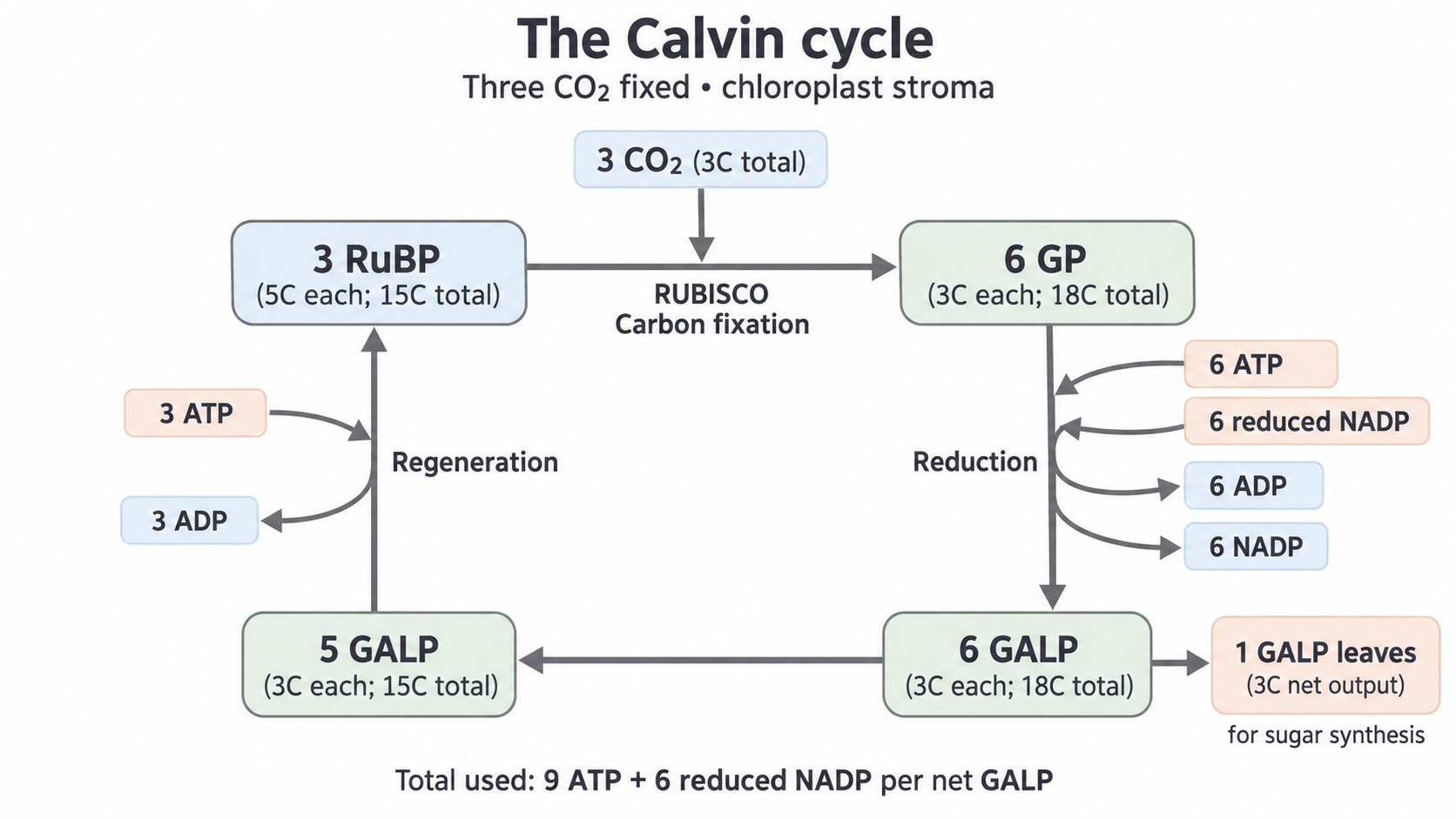
The diagram follows carbon-containing intermediates and the main energy and reducing inputs for three carbon dioxide molecules fixed. It is a simplified pathway, not a complete balanced chemical equation; phosphate, water and intervening reactions are omitted.
The carbon account is entering the GP/GALP pool, then divided between regenerated acceptor and net output. Thus five-sixths of these GALP molecules regenerate RuBP and one-sixth is available as net output. Regeneration does not create extra carbon, and the fifteen carbons returning to RuBP cannot also be counted as exported sugar.
For three carbon dioxide molecules fixed and RuBP regenerated:
This is a pathway accounting relationship, not a complete reaction equation.
A six-carbon sugar such as glucose can be made from the carbon in two net three-carbon GALP molecules, through further reactions. The corresponding Calvin-cycle account is therefore six carbon dioxide molecules fixed, eighteen ATP used and twelve reduced NADP used. It is misleading to say that each carbon dioxide fixed produces one glucose or that all six GALP in the diagram leave the cycle. GALP is the immediate net sugar-phosphate output; glucose is made subsequently.
To scale the account, first find the number of net GALP molecules from the carbon input: three carbon dioxide molecules supply the three carbons of one net GALP. Then multiply by nine ATP and six reduced NADP per net GALP. For example, fixing nine carbon dioxide molecules gives three net GALP and uses twenty-seven ATP and eighteen reduced NADP, assuming the simplified pathway operates with acceptor fully regenerated. These counts describe this pathway, rather than every energy cost of an entire living leaf.
Continue this lesson.
You’re previewing NovaLearn without an account. Create a free account to read the rest.
Create free account