7.5 - The link reaction and Krebs cycle
Glycolysis leaves much of glucose's chemical energy in pyruvate. The link reaction and Krebs cycle continue its oxidation, releasing carbon dioxide and transferring energy to ATP and reduced carriers. Following the carbon and the carriers shows why these mitochondrial reactions are essential to aerobic respiration.
Why pyruvate enters mitochondria
One glucose molecule contains six carbon atoms, and glycolysis in the cytoplasm produces two three-carbon pyruvate molecules. No carbon dioxide is released by glycolysis: all six carbons remain in those pyruvate molecules. To continue aerobic oxidation in a eukaryotic cell, pyruvate must enter a mitochondrion.
The mitochondrial matrix is the compartment enclosed by the inner mitochondrial membrane. It contains the enzymes for the link reaction and most enzymes of the Krebs cycle, together with their substrates and coenzymes. These enzymes catalyse particular reactions; the cytoplasm's glycolytic enzymes cannot simply replace them. Transport proteins allow pyruvate to cross the inner membrane and reach this enzyme system. The different locations therefore reflect the distribution of the necessary enzymes and the compartmental organisation of respiration.
The usual location summary is:
| Stage | Location in a eukaryotic cell | Reason this location matters |
|---|---|---|
| Glycolysis | Cytoplasm, specifically the cytosol | Its soluble enzymes act here; a mitochondrion is not needed for glycolysis itself. |
| Link reaction | Mitochondrial matrix | The enzymes that oxidise pyruvate and prepare a two-carbon group for the cycle are here. |
| Krebs cycle | Mainly the mitochondrial matrix | Most cycle enzymes are here; one cycle enzyme is attached to the inner membrane with its catalytic region facing the matrix. |
The membrane-associated exception does not move the cycle into the cytoplasm. It is a useful reason to say “most cycle enzymes are in the matrix”, rather than claiming every respiratory enzyme floats freely there. You do not need its name or the names of other cycle intermediates for this specification point.
The reduced carriers produced in these mitochondrial reactions are also positioned to supply the later mitochondrial stage, oxidative phosphorylation. That stage uses their electrons to support further ATP synthesis; its mechanism follows in 7.6.
The link reaction oxidises pyruvate
The link reaction connects glycolysis to the Krebs cycle by converting each three-carbon pyruvate into a two-carbon group that can enter the cycle.
Oxidation and reduction
Oxidation is loss of electrons; reduction is gain of electrons. In these respiratory reactions, removing hydrogen from an organic substrate transfers electrons to a carrier, so the substrate is oxidised and the carrier is reduced.
During the link reaction, one carbon is removed from pyruvate as carbon dioxide, CO₂. Removal of carbon dioxide is called decarboxylation. Pyruvate is also oxidised as hydrogen is removed, and NAD accepts electrons and hydrogen to become reduced NAD. NAD is a coenzyme: it works with enzymes and carries reducing power between reactions. Reduced NAD is also written NADH.
The remaining two-carbon group is carried by coenzyme A into the cycle. You may see this carrier-bound group called acetyl coenzyme A. Here, following the two-carbon group matters more than memorising that additional compound name.
| Outcome of the link reaction | Per one pyruvate molecule |
|---|---|
| Two-carbon groups delivered to the cycle | 1 |
| CO₂ molecules released | 1 |
| Reduced NAD molecules formed | 1 |
| Reduced FAD molecules formed | 0 |
| ATP molecules formed directly | 0 |
The carbon check is three carbons in pyruvate becoming two in the group delivered onward and one in CO₂. The link reaction produces no ATP directly, but it still contributes to later ATP formation because its reduced NAD carries electrons onward. Carbon dioxide is a carbon-containing waste product, not the carrier supplying that later energy transfer.
A cycle that regenerates its acceptor
The two-carbon group from the link reaction enters a sequence whose starting acceptor is regenerated, allowing the sequence to repeat.
First, the two-carbon group combines with a four-carbon acceptor to form a six-carbon compound. Enzyme-controlled reactions then release one CO₂ as a five-carbon compound forms, and another CO₂ as a four-carbon compound forms. Further reactions regenerate the original four-carbon acceptor. It can combine with another two-carbon group, so the pathway is a cycle, rather than a chain that uses up its starting acceptor on each turn.
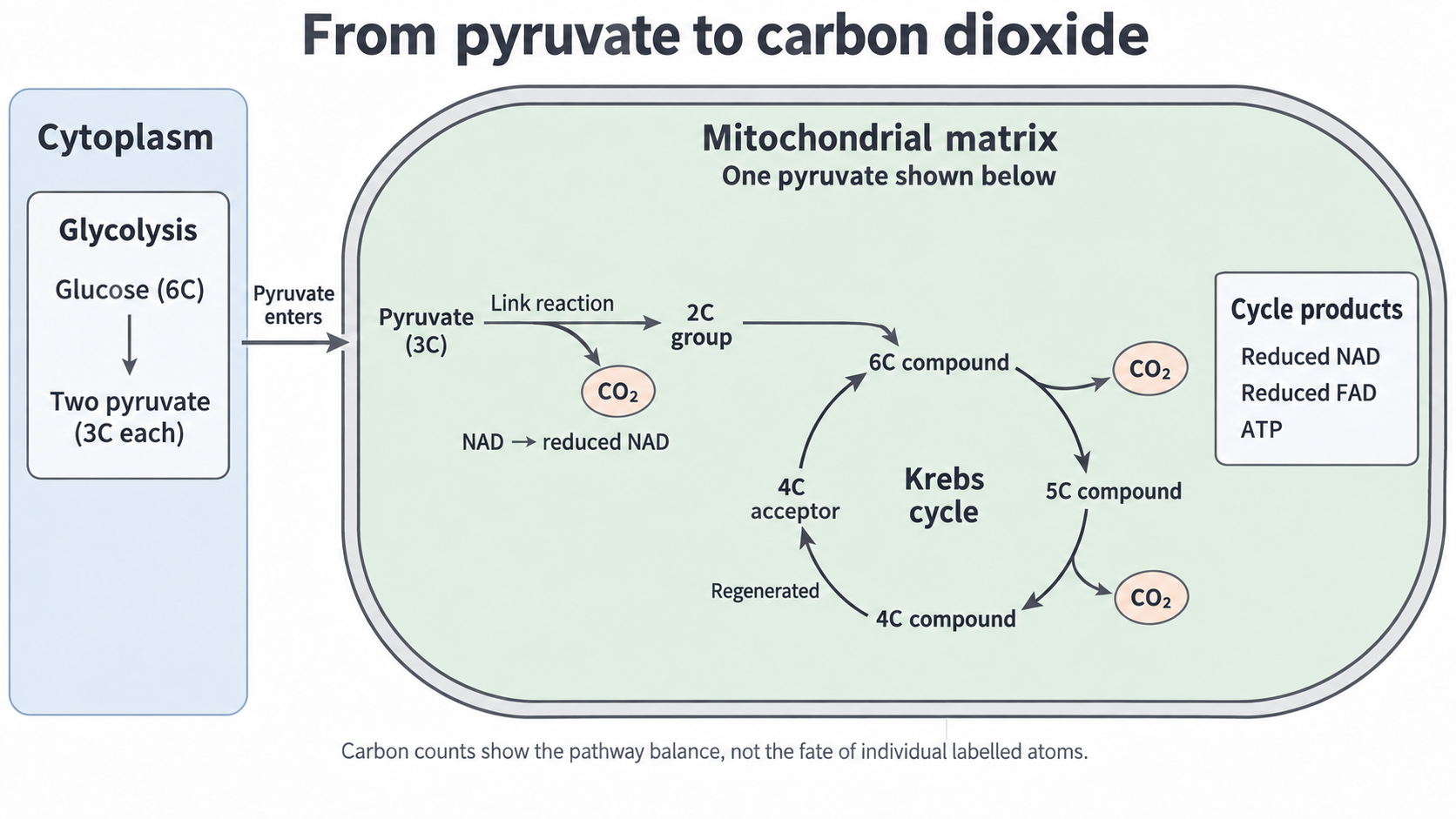
The schematic follows one of the two pyruvate molecules produced from glucose. Carbon counts show the pathway balance; they do not trace individual labelled carbon atoms through their first turn.
Continue this lesson.
You’re previewing NovaLearn without an account. Create a free account to read the rest.
Create free account