6.5 - Comparing bacteria and viruses
A bacterium is a cell; a virus is a particle that depends on a host cell to produce more viruses. Comparing their structures explains this difference and helps us interpret unfamiliar descriptions without assuming that all bacteria or all viruses look alike.
Bacterial cell organisation
A bacterial cell has the internal machinery needed to make proteins and carry out metabolism, even though it has no membrane-bound nucleus.
Bacterium
A single-celled prokaryotic organism: its main DNA is not enclosed by a nuclear envelope.
Recall the cell plan from prokaryotic ultrastructure. The plasma membrane, also called the cell-surface membrane, encloses cytoplasm containing enzymes and 70S ribosomes. Ribosomes carry out translation, assembling amino acids into proteins. Bacteria lack mitochondria, rough endoplasmic reticulum and a Golgi apparatus; lacking these organelles does not prevent them from making proteins or releasing energy through metabolic reactions.
The main chromosome is usually a circular, double-stranded DNA molecule in a region of cytoplasm called the nucleoid. It is not inside a nucleus. Many bacteria also contain plasmids, separate DNA molecules that are commonly small and circular. These can carry additional genes. Plasmids are not present in every bacterium, and bacterial chromosome number and shape have exceptions.
Most bacteria have a cell wall containing peptidoglycan, also called murein, outside the membrane. The wall supports the cell and helps prevent bursting when water enters by osmosis. Some bacteria lack a wall. Where present, a capsule is an additional outer protective layer, commonly made of polysaccharides. Pili are surface protein appendages often involved in attachment; flagella are longer structures that can provide movement. Capsules, pili and flagella vary between bacteria. One diagram containing all of them is a useful model, not a checklist that every bacterial cell must satisfy.
Mesosomes are historical pocket-like membrane appearances produced during specimen preparation, particularly chemical fixation. They are preparation artefacts, not normal bacterial organelles for respiration or division. They are therefore absent from the modern cell model used here.
Viral genome, capsid and envelope
A virus particle packages genetic information for delivery into a host cell rather than enclosing a working cellular system.
Capsid
The protein coat that surrounds and protects a viral genome.
The genome is the complete genetic information of an organism or virus. A viral genome is DNA or RNA, depending on the virus. This describes the molecule carrying the genome; it does not mean that a bacterium contains no RNA. Bacterial cells also contain RNA used in processes such as protein synthesis. Viral genomes vary in arrangement and may be single-stranded or double-stranded. Do not assume that every virus has a circular DNA genome like the usual bacterial model.
The capsid consists of protein subunits. A non-enveloped virus has no additional outer lipid envelope. An enveloped virus has a lipid bilayer surrounding the capsid; its envelope is acquired from host-cell membrane during virus production and contains viral surface proteins. Surface proteins on the capsid or envelope can bind to suitable receptors on a host cell, helping explain why a virus can enter some cell types but not others. The precise attachment proteins and capsid shape differ between viruses.
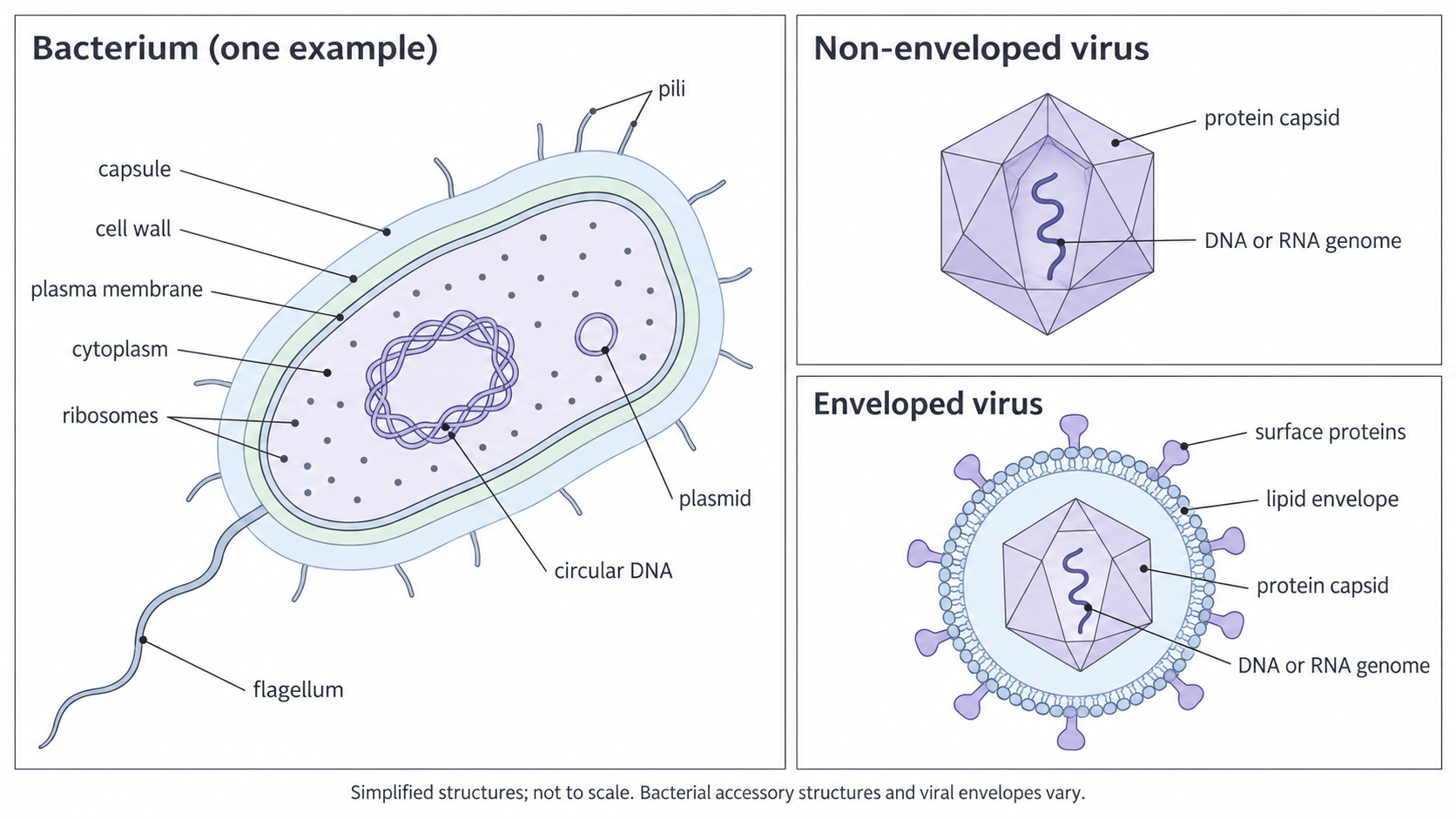
Conceptual structures, not micrographs and not drawn to scale. The example bacterium includes variable accessory structures. The two virus models show why an envelope is an additional covering rather than another name for the capsid.
Viruses are acellular, meaning they are not cells. A virus particle has no cytoplasm containing a cellular metabolic system, no ribosomes and no bacterial peptidoglycan wall. It has no nucleus, mitochondria, ER or Golgi apparatus. Some viruses carry enzymes needed during infection, but possessing an enzyme does not supply the ribosomes and complete machinery of a cell. A viral envelope is not evidence that the particle is a cell: it surrounds a viral genome and capsid, not cytoplasm with ribosomes.
Continue this lesson.
You’re previewing NovaLearn without an account. Create a free account to read the rest.
Create free account