1.11 - Diet and energy budgets
Food supplies energy, while living processes transfer energy out of the body. Learn how to analyse diet and energy-budget data in 1.11(i), then use the balance to explain weight loss, weight gain and the development of obesity in 1.11(ii).
Intake and expenditure
An energy budget compares energy entering and leaving the body over the same period.
Energy budget
An account of dietary energy intake, energy expenditure and the resulting change in the body's energy stores over a stated time.
Energy intake is the energy available to the body from consumed food and drink. Carbohydrates, lipids and proteins can supply energy. Energy expenditure is energy transferred during living processes, including energy dissipated as heat and energy used to do external work. Respiration releases usable energy from chemical stores; energy is transferred rather than created or destroyed.
Expenditure continues during rest. Basal metabolic rate (BMR) is the rate of energy expenditure under standard awake, resting, fasting conditions in a comfortably warm environment. It supports processes such as maintaining ion gradients, breathing and circulation. A daily budget may give the estimated energy used for basal processes over the day rather than the rate itself.
Physical activity adds expenditure through muscle activity. Digestion, absorption and processing of food also require energy. Extra thermoregulation, such as shivering in cold conditions, can increase expenditure. Body size, body composition, age, activity and physiological state affect requirements, so one universal daily value cannot describe everyone.
Read the category definitions before adding them. If a supplied total already includes basal metabolism, do not add BMR again. Likewise, an activity figure may represent either total expenditure during that activity or expenditure above rest. A valid budget counts each contribution once and uses the same time interval for intake and expenditure.
Food energy and portions
A food label states energy for a specified quantity, so the amount consumed matters as well as the energy density.
Energy density is energy per unit mass, for example kilojoules per gram. A label commonly gives energy per 100 g or per portion. Its kJ and kcal entries express the same energy in different units; they are not two contributions to add. NHS: Understanding calories.
Let be the energy, in kJ, stated on a label for 100 g of food. A portion of mass supplies
Express in grams, so is the number of 100 g portions and is in kJ. For a per-100 mL label, use volume in mL instead of mass in g.
For a hypothetical food with 720 kJ per 100 g, a 125 g portion supplies
The portion exceeds 100 g, so its energy must exceed 720 kJ. This sense-check would reveal accidentally dividing 720 by 1.25.
Convert quantities to matching units before combining them: and . Thus 2.25 MJ is 2250 kJ. If a task supplies , then 600 kcal is , approximately 2.51 MJ. Use the supplied conversion and retain unrounded values until the final answer.
Compare equal masses when comparing energy density, but compare the actual portions when comparing energy intake. A 60 g portion of food X at 1000 kJ per 100 g supplies 600 kJ. A 90 g portion of food Y at 800 kJ per 100 g supplies 720 kJ. Y has the lower energy density but the greater portion energy.
Daily balance and comparisons
Subtract expenditure from intake to find the net balance, then use its sign and size to interpret the budget.
is net energy balance, is total energy intake and is total energy expenditure over the same period, all in the same energy unit. Positive is a surplus; negative is a deficit; zero is energy balance.
The following original, hypothetical record covers one complete 24-hour period. Expenditure categories are separate estimates, with activity and extra thermoregulation given above basal expenditure.
| Intake category | Energy (kJ per 24 h) | Expenditure category | Energy (kJ per 24 h) |
|---|---|---|---|
| Breakfast | 1450 | Basal processes | 5700 |
| Lunch | 2600 | Physical activity above rest | 2200 |
| Evening meal | 3150 | Food processing | 900 |
| Snacks and drinks | 1800 | Extra thermoregulation | 400 |
| Total | 9000 | Total | 9200 |
Substitution gives . This is a 200 kJ deficit over 24 hours, not a negative intake. Energy expenditure is greater than intake; the difference must be supplied from body stores if the estimates are accurate.
Fractions, ratios and percentages
Snacks and drinks supply of this day's intake, or . Physical activity accounts for of expenditure to one decimal place. The denominators differ because the first question concerns intake and the second expenditure. Intake:expenditure is , so intake is slightly less than expenditure.
The chart compares this day A with two further hypothetical days. The full numerical values are labelled so a small difference is not mistaken for a large one.
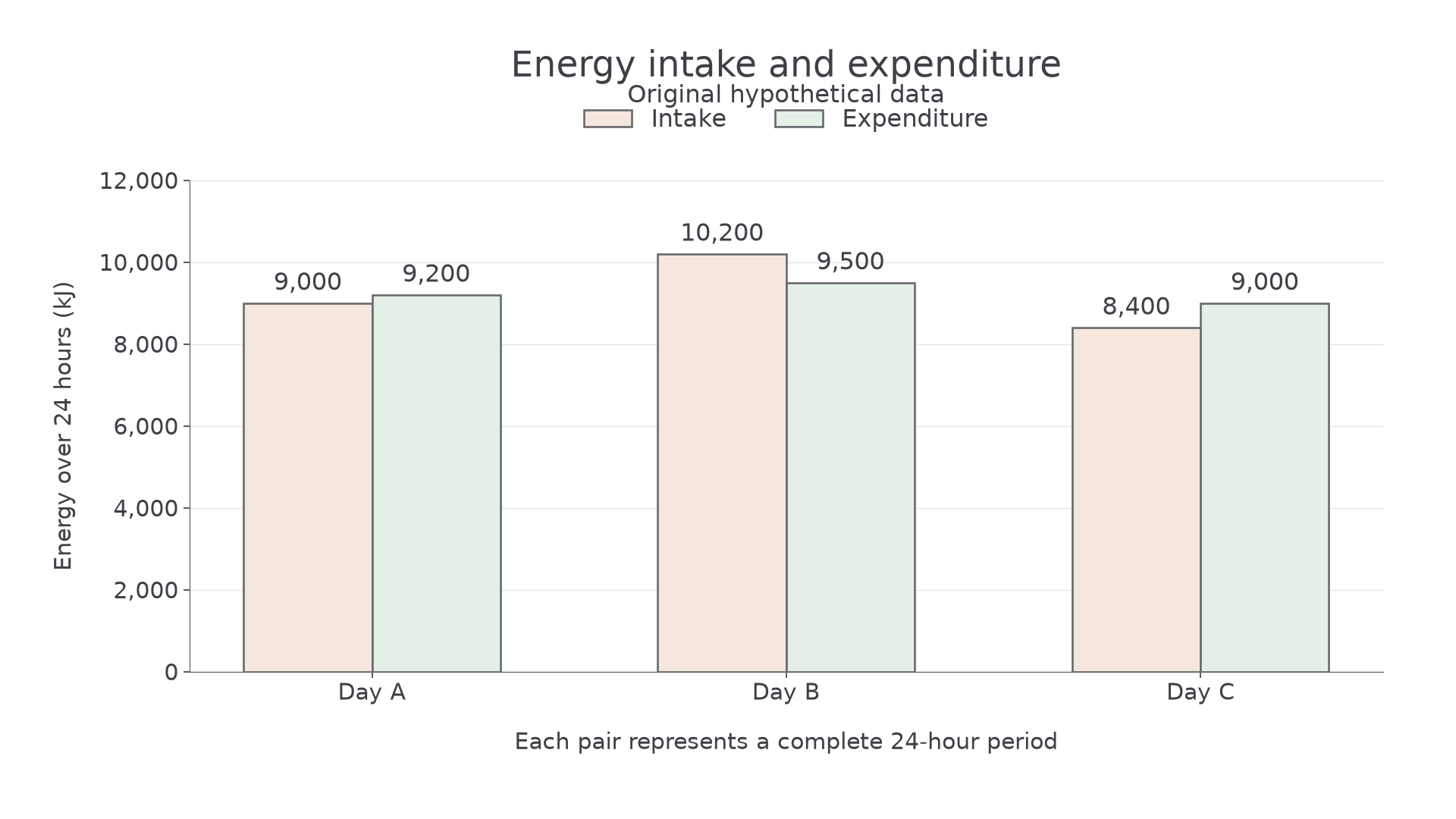
Figure: Day A has intake 9000 and expenditure 9200 kJ; day B has 10200 and 9500 kJ; day C has 8400 and 9000 kJ. Each pair covers 24 hours, with a zero-based common energy axis.
Day B's surplus is . As a percentage of expenditure, this is to one decimal place. Day C's balance is . A, B and C together have a net balance of ; the surplus on B does not describe the whole three-day record.
Unknown quantities and estimates
An equation can reveal a missing contribution, but an estimate is useful for checking whether the solution is plausible.
Suppose a hypothetical budget separates expenditure into basal processes , activity above rest , food processing and extra thermoregulation . Then
For zero balance, . With all energies in kJ over 24 hours, let , , and :
Adding the known expenditure gives , so and . Check by substitution: , equal to intake. The value is a missing entry in a model budget, not an exercise recommendation.
A missing portion can be found similarly. Suppose a model has 8000 kJ already recorded, total expenditure of 9500 kJ, and one unrecorded food with energy density . If the model assumes zero balance, its missing mass satisfies
The missing food supplies 1500 kJ, which is . Grams cancel to give kJ. The mass would be different if the assumed balance were different.
Estimate before accepting a result
For a quick estimate, use about 9 MJ intake and 7 MJ known expenditure: the missing contribution should be roughly 2 MJ, consistent with 2.2 MJ. An answer of 2200 MJ would fail this check by a factor of 1000.
For day A, rounding both 9.0 MJ intake and 9.2 MJ expenditure to about 9 MJ predicts a small balance. Exact subtraction is needed to determine its sign. Subtracting nearly equal values makes the difference sensitive to errors: if actual intake were 300 kJ higher than recorded, A's balance would be , a small surplus. A rounded estimate can check magnitude without establishing the sign of a small balance.
Imbalance and body stores
A sustained difference between intake and expenditure changes the energy stored in the body and can change body mass.
In positive energy balance, intake exceeds expenditure. Some energy is stored in glycogen, but longer-term surplus can increase stores of lipid in adipose tissue. Repeated surplus can therefore lead to weight gain. If excess body fat accumulates sufficiently, obesity can develop. Positive balance can also support normal growth; gaining mass does not by itself establish obesity.
Obesity
A condition involving excessive body fat that can impair health. Body mass alone does not describe how much fat a person has.
In negative energy balance, expenditure exceeds intake. The body draws on stored fuels, including glycogen and fat, to support respiration and living processes. Continued depletion of stores tends to cause weight loss. This describes a biological consequence, rather than establishing that a particular deficit is suitable for a person. NHS: Understanding calories.
With zero average energy balance, intake matches expenditure over the relevant period and total energy stores are approximately stable. This can occur at different body-fat levels. A person can maintain obesity while currently in balance; a current surplus is not required to maintain previously accumulated fat.
Obesity develops through interacting influences on intake, expenditure and fat storage, including biological susceptibility and the food and activity environment. Sustained surplus describes the energy accounting; it does not, by itself, explain why that surplus arose. Obesity increases the risk of conditions including cardiovascular disease and type 2 diabetes, but an energy budget cannot diagnose an individual or predict that a particular disease will occur. WHO: Obesity and overweight.
Do not convert a short budget into an exact long-term prediction of kilograms gained or lost using one fixed energy-per-kilogram value. Body composition and energy expenditure can change as body mass changes. Short-term mass also varies with water and gut contents, so a one-day mass change need not represent the same change in body-fat stores. Hall and colleagues: Dynamic body-weight modelling, NIDDK: Integrative Physiology research.
What diet data can establish
An energy budget answers a specific quantitative question, while judging a diet or explaining a trend requires more evidence.
Matching energy intake to expenditure does not demonstrate that a diet supplies enough vitamins, minerals, essential nutrients or fibre. Two diets could provide the same total energy but have different composition. Energy totals alone cannot establish nutritional adequacy. WHO: Healthy diet. Likewise, a high energy density does not tell you the total eaten unless portion size is known.
Food diaries may omit snacks, drinks or portion details. Label values and estimated activity expenditure have uncertainty. Record the same period, use clear portion measurements, include all consumed items and avoid double-counting expenditure. Repeated records across representative days, including different activity patterns, provide a better picture than selecting one unusual day.
A reported surplus is consistent with increasing stores if it is accurate and sustained. If a record seems inconsistent with a longer-term mass trend, consider missed intake, inaccurate expenditure, unrepresentative days and changes in body water or composition rather than treating the budget as perfect. The reasoned conclusion is limited by the measurements.
An observational association between a dietary pattern and obesity does not by itself establish that the pattern caused obesity. Groups may differ in activity, age, medicines or other influences. The energy-balance mechanism can help interpret an association, but a causal claim needs evidence that addresses alternative explanations. NIDDK: Factors affecting weight and health.
Calculate the balance with compatible units and a defined time period. Interpret its sign in terms of stores, then ask whether the measurements are complete, representative and sufficient for the conclusion.
The same distinction applies to comparisons: a difference in recorded energy intake is evidence about intake, not proof of a difference in total expenditure, nutrient adequacy or future health.