1.14 - Triglycerides and fatty acids
Fats and oils contain triglycerides, whose properties depend on the fatty acids attached to them. You will follow how glycerol and three fatty acids join, how that reaction can be reversed, and how carbon–carbon double bonds affect a lipid's structure and physical properties.
Glycerol and fatty acids
A triglyceride is built from two kinds of molecule: one glycerol and three fatty acids.
Lipids are a broad group of biological molecules with low solubility in water. Triglycerides, also called triacylglycerols, are the main lipids in fats and oils and are used as energy stores. They contain carbon, hydrogen and oxygen, but are structurally different from the carbohydrates you have studied.
Triglyceride
A lipid in which three fatty-acid residues are joined to one glycerol molecule by three ester bonds.
Glycerol has three carbon atoms and three hydroxyl groups, each written as . Its condensed structure is:
There is one hydroxyl group on each carbon. These three groups explain why glycerol can attach to three fatty acids.
A fatty acid has a hydrocarbon chain, containing carbon and hydrogen, with a carboxyl group, , at one end. The carboxyl carbon is double-bonded to one oxygen and single-bonded to an group. The other end of a typical unbranched fatty acid is a methyl group, .
In a shortened structural formula, represents the hydrocarbon chain. Thus represents a fatty acid; is a label for a group of atoms, not a chemical element. Fatty acids can differ in chain length and in the bonds within the chain. The three fatty acids in a triglyceride may be identical or different.
A triglyceride is not a polymer made from a long sequence of repeating monomers. It has a three-carbon glycerol backbone with three attached fatty-acid chains.
Forming ester bonds
Each fatty acid attaches when its carboxyl group reacts with one hydroxyl group of glycerol.
This is a condensation reaction: two molecules join and a molecule of water is produced. In the net atom accounting, the carboxyl group contributes an and the glycerol hydroxyl group contributes an H. Together these form . The glycerol's oxygen remains in the joining link.
The new ester bond joins that oxygen to the carboxyl carbon of the fatty acid. The ester group contains the arrangement ; its carbonyl remains present. It is the joining single bond between glycerol oxygen and fatty-acid carbon that forms, not a new carbon–carbon bond.
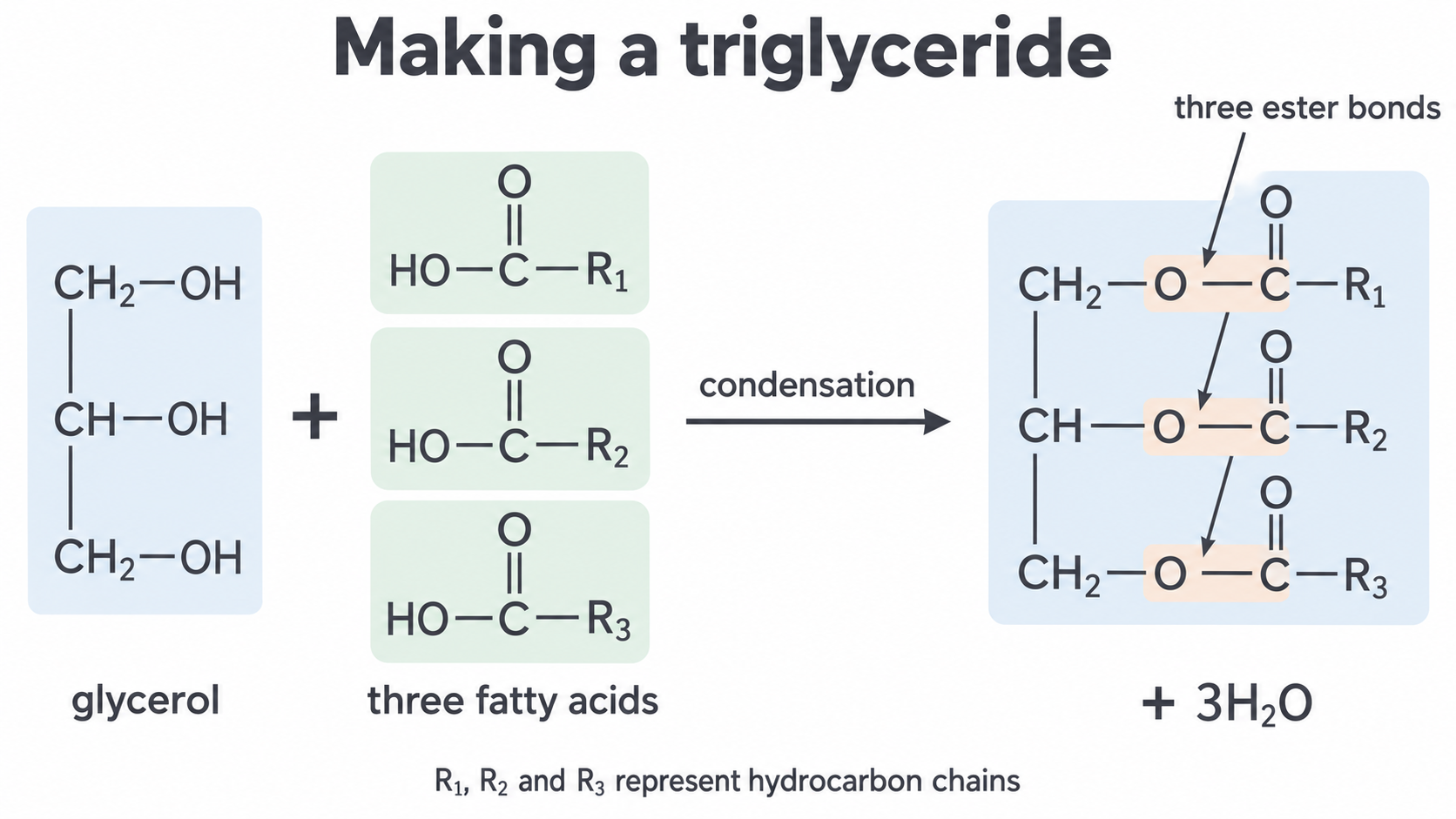
One hydroxyl group reacts at each of glycerol's three carbons. The highlighted joining bonds are the three ester bonds; the fatty-acid carbonyl groups remain intact. The labels , and represent hydrocarbon chains.
The reaction occurs three times to form a complete triglyceride. Each ester bond formed corresponds to one water molecule produced, so the overall relationship is:
glycerol + 3 fatty acids → triglyceride + 3 water molecules
This summarises the net structural change; it does not mean that simply mixing the molecules in water makes triglycerides spontaneously. Cellular synthesis uses enzyme-controlled steps.
For example, complete formation of two triglyceride molecules uses two glycerol molecules and six fatty-acid molecules. It forms six ester bonds and produces six water molecules. For complete triglyceride molecules, both the number of ester bonds formed and the number of water molecules produced are . Count three reactions per triglyceride, rather than counting the starting molecules as if they formed one long chain.
Hydrolysing triglycerides
Hydrolysis reverses the net joining reaction by using water to split ester bonds.
In hydrolysis, water is a reactant. At each ester link that is split, its H and restore a hydroxyl group on glycerol and a carboxyl group on the fatty acid. Complete hydrolysis splits all three ester bonds, giving one glycerol molecule and three fatty-acid molecules.
Condensation produces water as the molecules join; hydrolysis uses water as they separate. Three waters are used in complete hydrolysis of one triglyceride. Partial hydrolysis can split fewer ester bonds, leaving some fatty acids attached, so the word complete matters when predicting the products.
For example, complete hydrolysis of four triglyceride molecules produces four glycerol molecules and twelve fatty-acid molecules and uses twelve water molecules. The hydrocarbon chains are released from glycerol; they are not broken into individual carbon atoms. Enzymes called lipases catalyse ester-bond hydrolysis during fat digestion, although digestion can produce partially hydrolysed molecules as well as free fatty acids.
Formation and complete hydrolysis involve the same three ester links in opposite directions. Formation releases three waters per triglyceride; complete hydrolysis consumes three.
The products can be predicted from the original structure, even when the three fatty-acid chains are different.
Reading saturation from structure
Saturation is decided by the bonds between carbon atoms in a fatty-acid chain.
Saturated and unsaturated fatty acids
A saturated fatty acid has no carbon–carbon double bonds. An unsaturated fatty acid has at least one carbon–carbon double bond: a monounsaturated fatty acid has one, and a polyunsaturated fatty acid has two or more.
Carbon normally forms four bonds. Replacing a carbon–carbon single bond with a double bond means the two carbons have fewer bonds available for hydrogen. For the same carbon skeleton, each carbon–carbon double bond corresponds to two fewer hydrogen atoms than in the saturated version. “Saturated” therefore refers to the maximum hydrogen content of that chain.
Compare three real 18-carbon fatty acids. The carboxyl carbon is included in the count of 18.
| Fatty acid | Molecular formula | Carbon–carbon double bonds | Classification |
|---|---|---|---|
| Stearic acid | 0 | Saturated | |
| Oleic acid | 1 | Monounsaturated | |
| Linoleic acid | 2 | Polyunsaturated |
Stearic acid's condensed structure is . Oleic acid's structure is . In oleic acid, the central identifies the carbon–carbon double bond; it replaces two hydrogen-bearing groups with two groups. The condensed formula identifies the double bond but does not itself show its three-dimensional arrangement. Oleic acid's double bond has the cis arrangement described in the next section.
Do not count the in the carboxyl or ester group as evidence of unsaturation. It is a carbon–oxygen double bond. A triglyceride with three saturated fatty-acid chains still contains three carbonyl groups.
A triglyceride whose three chains contain no is saturated. If one or more chains contain , the triglyceride contains unsaturated fatty-acid residues. State which chains are monounsaturated or polyunsaturated rather than assuming all three are the same. All of these triglycerides still have three ester links: the degree of saturation does not change the number of attachment sites on glycerol.
Chain shape and packing
A carbon–carbon double bond changes chain geometry as well as hydrogen content.
Many naturally occurring unsaturated fatty acids have cis double bonds: the two chain segments attached to the double-bond carbons are on the same side of the double bond. This fixes a bend, or kink, in the chain. Saturated chains lack these cis double-bond kinks and can lie more closely alongside one another. They are usually drawn as regular zigzags, not perfectly straight rods.
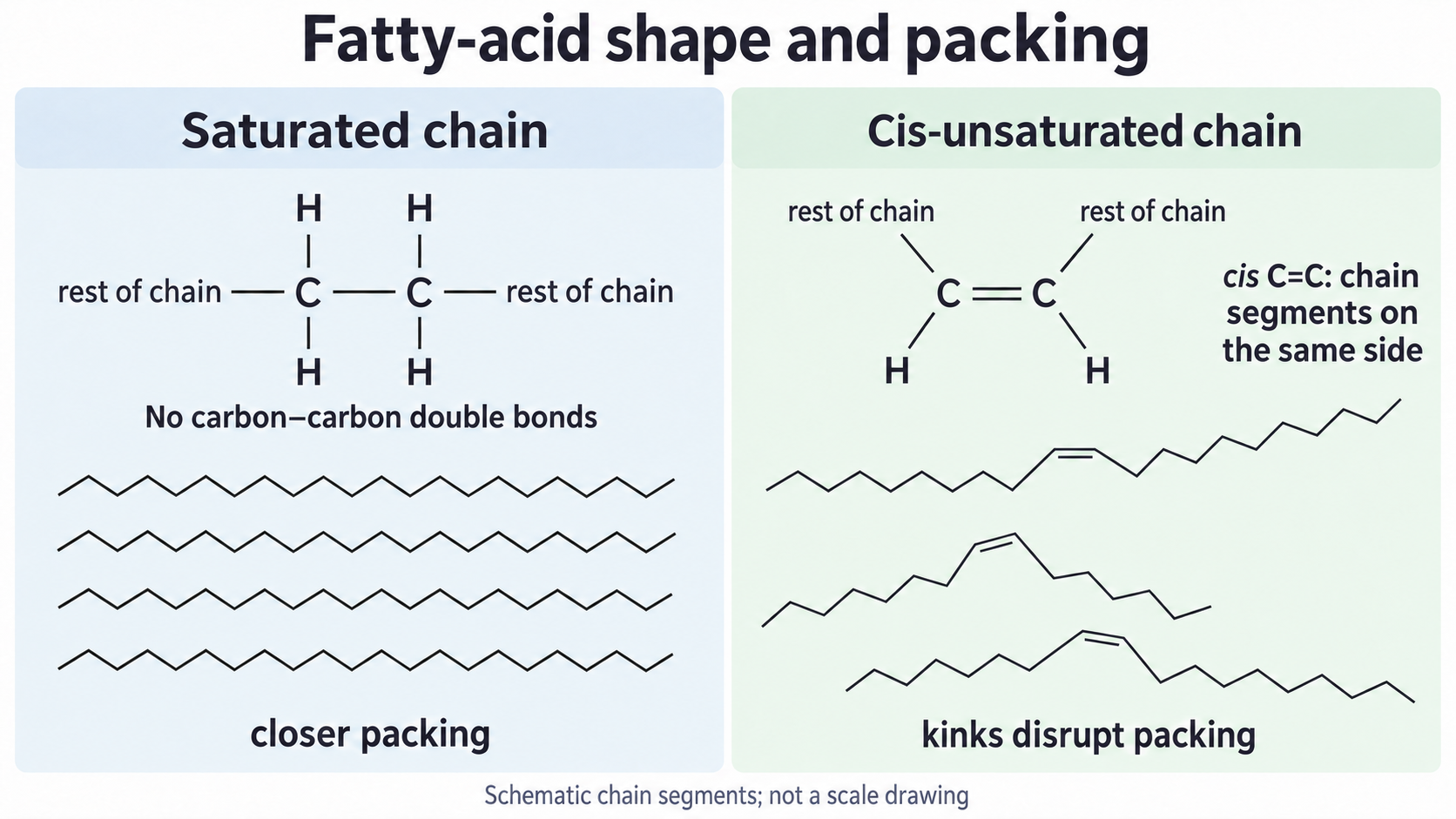
The upper structures show two hydrogens on each carbon in a saturated chain segment, compared with one on each double-bond carbon in a cis-unsaturated segment. The lower sketches illustrate close packing and disrupted packing; their molecule counts and spacing are not quantitative measurements.
Intermolecular attractions act between neighbouring molecules. Close packing allows greater contact between the chains and stronger overall attractions. Cis kinks make this packing less efficient. For comparable chain lengths, triglycerides containing more cis-unsaturated chains therefore tend to have lower melting temperatures than triglycerides containing saturated chains: less thermal energy is needed to overcome the attractions that hold the molecules together in the solid.
Melting separates molecules enough for them to move past one another. It does not split the ester bonds or break the bonds within them. Chemical hydrolysis and physical melting are different changes.
This helps explain why fats rich in saturated chains are often solid at room temperature and oils rich in cis-unsaturated chains are often liquid. These are trends, not definitions. Chain length, the arrangement of double bonds, the mixture of triglycerides and the temperature also affect physical state. Foods contain mixtures, so neither “animal fat” nor “plant oil” establishes every molecule's saturation.
There is also a trans arrangement of a carbon–carbon double bond, in which the two chain segments lie on opposite sides. Such a chain is still unsaturated, because it contains , but lacks the pronounced cis kink and can pack more closely. Thus “all double bonds produce the same kink” is not a valid rule.
When comparing structural evidence, first establish whether the chains have similar lengths, then identify the number and arrangement of their carbon–carbon double bonds. Predict a packing and melting trend under those conditions; do not infer an exact melting temperature or a health outcome from a structural sketch alone.