7.4, 7.7 - Glycolysis, lactate and recovery
Glycolysis can supply ATP both when aerobic respiration keeps pace with demand and when it cannot. In 7.4, follow the investment and production of ATP and the recycling of NAD during lactate formation; in 7.7, discover how lactate can become fuel or be used to rebuild carbohydrate during recovery.
Phosphorylating a hexose
Glycolysis begins the breakdown of glucose in the cytoplasm, outside the mitochondria.
Glycolysis
An enzyme-controlled sequence that converts one six-carbon glucose molecule into two three-carbon pyruvate molecules, producing a small net gain of ATP and reducing NAD.
Glucose is a hexose, meaning that it has six carbon atoms. Early in glycolysis, phosphate groups are transferred from ATP to the sugar and its six-carbon derivative. This phosphorylation uses two ATP molecules per glucose; the ATP becomes ADP. Adding phosphate prepares the six-carbon compound for the later reactions and makes it more reactive. The phosphorylated six-carbon compound then splits into two three-carbon compounds, which follow the remaining steps of the pathway.
This is an ATP investment: ATP is used before more ATP is made. It does not mean that the cell loses ATP overall. Coupled reactions involving ATP make the early phosphorylation possible. The useful energy transfer depends on the net coupled reactions, rather than energy being released merely by breaking an ATP bond.
Each stage is catalysed by an intracellular enzyme. You need the overall sequence and its products, but not the names or detailed structures of the intermediate compounds. Keep the carbon accounting clear: one six-carbon starting molecule supplies two three-carbon products; glycolysis itself releases no carbon dioxide.
ATP and reduced NAD production
After the six-carbon compound splits, reactions involving both three-carbon compounds produce ATP and reduced NAD as pyruvate forms.
NAD is a coenzyme: a small non-protein molecule that works with enzymes. In glycolysis it accepts hydrogen, including electrons, from the compounds being oxidised. NAD is therefore reduced to reduced NAD, also written NADH. The organic compounds lose hydrogen and are oxidised. Reduced NAD carries reducing power that can be transferred in later reactions; it is not another name for ATP.
ATP is made when phosphate groups are transferred directly from phosphorylated compounds to ADP. This is substrate-level phosphorylation. Each of the two three-carbon pathways produces two ATP molecules, so four ATP are formed in total. However, two were used earlier: the gross production is four ATP, while the net gain is two ATP per glucose.
Net ATP gain = ATP formed − ATP used.
For one glucose in glycolysis: ATP molecules gained.
The complete bookkeeping below refers to one molecule of glucose, not a glucose unit entering from glycogen by a different route.
| Quantity per glucose | Number of molecules |
|---|---|
| ATP used in the investment steps | 2 |
| ATP formed later: gross production | 4 |
| ATP gained overall: net gain | 2 |
| NAD reduced to reduced NAD | 2 |
| Pyruvate formed | 2 |
For example, if three glucose molecules complete glycolysis, six ATP are invested and twelve ATP are formed. The net gain is ATP, alongside six pyruvate and six reduced NAD. The answer is a molecular count, not an energy value in joules. The small ATP yield also makes biological sense: pyruvate still contains much of the chemical energy originally present in glucose.
Lactate formation regenerates NAD
Glycolysis is common to aerobic and anaerobic respiration because none of its steps directly uses oxygen.
When aerobic processing can keep pace, pyruvate can undergo further oxidation in mitochondria. Hydrogen and electrons carried by reduced NAD are ultimately transferred through aerobic processes to oxygen, regenerating NAD. These later reactions allow much more ATP to be produced than the net two ATP from glycolysis alone. Their detailed mitochondrial mechanisms are developed in the following lessons.
During intense activity, ATP demand and glycolytic rate can rise faster than aerobic processing can accommodate. Oxygen delivery may limit that processing, but lactate formation does not mean that every oxygen molecule has disappeared from the muscle. Aerobic metabolism and lactate production can occur at the same time.
To maintain glycolysis, the cell must keep a supply of NAD available to accept hydrogen. If NAD remained as reduced NAD, the oxidation step in glycolysis would eventually stop and its ATP supply would stop too. In animal cells, pyruvate is reduced to lactate, accepting hydrogen from reduced NAD. Reduced NAD is oxidised back to NAD, which can be used again in glycolysis. The enzyme lactate dehydrogenase catalyses the reversible pyruvate–lactate reaction.
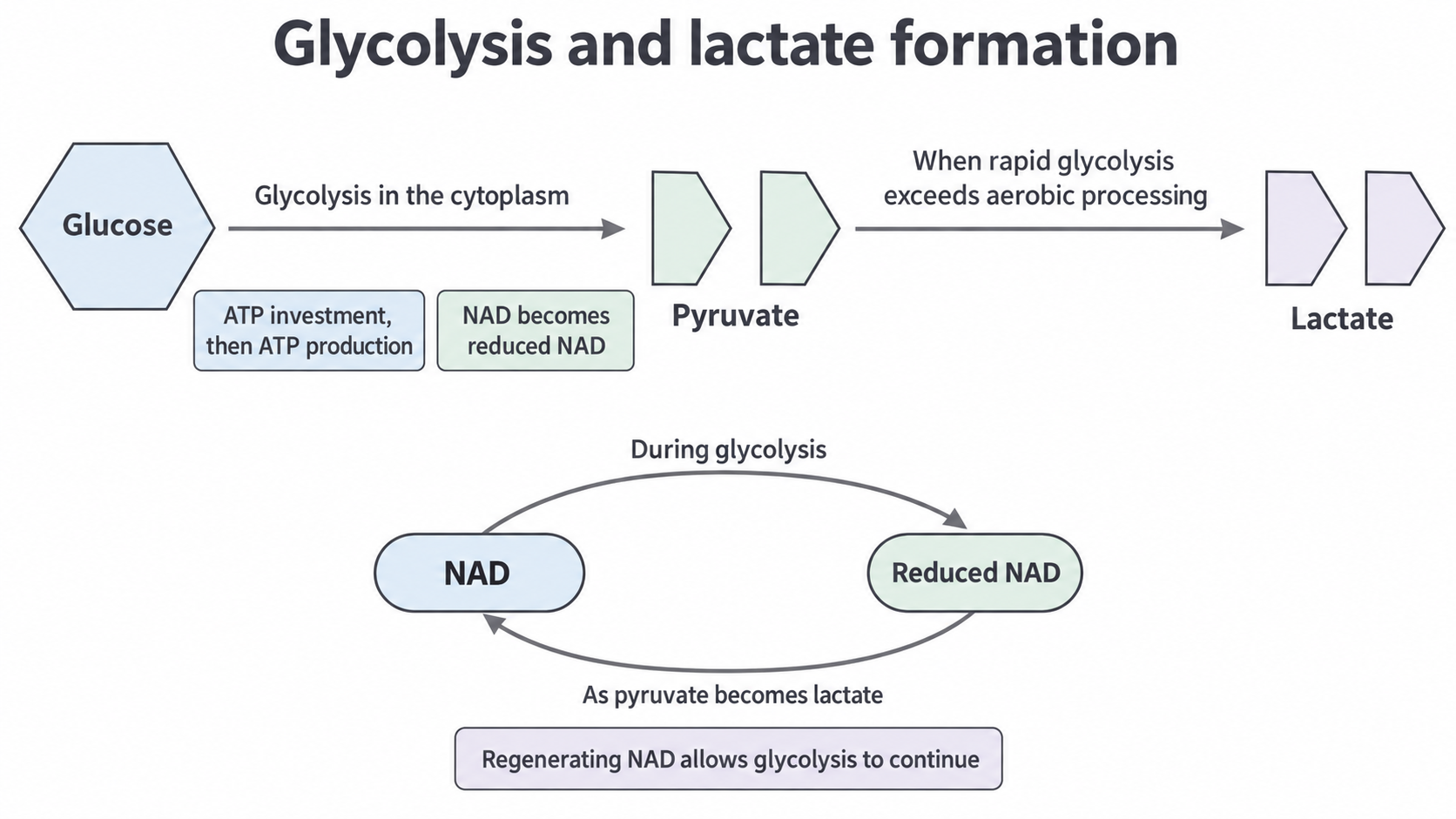
Glycolysis produces pyruvate and reduces NAD; conversion of pyruvate to lactate regenerates NAD. The shapes are symbolic, not molecular structures, and the lower loop tracks the coenzyme rather than carbon.
The lactate-forming step itself produces no additional ATP. Its role is to regenerate NAD, enabling substrate-level phosphorylation in glycolysis to continue. Starting with one glucose, the anaerobic route to two lactate molecules therefore has a net gain of two ATP. There is no net accumulation of reduced NAD through the complete glucose-to-lactate route: the reduced NAD made in glycolysis is used again when lactate forms.
Lactate formation sustains ATP production indirectly by recycling NAD. The ATP is produced in glycolysis; substantial chemical energy remains in lactate because the glucose carbon has not been completely oxidised.
This explains why the pathway can support a brief period of rapid ATP demand, while providing much less ATP per glucose than complete aerobic oxidation.
Continue this lesson.
You’re previewing NovaLearn without an account. Create a free account to read the rest.
Create free account