5.15, Core practical 13 - Temperature, development and life cycles
Climate change can alter where organisms survive and when they grow, reproduce or migrate. In 5.15, you will connect changing rainfall and seasonal cycles to these responses; in Core practical 13, you will investigate temperature using seedling growth and decide how far a controlled experiment can explain events in an ecosystem.
Climate and species distribution
A species can establish a population only where individuals survive and reproduce successfully. Temperature and water availability help set those conditions, alongside light, soil, food, competitors, predators and pathogens.
Changing rainfall means more than a change in the annual total. The same total falling in a few intense storms, separated by long dry periods, can give different soil moisture from regular light rain. A prolonged dry season can reduce seed germination and seedling survival. Plants may close stomata to conserve water, reducing carbon dioxide entry and photosynthesis; less material is then available for growth. Animal populations can be affected through reduced plant food, drinking water or prey. Drying ponds may remove breeding habitat before amphibian larvae complete development. Conversely, persistently waterlogged soil restricts oxygen supply to roots, limiting aerobic respiration and growth. Responses depend on the species and habitat.
As climate changes, an area may become suitable for a warm-tolerant species while becoming unsuitable for a cold-adapted species. Expansion towards higher latitudes or altitudes is possible, but a suitable temperature does not ensure colonisation. Seeds must reach the site; animals need routes to it; the right host, prey or pollinator must also be present. A mountain summit or fragmented habitat may leave a population with little room to move. Rainfall changes can make the suitable direction east, west or downhill in some places. A population can also decline locally without its range moving.
Predict distribution from the combination of conditions and interactions needed for survival and reproduction. A universal “all species move north” rule cannot explain these responses.
Long-term surveys at many sites are needed to distinguish a persistent range change from a single unusual year's sightings. When linking observations to climate, investigate other changes such as land use and sampling effort. The IPCC assessment documents varied range responses, including effects of precipitation as well as temperature (AR6 WGII, Chapter 2).
Seasonal cycles and mismatch
The timing of an organism's activities can matter as much as its location. Leaf emergence, flowering, insect emergence, breeding and migration are stages in seasonal cycles.
Phenology
The seasonal timing of biological events, such as flowering, egg hatching or migration.
Warmer conditions can allow some seedlings to develop earlier and some insects to reach adulthood sooner, within their suitable temperature range. A longer favourable season can allow an insect with several reproductive cycles a year to complete an extra generation. That can change population size and its potential to spread. However, development also depends on water, food and inherited responses to environmental cues. A warm but dry spring may prevent growth that temperature alone would favour. Some plants need a period of winter chilling before normal spring development, so a warmer winter need not simply advance flowering. Day length remains a cue even when the temperature pattern changes.
Interacting species need not respond at the same speed or to the same cue. Consider birds whose chicks need abundant caterpillars. If spring conditions move the caterpillar food peak much earlier but the birds' breeding advances less, peak chick food demand can fall after the food peak. Parents may bring less food; chick growth and survival can fall, reducing recruitment into the population. This is a phenological mismatch. A similar problem can arise if flowering and pollinator activity overlap less. Neither outcome is inevitable: a population may adjust its timing, use alternative foods or retain sufficient overlap.
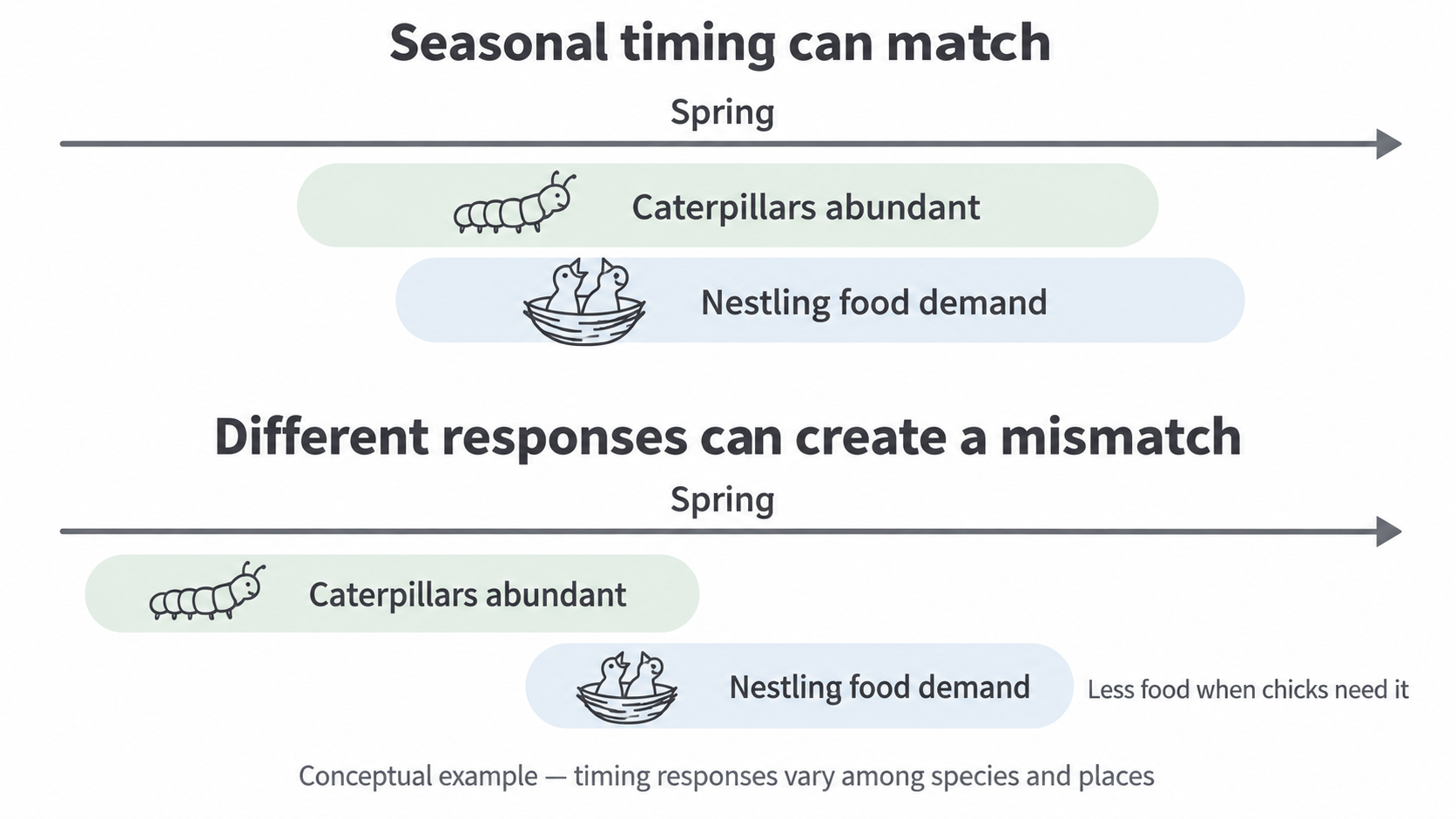
The windows illustrate greater and smaller seasonal overlap. They are conceptual, with no numerical dates, durations or measured population data.
Research across many phenological records finds variation in responses among organisms; it supports investigating interactions rather than assuming one common timing shift (Thackeray and colleagues, 2016). To test a mismatch locally, record both the food-availability curve and the consumer's demand period, together with breeding success, across years. An earlier first sighting alone does not measure the whole food peak or demonstrate reduced breeding success.
Defining development measures
A temperature experiment needs a measurable response with an unambiguous starting point and endpoint. Growth is an increase in size or biomass; development includes progression through life-cycle stages. Shoot extension is one growth measure that can be used to investigate temperature effects on young plants, but a longer shoot does not by itself show more biomass or completion of a whole life cycle.
Core practical 13 permits different organisms. This lesson uses the seedling alternative: measure the same seedling's shoot length at the beginning and end of a fixed interval. Do not divide final length by time when seedlings already had shoots at the start.
If lengths are in millimetres and time in days, the rate is in . This is the average over the stated interval, not an instantaneous rate.
The alternative brine-shrimp investigation asks different questions. Hatching success is the proportion of initially incubated cysts that have hatched by a stated time, often expressed as a percentage. Hatching time is the time to a defined event, such as 50% of the initial cysts having hatched, if that threshold is reached. Hatching rate needs a stated denominator: for example, newly hatched nauplii per hour during a specified interval, or the reciprocal of time to a defined endpoint as a rate proxy. A percentage at 24 hours has no “per hour” unit and may combine speed with eventual success. These definitions prevent confusing a faster process with a greater final proportion completing it; they are not a second compulsory method.
A controlled seedling investigation
A controlled experiment changes temperature while keeping other important growth conditions comparable. The question here is: how does temperature from 10 to 30 °C affect cress shoot extension over 48 hours?
Preparing comparable seedlings
Use commercially sourced garden-cress seeds of one species and cultivar, from one batch; do not collect protected or wild plants. Germinate them together under the same moist, illuminated conditions. Use healthy seedlings of the same age and developmental stage with shoots about 10–12 mm long. Set the selection rule before allocating treatments, record exclusions, and randomly allocate suitable seedlings rather than putting the largest in one treatment. The result will apply to this selected stage, rather than to germination success of the whole seed batch.
For each run prepare five identical transparent vessels, each with one seedling supported upright in the same amount of inert growing material, with the root moist and the shoot above it. A suitable short-term support is a small plug of clean absorbent material in the vessel; avoid compressing or damaging the root. Add the same initial volume, for example 20.0 cm³ of water, using a graduated measuring cylinder with 0.5 cm³ divisions, read at eye level. Select vessel/support dimensions in a pilot so this volume moistens the roots without submerging the shoot or excluding air. Use identical loose covers with equal ventilation. A 48-hour comparison of these young seedlings does not require different nutrient treatments: keep water source and any supplied nutrient solution identical.
Temperature, controls and independent repeats
Use five thermostatically controlled illuminated chambers, set to 10, 15, 20, 25 and 30 °C. Pilot this range with the chosen seedlings; revise it if distress, damage or unusably small measurable growth occurs. Measure the temperature beside each seedling with a checked digital probe, resolution 0.1 °C, rather than trusting a dial. Compare probes together at a common temperature before use and record any offset. Log at regular intervals, for example every 10 minutes, and record the actual range and any deviations. A displayed 0.1 °C digit is resolution, not proof of ±0.1 °C accuracy.
Give each chamber the same lamp type, light intensity at shoot height and 16-hour light/8-hour dark cycle; check intensity with a light meter rather than assuming equal lamp distance guarantees equality. Keep vessel size, support, starting water availability, air exchange, duration and handling equal. Weigh each prepared vessel at the start with a balance reading to 0.1 g. At each daily observation restore evaporative water loss to its own starting mass with measured water; record the amount added. Over this short interval, this is an approximate moisture control because plant mass also changes. Check support moisture and avoid waterlogging. Adding one fixed volume daily regardless of different evaporation could make temperature also a drought treatment.
Carry out three complete runs with fresh seedlings, germinating each run's group together from the same seed batch. In every run, randomly reassign the five temperatures to the five chambers, then allow them to equilibrate before introducing the fresh seedlings, so the same chamber is not always the warmest treatment. Each temperature then has three independent chamber/run replicates. The five seedlings in a run are compared at the same time, limiting the effect of a different run date. More independently controlled replicates would strengthen the design. Repeatedly measuring one seedling does not create new biological replicates; nor would many seedlings sharing one chamber independently replicate that chamber's temperature treatment. If only one chamber is available, run separately randomised temperature trials with fresh organisms, record date effects, and recognise that this is less well protected against changing background conditions.
Recording the response safely
After the chambers have equilibrated, place the labelled vessels in them. Measure shoot length from the same marked base at the support surface to the shoot apex, without including a leaf tip, using a millimetre ruler aligned alongside the shoot. Use a hand lens to identify the apex consistently if necessary. Read at eye level and do not stretch the plant. Keep the definition, observer and orientation consistent. Record the initial length and actual time. Record length, appearance, temperature and water additions at 24 hours, then final length and time at about 48 hours; use the actual elapsed time for each rate. Intermediate observations can reveal wilting or a non-constant response even though the calculation below uses the two endpoint readings.
Make a scientific drawing from your own observation of a representative seedling at the beginning and end: use clear single outlines, no shading, straight non-crossing label lines, and annotate the observed shoot, cotyledons and any visible true leaves. Add a measured length or a scale derived from the ruler, date and specimen identity. Do not invent a leaf or copy a generic drawing as an observation. Keep every individual's numeric readings, not just treatment means.
Assess the equipment and organism risks with the supervisor. Keep electrical probes and lamps away from spilled water; dry hands before operating controls, and follow chamber instructions. Handle glass carefully, clean spills promptly, wash hands after handling seeds/supports and do not eat the experimental seedlings. Keep conditions within the piloted non-damaging range, use the smallest number of organisms that gives useful evidence, and stop a treatment if seedlings show serious damage. Record such an endpoint rather than silently deleting failures. Do not open or smell mouldy cultures; seal and dispose of them by the centre's procedure. Healthy plants may be retained under suitable growing conditions when the investigation ends.
Continue this lesson.
You’re previewing NovaLearn without an account. Create a free account to read the rest.
Create free account