4.12, Core practical 7 - Water, minerals and deficiency investigations
A plant can receive plenty of water and light yet fail to grow normally because one mineral is missing. In 4.12 you will connect water, nitrate, calcium and magnesium to plant function; in Core practical 7 you will investigate those requirements by comparing controlled nutrient solutions and analysing growth.
Water in growing plants
Water is both a material used by a plant and the medium in which much of its chemistry occurs. It is a reactant in photosynthesis: together with carbon dioxide, it supplies the material from which carbohydrates are made using light energy. The plant uses those carbohydrates in respiration and to build other organic molecules. Dissolved mineral ions are not a substitute for the carbon fixed from carbon dioxide.
Water is a solvent for ions and many other substances, allowing reactions in cells and transport in solution. Water entering a plant cell by osmosis fills its vacuole and presses the cell contents against the wall. This turgor pressure supports non-woody tissues and helps drive cell expansion when the wall can extend. A shortage of water reduces turgor, so leaves may wilt and expansion slows even if mineral supplies are adequate.
Water also carries mineral ions from roots through xylem. Evaporation from leaf surfaces removes heat, helping cool the plant, although excessive water loss can cause a shortage. These roles explain why a mineral-deficiency experiment must keep water supply comparable: a dry treatment could reduce growth for reasons unrelated to its missing ion.
Ions and deficiency patterns
Plants absorb mineral nutrients as dissolved inorganic ions. A deficiency is an insufficient supply for normal function, rather than the absence of every atom of that element from the plant. A plant may initially use ions already present in its tissues.
| Ion | Why it matters | Plausible consequence of shortage |
|---|---|---|
| Nitrate, | A nitrogen source for making amino acids and therefore proteins, including enzymes; nitrogen is also needed for nucleotides. Nitrate must first be assimilated into organic compounds. | Less new protein and other nitrogen-containing material can be made, so growth is restricted. Older leaves may become generally pale or yellow. |
| Magnesium, | A magnesium ion is at the centre of each chlorophyll molecule. | Reduced chlorophyll gives chlorosis, a loss of green colour, often between veins on older leaves. Reduced light absorption can restrict photosynthesis and growth. |
| Calcium, | Calcium links pectin components in cell walls, helping bind cells in the middle lamella, and helps maintain membrane function. | Rapidly growing root and shoot tissues can be damaged; young leaves may be distorted and growing tips may die. |
Nitrogen and magnesium can be redistributed from older tissue to younger growth, helping explain why older leaves often show symptoms first. Calcium is poorly redistributed through phloem, so a shortage commonly affects young growing tissue. These are useful patterns, not an infallible key: species, age, disease, water stress and several deficiencies can produce overlapping symptoms.
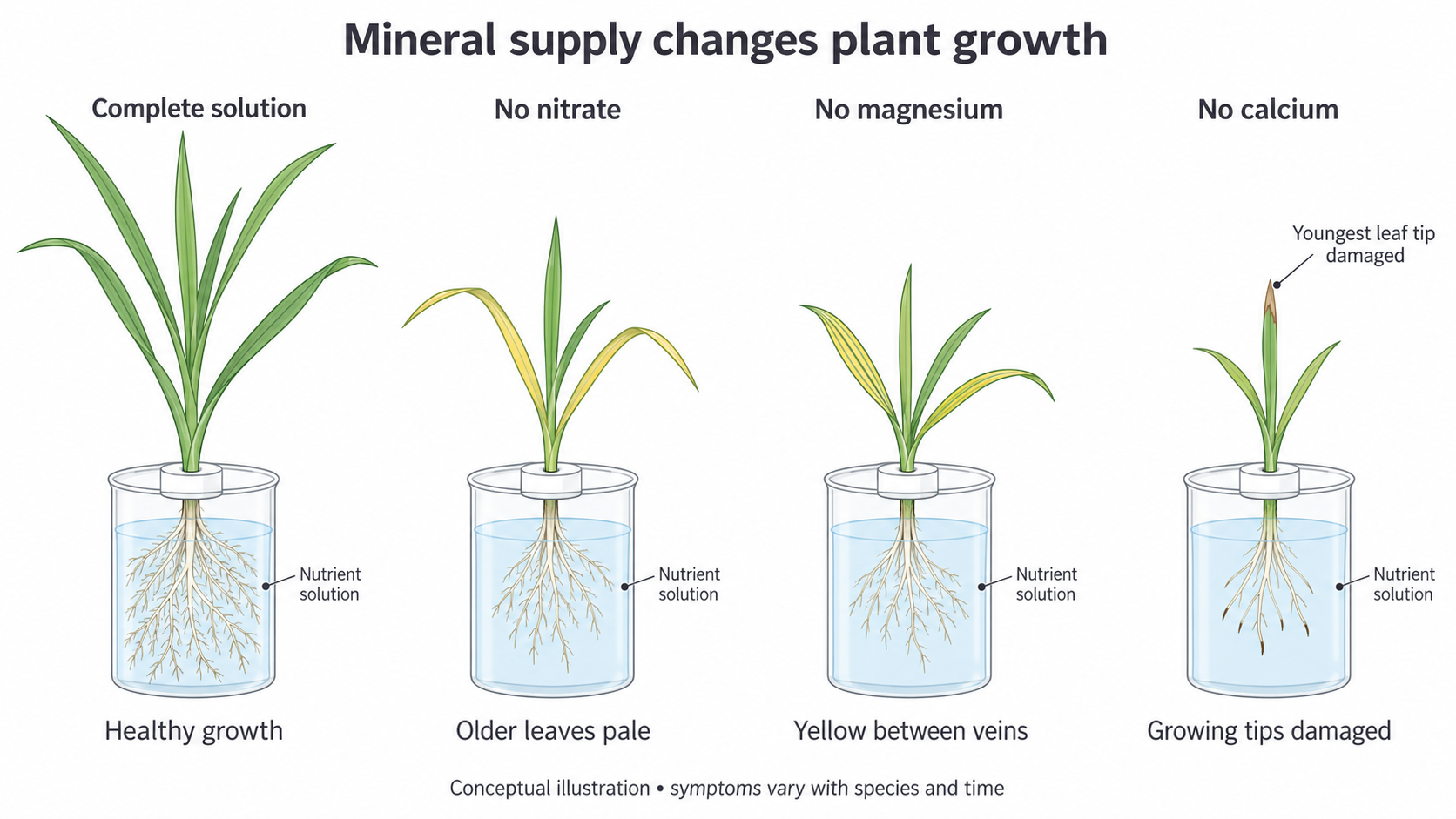
Conceptual ImageGen illustration, not photographs or measured results. Nitrate omission is associated with older pale leaves; magnesium omission with interveinal yellowing; calcium omission with damaged growing tips. Actual symptoms and their timing vary. Real vessels are screened from light during growth.
The useful causal explanation runs from ion to molecule or structure, then to a cell process and plant growth. Saying only “minerals make plants healthy” does not explain that connection.
Making a valid nutrient omission
Core practical 7 asks whether a particular mineral supply affects plant development. Hydroponic culture grows roots in a defined nutrient solution rather than soil, whose unknown mineral reserves would make an omission difficult to control. The independent variable is the nutrient treatment: complete solution, no nitrate, no magnesium or no calcium. Dependent variables can include shoot-length increase, dry mass and recorded leaf symptoms.
Complete nutrient solution
A solution supplying all the essential mineral nutrients required for growth, at suitable concentrations. It contains more than just the three ions being investigated.
The complete solution is the positive growth control: it shows how the plants grow under the same conditions with an adequate mineral supply. Distilled water alone is a multiple-deficiency treatment, not a substitute for this control. Equal solution volumes and starting plant sizes are also required; the mere presence of a control vessel does not make every other variable controlled.
Preserve the other nutrients
Use a validated school nutrient-omission set prepared by the technician from its full recipe, with every treatment labelled. The recipe record must show that all essential nutrients other than the target remain at suitable, comparable concentrations, that the target has no alternative source, and which replacement ions have changed. For a no-nitrate treatment intended to test nitrogen deficiency, exclude other supplied nitrogen sources such as ammonium too; otherwise the plant could still obtain nitrogen. Do not simply leave out a whole salt. Omitting calcium nitrate removes both calcium and nitrate; replacing it appropriately with calcium chloride can retain calcium in a no-nitrate mixture. Similarly, removing magnesium sulfate without replacing sulfate also changes sulfur supply.
Solutions must remain electrically neutral. It is impossible to remove a charged ion while literally keeping every other ion identical. A checked recipe uses alternative salts to retain the other essential nutrients and maintains a suitable pH and total solute concentration. Its replacement ions must remain below damaging concentrations. A technician checks stock compatibility too: concentrated calcium and phosphate mixtures can precipitate, silently changing availability.
Include full-nutrient replacement-ion controls for each recipe's extra ion load, such as the extra chloride introduced when nitrate salts are replaced. These retain adequate nutrition and test whether that replacement load itself inhibits growth. They cannot prove every possible ion interaction absent; if they change growth, redesign the mixture rather than attribute the whole effect to the target omission. Repeating an omission with a second independently balanced recipe, or a properly balanced restoration treatment, strengthens the interpretation. Adding any fertiliser indiscriminately would change several variables.
Growing matched plants safely
A fair comparison needs independent plants experiencing the treatments for long enough to exhaust readily available reserves. The following method is designed for barley seedlings and a 21-day comparison after germination; a centre may pilot a longer period if symptoms develop slowly.
- Germinate one seed lot under identical conditions for about a week using a low-mineral support and distilled water. Select healthy seedlings of the same age with similar initial shoot lengths and root development. Record initial lengths, then allocate matched seedlings randomly among treatments rather than putting the largest plants in the complete solution.
- Use at least four independent vessels per treatment, one plant per vessel, including the replacement-ion controls. Four plants sharing one vessel are not four independent solution replicates. Rinse roots gently with distilled water to reduce carry-over; avoid damaging them and do not cut off seed reserves to force a result.
- Use clean labelled glassware and dedicated pipettes for each mixture. Measure the same working volume, for example , into identical vessels. Support each seedling with a loose inert collar so roots reach solution while the shoot remains above it. Keep the roots aerated in the same way in every vessel; oxygen shortage can restrict root respiration and ion uptake.
- Cover the outside of vessels with opaque sleeves to reduce algal growth, while retaining access for checking roots and levels. Algae compete for nutrients and alter solution conditions. Keep vessels in the same growth cabinet, for example and a 16-hour light period. Check temperature with a thermometer. Randomise positions initially and rotate trays systematically to reduce a light-position effect without mixing treatment labels.
- Use a calibrated pH meter to check solutions before use and at replacement. Calibrate against two appropriate buffer standards, rinse the electrode with distilled water between samples, blot gently as instructed, and wait for a stable reading. Keep the same approved pH range, for example 5.5–6.0, across treatments because pH affects nutrient availability. The technician makes any adjustments with suitable reagents; a pH change must not reintroduce the omitted nutrient.
- Mark the starting liquid level. Replace evaporated water with distilled water to that level, then replace the whole nutrient solution at the same scheduled interval, such as every two days, using freshly prepared treatment solution. Topping up continually with full-strength nutrient solution could concentrate salts. Record dates, volumes, pH, unusual events and symptoms in a laboratory record.
Measuring solution volumes
Read the bottom of the meniscus at eye level in appropriate calibrated glassware. When an approved compatible stock is supplied at working concentration, two successive tenfold dilutions give : transfer into a volumetric flask and make up to the mark with distilled water, mixing to obtain ; then transfer of that dilution into a second flask and make up and mix again. Each step is a final volume of , not the addition of of water. This is a serial dilution. Use it only for stocks approved for this dilution method; separately supplied incompatible nutrient stocks are diluted according to their own recipe before combination.
Specific risks and responsible handling
Staff assess the actual salts, stock concentrations and reagent safety sheets before use; a dilute working solution and a concentrated stock do not necessarily have the same hazard. Wear eye protection when preparing/transferring solutions, use pipette fillers, and wash hands after plant or solution handling. Keep labelled chemicals away from food. Staff handle concentrated salts and pH adjustments; avoid contact and splashes and report spills promptly. Secure glass vessels in racks, keep water away from electrical equipment and use the centre's disposal route for nutrient/reagent waste. Plants are living experimental material: use enough independent plants to answer the question, handle them gently, and avoid unnecessary destructive sampling. Written preparation alone does not demonstrate practical competence or award the centre-authenticated practical endorsement.
Recording growth, colour and biomass
A change in height, a change in colour and a change in biomass measure different aspects of plant performance. Record them separately instead of combining them into an undefined “health” score.
Measure shoot length from the same defined base to the tip of the longest leaf, using the same gentle straightening convention at day 0 and day 21. A millimetre ruler gives readings to the nearest ; avoid parallax and do not stretch the leaf. Record raw readings, not just increases. Draw an observed leaf and root outline with clear single lines, a title and annotations identifying the observed pale area, vein pattern or damaged tip. Add a measured size or scale where possible; do not copy the idealised illustration as if it were your specimen. Compare colours under the same white light and record which leaves are affected.
Fresh mass includes variable water content. For a dry-mass endpoint, rinse off adhering salts, blot consistently, remove any remaining grain by the same defined convention, and dry the harvested plant in a labelled, preweighed container in a supervised low-temperature oven, for example . Cool before weighing; repeat drying, cooling and weighing until successive readings are constant at the balance's resolution. Staff handle hot equipment with heat protection. Tare the container or subtract its mass. Use a balance reading to . Destructive harvest prevents later growth measurements, so do it at the endpoint. Final dry mass is an endpoint comparison; it is not dry-mass increase unless initial dry mass was measured in a separate matched destructive sample.
The following is a complete original constructed teaching dataset, not a claim that these are observed classroom results. Each row is one independent barley plant in its own vessel, treated for 21 days after matching. All main treatments use the same culture conditions. The dry mass excludes the residual grain.
Continue this lesson.
You’re previewing NovaLearn without an account. Create a free account to read the rest.
Create free account