5.7, 5.9 - Chloroplasts and light-dependent reactions
A chloroplast converts absorbed light energy into chemical forms that can drive the manufacture of organic molecules. In 5.9, you will connect its compartments and membranes with their functions; in 5.7, you will follow electrons from water to reduced NADP and explain how their transfer supports ATP production. Keeping electrons, protons and energy separate makes this mechanism easier to understand.
Compartments within a chloroplast
A chloroplast contains an internal membrane system surrounded by a double membrane envelope.
The envelope consists of an outer and an inner membrane. It separates the chloroplast from the cytoplasm, and transport proteins in the inner membrane regulate the exchange of many substances. The envelope is distinct from the internal membranes where the light-dependent reactions occur.
Stroma
The fluid-filled region inside the chloroplast envelope but outside the thylakoids.
The stroma contains enzymes for the Calvin cycle, in which carbon dioxide is incorporated into organic molecules using ATP and reduced NADP. These products are made available on the stroma side of the internal membranes, close to the enzymes that use them. The detailed Calvin cycle is the next lesson.
Chloroplasts also contain circular DNA and small ribosomes. They can make some of their own proteins, including components needed for photosynthesis, although many chloroplast proteins are encoded in the nucleus and imported. Starch grains can provide temporary storage of carbohydrate made from photosynthetic products; starch is not the molecule that transfers energy directly from the light-dependent reactions.
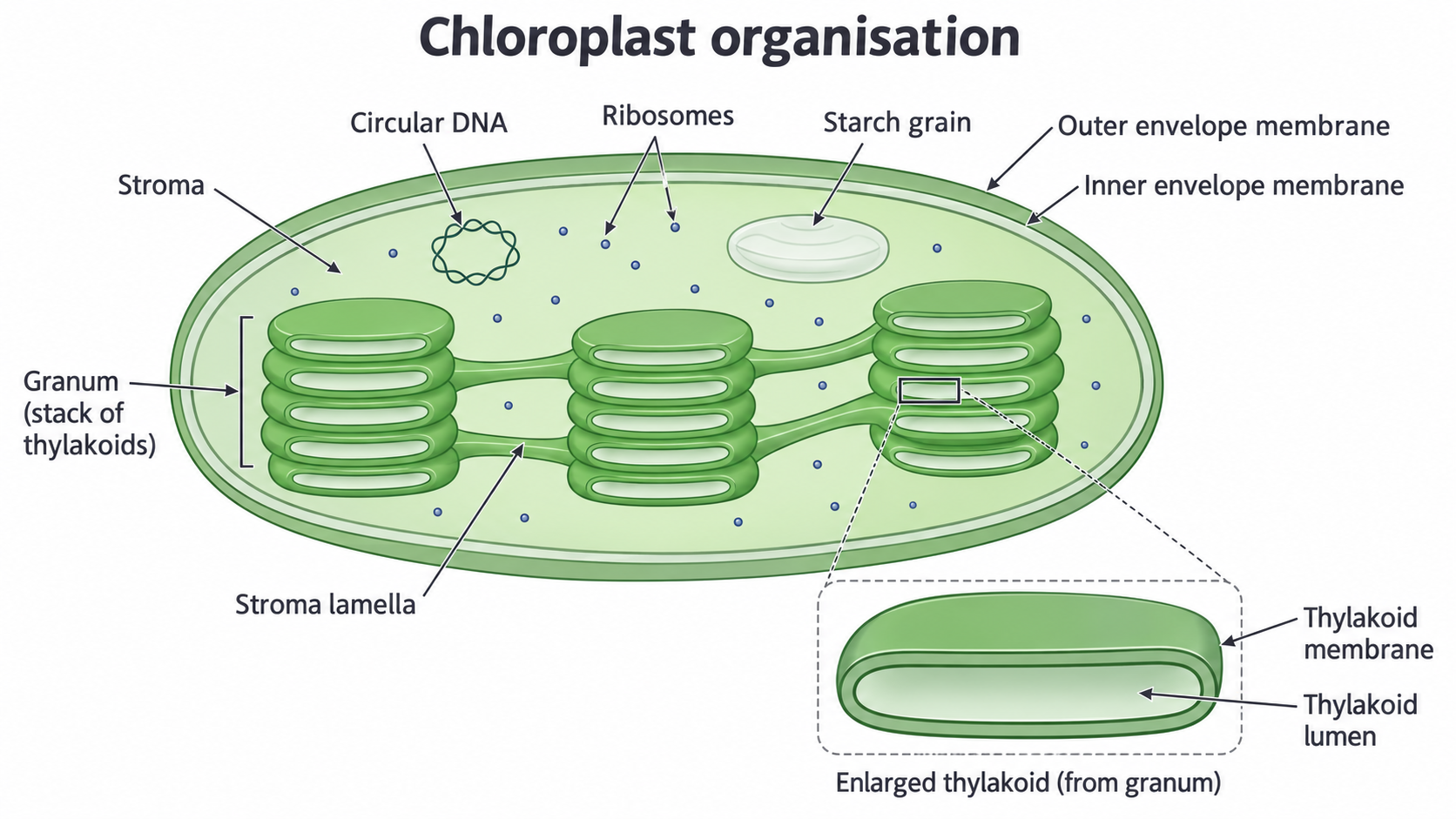
The stroma surrounds the internal thylakoids. The enlarged thylakoid is a conceptual view of one sac, not a separate organelle or a measured micrograph.
Thylakoids provide surfaces and compartments
The internal membranes form flattened sacs called thylakoids, whose organisation supports the light-dependent reactions.
Thylakoid
A membrane-bound sac within a chloroplast. Its enclosed internal space is the thylakoid lumen.
Thylakoids are stacked into grana; one stack is a granum. Unstacked thylakoid membranes called stroma lamellae connect grana. The extensive thylakoid membrane provides a large surface for chlorophyll-containing protein complexes, electron carriers and ATP synthase. These components occupy different regions of the connected membrane system; a simple pathway diagram does not show their exact distribution within a granum.
The thylakoid membrane has two sides: the lumen side faces the fluid inside the sacs, and the stroma side faces the fluid outside them. This membrane is a barrier to the free movement of protons, . It therefore allows a difference in proton concentration to be established between the lumen and the stroma. Its proteins control the relevant proton transfers. The small enclosed lumen allows proton accumulation to produce a substantial concentration difference.
For example, simply having a large amount of chlorophyll is insufficient for ATP production if the membrane cannot maintain this separation. Photosynthesis depends on organised proteins and a functional membrane as well as light absorption.
Light excites electrons in chlorophyll
Chlorophyll absorbs light energy, which raises electrons to a higher energy level.
Chlorophyll and other light-absorbing pigments are held in protein complexes in the thylakoid membrane. A photosystem contains light-harvesting pigments and a reaction centre. Energy absorbed by the light-harvesting pigments is transferred to reaction-centre chlorophyll. An excited electron can then be transferred from the reaction centre to an electron acceptor. This starts an electron-transfer pathway rather than merely warming the chloroplast.
The main pathway involves photosystem II followed by photosystem I. The numbers reflect their discovery, not the order in which they act. Light excites electrons at photosystem II; after transfer along carriers, light provides another energy input at photosystem I. This second excitation allows the electrons ultimately to reduce NADP.
When reaction-centre chlorophyll donates an electron, it must receive a replacement if transfer is to continue. Light supplies energy; it does not create electrons. Electrons are also not converted into ATP molecules: their transfer makes energy available for processes that lead to ATP synthesis.
Consider two otherwise identical chloroplast preparations receiving the same light. If one has less functional light-harvesting pigment, less light can be absorbed by its photosystems. Fewer electrons can be excited and transferred per unit time, so its capacity for the light-dependent reactions is reduced, provided light capture is limiting.
Photolysis replaces electrons and releases oxygen
Water supplies replacement electrons for photosystem II through a light-driven splitting reaction called photolysis.
Water splitting is associated with photosystem II on the lumen side of the thylakoid membrane. It is an enzyme-mediated process powered by the light-driven reactions, rather than light simply breaking water molecules anywhere in the stroma.
Photolysis supplies protons, electrons and oxygen. The equation shows material and charge balance; light provides the required energy.
Each product has a different role. The electrons replace those lost from photosystem II, allowing further excitation and transfer. The protons are released into the lumen and contribute to the proton gradient across the thylakoid membrane. Oxygen is released as a by-product and can diffuse out of the chloroplast and leaf; some may be used in respiration.
The oxygen released in photosynthesis therefore comes from water, not from the carbon dioxide that will be incorporated into organic molecules. Photolysis also supplies the electrons eventually used to reduce NADP. The electrons are transferred through a pathway; they do not jump straight from water to the Calvin cycle.
Continue this lesson.
You’re previewing NovaLearn without an account. Create a free account to read the rest.
Create free account