Core practical 16 - Measuring respiration rates
Respiring cells take up oxygen, but how can a tiny gas movement reveal a rate? Learn how to make a controlled respirometer comparison, convert a moving marker into oxygen uptake, and judge how confidently the results answer a biological question.
What the gas movement measures
A respirometer measures gas exchange around living material, giving evidence about its respiration.
Respirometer
Apparatus used to measure a change in gas volume or pressure associated with respiration over a known time.
In aerobic respiration, oxygen is consumed and carbon dioxide is produced. Oxygen supports the electron transport chain in mitochondria, allowing continued oxidative phosphorylation. A capillary respirometer contains a small trapped gas space connected to a narrow tube containing a coloured liquid marker. If carbon dioxide is removed by an absorbent such as soda lime, oxygen consumption produces a net decrease in gas in the chamber. Its pressure falls relative to atmospheric pressure, so the marker moves towards the chamber. Under stable conditions, the volume swept out in the capillary estimates the volume of oxygen consumed.
Without the absorbent, carbon dioxide production could replace some or all of the oxygen removed. Little marker movement would then not demonstrate little respiration. Even with absorbent, movement is an oxygen-uptake proxy: it does not directly measure ATP production, heat release or anaerobic respiration. Changes in temperature, atmospheric pressure or leakage can also move the marker.
Choose living material that suits this oxygen-uptake measurement. Germinating peas are convenient: their growing tissues respire using stored respiratory substrates, and large green photosynthetic tissues are absent. Use peas of the same species, germination stage and measured mass, kept moist but not submerged so oxygen can reach them. An external glucose solution is unnecessary in this investigation. Adding it would introduce additional variables rather than make all peas use identical internal reserves. A sealed yeast mixture can ferment when oxygen is limited, so its carbon dioxide production is not interchangeable with this aerobic oxygen-uptake method. Measuring fermentation would need a separately justified method.
A safe matched apparatus
Two matched capillary respirometers help distinguish biological oxygen uptake from physical gas movements.
The experimental chamber contains germinating peas; a separate control contains inert glass beads occupying the same volume. Match the chamber dimensions, trapped gas volume, capillary calibration, absorbent quantity and arrangement. Both capillary ends experience the same atmospheric pressure, and both chambers sit in the same thermostatically controlled water bath at the same depth. A temperature change expands or contracts trapped gas; atmospheric pressure changes alter the pressure difference across a marker. Matching makes these influences as similar as possible. The control also reveals drift when no organism consumes oxygen. It cannot repair a leak confined to the experimental tube.
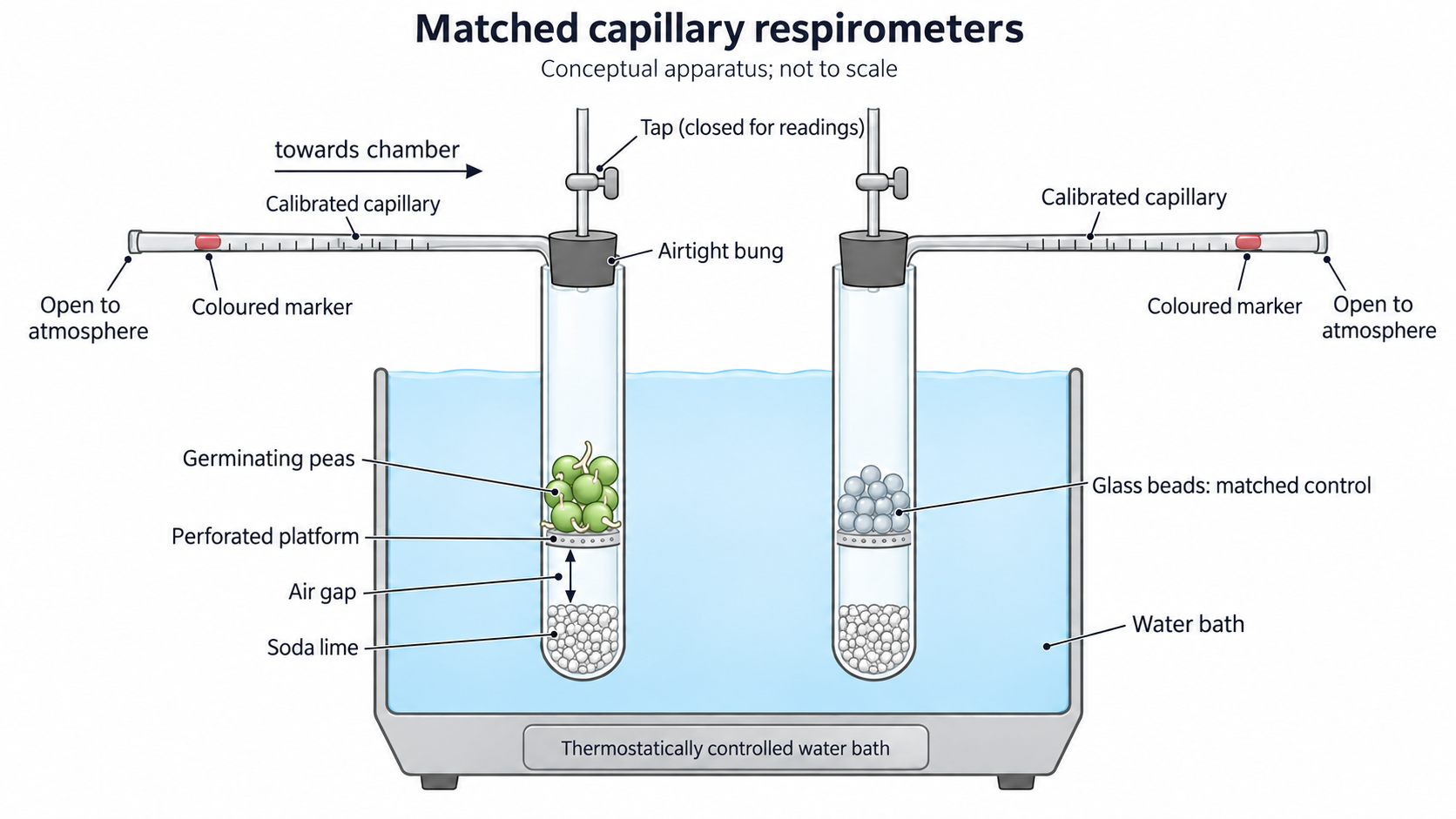
The experimental peas and control beads occupy matched chambers; a perforated platform and air gap separate each from the carbon dioxide absorbent. The capillary ends are open to the same atmosphere.
Use intact, supported laboratory glassware and airtight bungs/connections. A tap allows each chamber to communicate with air during temperature equilibration; it is closed for a timed reading. Check the empty apparatus for leaks before adding organisms: use its adjustment syringe or specified leak-test procedure to impose a small pressure change, close the tap and check that the marker position is maintained at stable temperature. A leak lets outside air replace consumed oxygen, commonly reducing the apparent uptake. Do not interpret biological movement during a trial as proof of a leak.
Soda lime is corrosive and its dust is hazardous. A trained supervisor dispenses it using suitable tools and the local risk assessment; wear eye protection and avoid skin contact and dust inhalation. Place it in a secure lower compartment below a perforated support with an air gap, so it cannot touch peas, moisture around them or anyone handling the peas. A loose plug alone is not permission for absorbent to spill onto organisms. Handle glass gently with protection when fitting tubing; damaged glass is replaced. Keep electrical bath equipment dry and use a moderate, approved bath temperature. Do not taste seeds; wash hands and dispose of absorbent by the supervised chemical-waste procedure.
Using germinating seeds avoids the animal-welfare concerns of confining invertebrates, although living material still needs appropriate moisture, temperature and a short exposure. If animals are used in an approved alternative, avoid harmful temperatures, crowding, oxygen depletion and chemical contact, and minimise handling and confinement. Do not claim that invertebrates certainly cannot suffer. Release or return organisms only under the centre's approved welfare and biosecurity arrangements.
Taking a controlled series of readings
A useful investigation changes a defined factor while keeping the measurement conditions comparable.
For example, test the prediction that increasing temperature from 15 to 25 °C increases oxygen uptake by germinating peas over this moderate range. The independent variable is measured bath temperature, and the dependent variable is corrected oxygen volume consumed per unit time, optionally per gram. Keep pea species, germination stage, moisture, mass, initial gas space, absorbent and recording duration controlled. Temperature affects enzyme-controlled respiration, but a prediction is not a result, and a higher rate cannot be assumed at every possible temperature.
Preparing and measuring
- Assemble the matched experimental and inert-control pair. Use a balance to record, for example, 2.0 g of gently blotted germinating peas. Avoid crushing them. Match their occupied volume with beads in the control, rather than assuming equal mass means equal volume. Record the apparatus identification and capillary calibration.
- Place both chambers in the bath with their equilibration taps open. Measure bath temperature with a thermometer or probe. Allow about five minutes initially, then check that temperature and marker behaviour are stable; an elapsed five minutes alone does not prove equilibration. The organisms and gas must reach the intended temperature before the reading begins.
- Introduce a small marker of suitable coloured manometer fluid into each capillary, according to its apparatus instructions. Keep capillaries horizontal, scales fixed and marker sizes comparable; large drops or sticking change the measurement. Use the adjustment syringe if supplied to place markers within the readable range. Close the equilibration taps and allow any disturbance to settle.
- Read the same edge of each marker at eye level against its scale. Record its starting coordinate and the start time. Read both markers at fixed intervals, for example every minute for five minutes, recording actual times, bath temperature and units. Keep handling and movement of the chambers to a minimum.
- Express displacement towards a chamber as positive. Subtract each marker's starting coordinate using this direction convention, then subtract the matched control displacement from the experimental displacement at the same elapsed time. For example, experimental movement of +28.0 mm and control movement of +2.0 mm give +26.0 mm corrected movement. If the control moves away from the chamber, its displacement is negative and subtraction must retain that sign.
- End before the marker leaves the scale or the limited oxygen supply changes respiration. Reopen the taps between runs to equalise pressure and replenish air safely. Use at least three independently prepared pea samples and paired controls at each temperature; repeated coordinates from one sample describe its time course, not independent biological replicates. Reset and re-equilibrate after changing temperature. Randomise the order of temperatures across samples where feasible, limiting bias from time or progressive seed development.
A spreadsheet can record signed coordinates, subtract starting positions and matched controls, apply each capillary's calibration, and calculate rates and means. Check the formula on one pair by hand before copying it. A temperature logger can verify stability; a suitable calibrated gas-pressure/oxygen sensor is an alternative instrument only if its measured signal is converted by an appropriate method. Automatic logging does not remove the need for controls, calibration or synchronised times.
At different temperatures, the same number of gas molecules occupies different volumes. Close comparisons over the same temperature use the stated volume conditions; for a precise comparison across temperatures, convert measured gas volumes to a common reference temperature and pressure or use calibrated oxygen amount measurements. A matched control removes physical drift within a run; it does not by itself standardise volumes between different bath temperatures.
Continue this lesson.
You’re previewing NovaLearn without an account. Create a free account to read the rest.
Create free account