3.8 - Gene loci, linkage and sex linkage
A gene's position helps explain how it is inherited. You will locate genes on homologous chromosomes, explain why some alleles tend to travel together, and use sex chromosomes to predict offspring and interpret family pedigrees.
Genes at corresponding loci
Chromosomes carry many genes in a particular order along their DNA.
Locus
A locus is the position of a gene on a chromosome. The plural is loci.
Recall that a gene is a DNA sequence providing information for a functional product, and an allele is an alternative version of a gene. A locus tells us where the gene is; an allele tells us which version is present. Two alleles of the same gene do not normally occupy two different gene positions on a chromosome.
In a diploid cell, a pair of homologous chromosomes has the same genes at corresponding loci. One homologue was inherited from each parent. They can carry different alleles: at one gene's locus, one homologue might carry A and the other a. This gives genotype Aa at that gene. At a different locus the homologues might carry B and b. A and B name different genes here; A and a name alleles of the same gene.
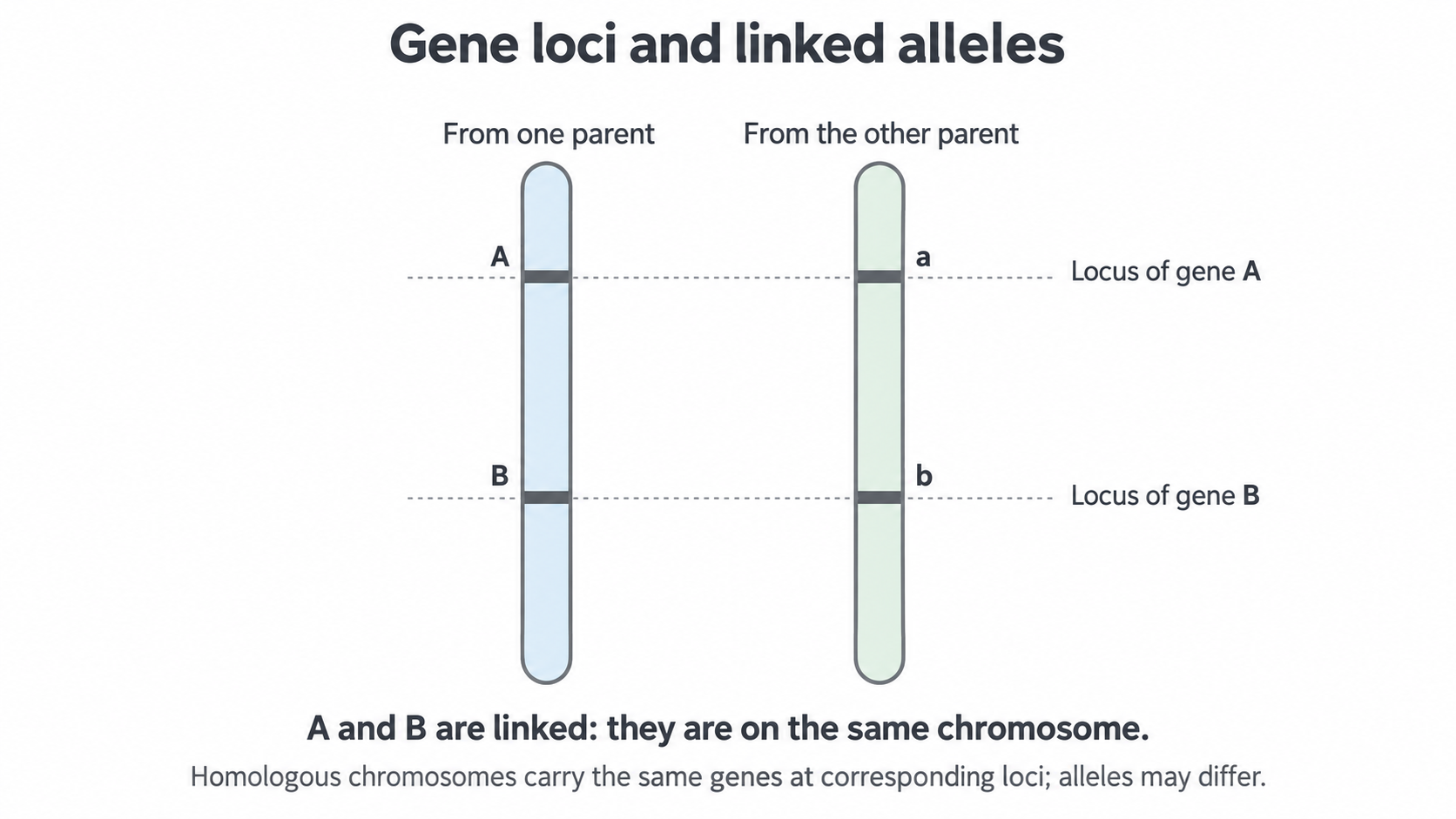
The two rods are homologous chromosomes, each represented before DNA replication. Corresponding positions contain the same genes, although the allele versions differ. The diagram is schematic and has no distance scale.
Do not confuse homologues with sister chromatids. Sister chromatids are the two copies made when one chromosome's DNA replicates. The two homologues in this diagram came from different parents; they are not copies made from each other. A chromosome does not have to be drawn as an X to be a chromosome.
Linked genes travel together
Genes on the same chromosome can be passed into a gamete together because they are carried on the same piece of DNA.
Linkage
Linked genes are genes on the same chromosome. Their alleles tend to be inherited together; the closer the loci, the more likely the original allele combination is to remain together.
In the diagram, one chromosome carries A with B, while its homologue carries a with b. Write this arrangement as AB / ab, with the slash separating the homologues. AaBb alone gives the individual's alleles but does not reveal their arrangement: AB / ab and Ab / aB both contain A, a, B and b. The arrangement matters when predicting combinations in gametes.
Consider a deliberately simplified case in which there is no crossing over between these two loci, the homologues separate equally, and all gamete types survive equally well. An AB / ab individual then produces AB and ab gametes, each with probability 1/2. It does not produce Ab or aB gametes under that stated assumption. For an Ab / aB individual under the same assumption, the possible gametes would instead be Ab and aB. Each gamete still receives one allele of each gene; linkage concerns which alleles arrive together.
For genes on different chromosome pairs, the orientation and separation of one pair need not determine the other pair's orientation. This is independent assortment. It can create four equally likely allele combinations from a double heterozygote under the usual equal-segregation assumptions. Applying that four-equal-combination prediction automatically to genes on the same chromosome would ignore linkage. We are following allele combinations, rather than introducing a full two-gene offspring cross.
Linkage does not mean that alleles can never be separated. During meiosis, crossing over can exchange corresponding DNA segments between non-sister chromatids of homologous chromosomes. An exchange between the two loci can produce new combinations, such as Ab and aB from an original AB / ab arrangement. These are recombinant combinations. An exchange outside the interval between the loci need not separate A from B. Closely spaced loci have fewer opportunities for an exchange between them, so their original combinations are more likely to stay together. Widely separated loci can behave approximately as if unlinked. The next lesson develops meiosis and variation; detailed stage names and chromosome-map calculations are not needed here.
Chromosome location affects whether two allele transmissions can be treated as independent. “Linked” means a tendency to travel together, not a guarantee that crossing over never separates them.
An observed mixture of original and recombinant combinations therefore need not contradict linkage. The biological question is whether the combinations behave as independently inherited genes would, using an appropriate model and sufficient evidence.
Sex chromosomes and allele notation
Sex linkage is inheritance associated with a gene's location on a sex chromosome.
In the simplified human chromosome model used for these crosses, females are XX and males are XY. An egg contributes an X; a sperm contributes X or Y. A daughter receives her father's X, whereas a son receives his father's Y. The model assumes ordinary XX/XY inheritance; the predictions are conditional on this model rather than an account of every human chromosome variation.
Sex-linked genes are on the sex chromosomes; autosomal genes are on the other chromosomes. Most classroom examples are X-linked. Although X and Y share small homologous regions, many X-linked genes lie in regions for which Y has no corresponding gene locus. We follow such a gene here. An XY individual has only one allele at that locus, described as hemizygous. It would be incorrect to call that individual homozygous recessive: there is no second allele at this locus on Y.
Use a hypothetical X-linked trait, with carrying allele N and carrying allele n. Superscripts label the alleles; X names the chromosome carrying them. Y has no N or n superscript because it lacks this locus. In this example N is completely dominant to n for the specified trait.
| Genotype | Phenotype in this model |
|---|---|
| Female without the trait, with two N alleles | |
| Female without the trait, a heterozygous carrier of n | |
| Female with the trait | |
| Male without the trait | |
| Male with the trait |
One n allele is enough for the trait in an XY individual because there is no N allele at the corresponding Y position to mask its phenotype. This explains why an X-linked recessive phenotype can be more frequent in males. Females can have the phenotype too, if they have the required genotype. “Recessive” describes the allele relationship in the heterozygote; it does not mean the allele cannot affect a hemizygote.
Haemophilia A and B are real examples with X-linked inheritance. Our hypothetical fully penetrant trait keeps the deduction explicit: assume that every listed genotype has exactly the phenotype shown, there are no new mutations, and pedigree relationships are accurate. In real X-linked conditions, heterozygous females can have variable symptoms, partly because X-chromosome inactivation changes which allele is active in different cells. A simple classroom table is therefore a model, not a universal clinical prediction. MedlinePlus Genetics distinguishes these inheritance patterns and their limits.
Continue this lesson.
You’re previewing NovaLearn without an account. Create a free account to read the rest.
Create free account