6.6 - Tuberculosis and HIV infection
Tuberculosis and HIV infection can both begin without obvious symptoms, yet their effects on human cells are very different. Following each pathogen from entry into a cell to changes in tissues and immune function explains how serious illness can develop, and why progression is not inevitable.
TB survives inside macrophages
Mycobacterium tuberculosis is a bacterium that can survive inside cells which normally destroy invading microorganisms.
Tuberculosis (TB) is the disease caused by this bacterium. Infection often begins when airborne particles containing the bacteria are inhaled and reach the alveoli, the small air sacs of the lungs. A person with infectious TB in the lungs or airways can release these particles into the air. Exposure does not always result in infection.
Macrophage
A large immune cell that can engulf microorganisms and cell debris by phagocytosis.
An alveolar macrophage surrounds a bacterium with its cell-surface membrane and encloses it in a membrane-bound vesicle called a phagosome. Normally, the phagosome matures and fuses with lysosomes, which contain digestive enzymes. The resulting compartment helps kill and digest the engulfed microorganism.
M. tuberculosis can interfere with this maturation, reducing phagosome–lysosome fusion and its exposure to destructive conditions. Its lipid-rich cell envelope also helps it resist host defences. Some bacteria therefore survive and reproduce by binary fission inside the macrophage. This is not a claim that every engulfed bacterium survives: many are destroyed or inhibited. If an infected macrophage dies, surviving bacteria can be released and infect further cells.
The immune response recruits more macrophages and other immune cells around infected cells. They can form a granuloma, an organised collection of immune cells, sometimes called a tubercle in TB. This can limit bacterial spread, but it does not necessarily eliminate every bacterium.
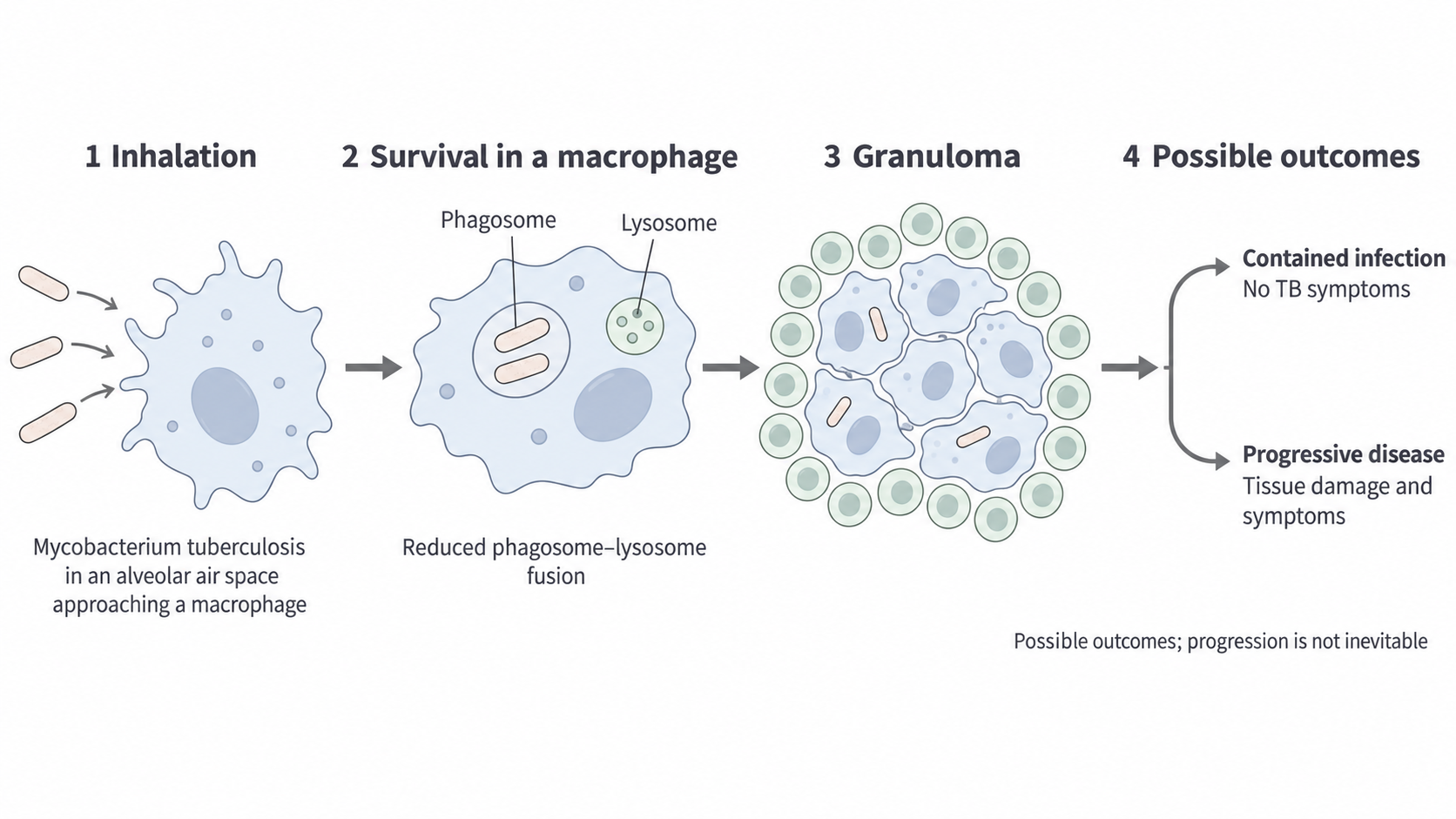
Schematic of TB infection. The phagosome contains whole bacterial cells; the separate lysosome shows the fusion step that M. tuberculosis can inhibit. A granuloma can contain infection, but its formation does not guarantee either clearance or permanent containment.
TB containment and lung damage
The outcome of TB infection depends partly on whether immune defences keep the bacteria under control.
Latent TB infection
TB infection in which bacteria remain in the body without causing the symptoms of TB disease. A person with latent TB infection does not transmit TB bacteria to others.
In contained infection, bacteria can persist for years while immune activity limits their growth. Many people with TB infection never develop TB disease. However, active disease can develop soon after infection or follow later reactivation, when previously contained infection becomes progressive. Weakened immune function increases this risk; it is not a necessary stage that every infected person passes through.
In progressive lung TB, bacterial multiplication and the inflammatory immune response damage tissue. In some lesions, cells die, producing a soft, dead centre called caseous necrosis. If this material breaks down and drains into an airway, a cavity can form. Bacteria then have access to airways, helping explain both coughing and the release of infectious particles. Not every case produces cavities or every listed symptom.
| Change during lung disease | Possible consequence |
|---|---|
| Inflammation and tissue damage in the lungs and airways | A persistent cough and chest pain |
| Damage involving small blood vessels | Blood in coughed-up sputum |
| Loss of functioning gas-exchange tissue, with inflammation or scarring | Reduced oxygen transfer, contributing to breathlessness and fatigue |
| A prolonged systemic response to infection | Fever, night sweats, reduced appetite and weight loss |
The symptoms arise from infection and the body's response together; they are not explained simply by bacteria “eating the lungs”. Severe lung damage can compromise gas exchange. Bacteria may also spread through lymph or blood to other sites, such as the brain or kidneys, where the symptoms depend on the organ affected. Extensive disease can be fatal, particularly without effective treatment.
TB is treatable and often curable with an appropriate combination of antibiotics. Treatment can also reduce the risk that latent infection progresses. These possibilities are why the biological sequence ends in a possible serious outcome rather than a prediction of death for every person infected.
HIV replicates in helper T cells
Human Immunodeficiency Virus, or HIV, is an enveloped RNA virus that uses human cells to make new virus particles.
Its important targets include CD4 helper T lymphocytes, usually shortened to helper T cells. These immune cells help coordinate responses by stimulating cells such as B lymphocytes, cytotoxic T cells and macrophages. They are not the cells that secrete antibodies; antibody secretion is carried out by plasma cells derived from B lymphocytes. HIV can also infect some other immune cells, including macrophages, but helper T cell loss is central to the weakening of immunity.
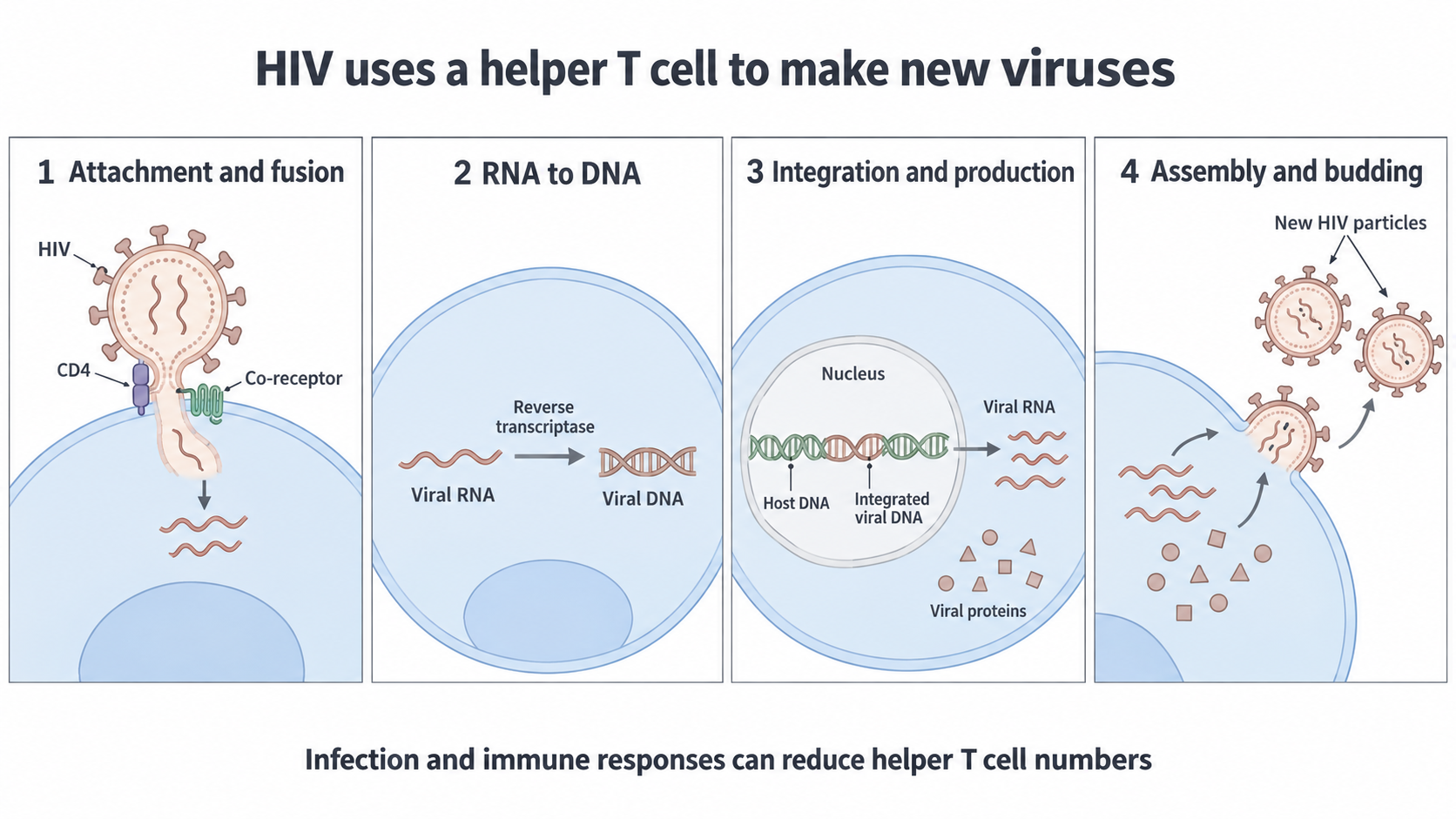
HIV's envelope attachment proteins bind to the CD4 receptor and a suitable co-receptor on the target cell's surface. A co-receptor is an additional binding site needed for entry; CCR5 and CXCR4 are examples. Receptor compatibility helps explain why HIV does not infect all human cell types equally. The viral envelope fuses with the cell-surface membrane, allowing the viral contents to enter.
HIV is a retrovirus: its enzyme reverse transcriptase makes a DNA copy from viral RNA. The viral DNA enters the nucleus, where another viral enzyme, integrase, inserts it into the host cell's DNA. It is DNA, not the original viral RNA, that becomes integrated.
The integrated viral sequence can be transcribed to produce viral RNA. Some RNA provides genomes for new particles; other RNA is translated by host ribosomes to produce viral proteins. Viral RNA and proteins assemble at the cell surface. New particles bud out through the cell-surface membrane, acquiring an envelope. Viral protease processes viral proteins during maturation, making newly produced particles infectious. The cycle can then begin in further susceptible cells.
Continue this lesson.
You’re previewing NovaLearn without an account. Create a free account to read the rest.
Create free account