3.6, 3.7 - Gametes and mammalian fertilisation
A sperm must reach an egg, cross its protective coat and deliver genetic material without allowing several sperm to fertilise the same egg. In 3.6, you will connect the specialised structures of mammalian gametes to these jobs. In 3.7, you will follow the acrosome reaction, cortical reaction and union of the parental nuclear material to form a zygote.
A sperm delivers a haploid genome
A sperm is a small, motile cell specialised to deliver a paternal set of chromosomes to an egg.
Gamete
A reproductive cell with one set of chromosomes, described as haploid, that can contribute its genetic material at fertilisation.
A haploid cell has one set of chromosomes, represented by n. In humans, a normal sperm carries 23 chromosomes. A diploid cell has two sets, represented by 2n. The egg supplies the other haploid set, so fertilisation restores the diploid chromosome complement rather than doubling it in every generation. How meiosis makes genetically different gametes is developed in 3.9.
The sperm's structures work together:
| Structure | Link to function |
|---|---|
| Compact nucleus in the head | Carries the haploid paternal genome in a small volume. |
| Acrosome, a membrane-bound cap over the front of the head | Contains enzymes released during the acrosome reaction, helping the sperm pass through the egg's surrounding layers. |
| Long flagellum | Bends to propel the sperm through fluid; it is not a device for injecting the nucleus. |
| Many mitochondria in the midpiece | Produce ATP through aerobic respiration; ATP supports the movement machinery of the flagellum. |
| Small amount of cytoplasm and a compact shape | Keep the cell specialised for movement and delivery rather than for supplying the embryo with a large cytoplasmic store. |
ATP is also produced by glycolysis in sperm. The relative contributions depend on species and conditions, so “mitochondria provide ATP” does not mean that all sperm ATP comes from mitochondria. ATP hydrolysis supplies usable energy to the movement machinery; mitochondria do not push the cell themselves.
The plasma membrane surrounds the sperm. Proteins at its surface participate in interactions with the egg's surroundings and, later, with the egg membrane. Successful fertilisation therefore requires more than a sperm with a moving tail: its head must also undergo the right changes and interact with the egg.
An egg supplies cytoplasm and a protective coat
An egg is specialised to receive a sperm and provide the cytoplasm in which early development begins.
The mammalian cell released at ovulation is more precisely a secondary oocyte, paused before completing meiosis. It is commonly called the egg. It has a haploid chromosome set, although its chromosomes still have sister chromatids at this stage. Fertilisation normally triggers completion of this meiotic division. Detailed meiotic stages are not needed here.
The egg has a much larger volume of cytoplasm than a sperm. Its cytoplasm contains organelles, stored RNA and proteins that support the first stages of development. Mammalian eggs contain relatively little yolk compared with bird eggs: do not imagine that the egg contains all the food needed for the whole pregnancy. The egg itself has no flagellum and is moved along the oviduct by the reproductive tract.
Just inside the egg's plasma membrane are cortical granules, membrane-bound secretory vesicles. Their contents can be released rapidly after sperm–egg fusion. Outside the plasma membrane lies the zona pellucida: an extracellular glycoprotein coat, distinct from the cell membrane. A glycoprotein is a protein with carbohydrate groups attached.
The zona pellucida protects the egg and early embryo and participates in sperm binding. After fertilisation, changes to this coat help prevent further sperm from binding and penetrating. Surrounding follicle cells, often called cumulus cells, are outside the zona and are omitted from the schematic.
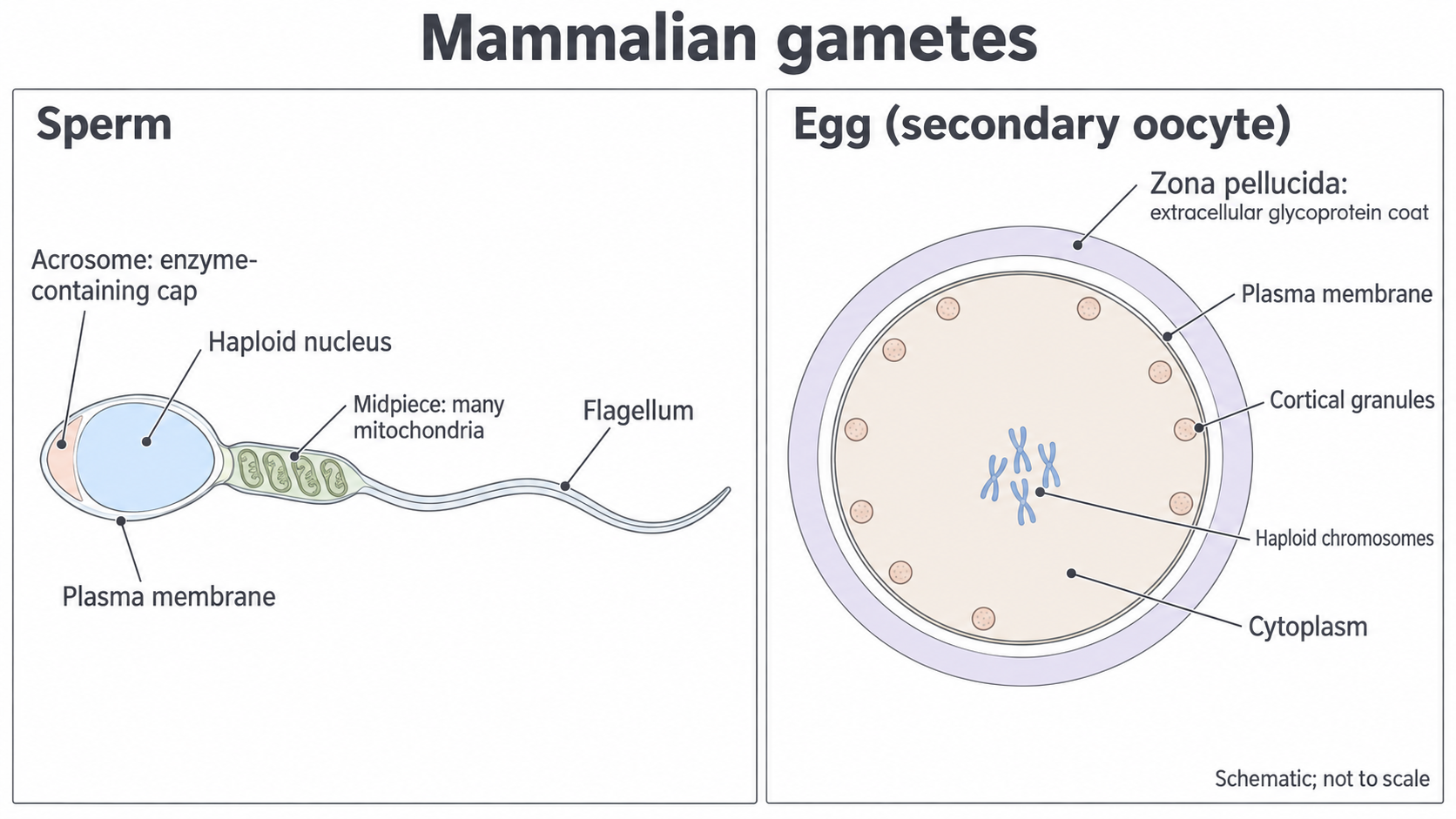
The zona pellucida is outside the egg's plasma membrane, whereas cortical granules are inside it. The chromosome symbols indicate a haploid set, not a measured chromosome number; the two gametes are not drawn to the same scale.
To recognise a structure, use its location as well as its name. The acrosome is a cap on the sperm head; the zona pellucida is a coat around the egg; cortical granules are vesicles in the egg's outer cytoplasm. They cannot be interchanged. Both gametes contribute a haploid genome, but they make very unequal cytoplasmic contributions: the sperm is specialised for delivery and the egg for receiving and supporting early development.
The acrosome reaction enables zona penetration
Natural mammalian fertilisation usually occurs in the oviduct, where sperm must pass the egg's surrounding layers before reaching its plasma membrane.
During passage through the female reproductive tract, sperm undergo physiological changes called capacitation, which prepare them for fertilisation. This is different from the acrosome reaction itself. Sperm encounter the cumulus cells, interact with the zona pellucida and penetrate the zona to reach the space between the zona and the egg membrane.
In the acrosome reaction, the sperm's plasma membrane and outer acrosomal membrane fuse at sites over the head. Acrosomal contents are released and the sperm head surface changes. Enzymes help break down material in the surrounding layers, while flagellar movement supplies mechanical force for penetration. The sperm passes through a local route in the zona; it does not dissolve the entire coat. The egg's plasma membrane remains a separate barrier that will be crossed by membrane fusion, not by acrosomal enzymes digesting the egg open.
The familiar simplified sequence places the acrosome reaction at contact with the zona. Its timing varies: live tracking in mice showed that many sperm which actually fertilised eggs began the reaction before reaching the zona. The secure mechanistic link is that the acrosome reaction prepares the sperm for penetration and later fusion, not that zona contact is always its only trigger. Enzymes and mechanical movement contribute together; do not treat one named enzyme as the only universal means of penetration in all mammals.
Once a sperm has crossed the zona, proteins on the sperm and egg surfaces allow the cells to interact and their plasma membranes to fuse. The sperm's genetic material can then enter the egg cytoplasm. Crossing the zona and fusing with the egg membrane are two different events.
Continue this lesson.
You’re previewing NovaLearn without an account. Create a free account to read the rest.
Create free account