2.10 - Enzymes and activation energy
Cells need chemical reactions to happen fast enough to sustain life at ordinary biological temperatures. Learn how an enzyme's three-dimensional structure selects its substrates, how it lowers the energy barrier to reaction, and why some enzymes work inside cells while others act outside them.
Active sites and substrate specificity
An enzyme's folded structure brings particular amino acid side chains together to form a small region where a reaction can take place.
Enzyme
A biological catalyst: it increases the rate of a chemical reaction without being used up by that reaction.
The protein enzymes considered here have specific three-dimensional structures, usually characteristic of globular proteins. Their folding depends on their amino acid sequence and the interactions that hold that fold together. Only a small part of the enzyme directly binds the reacting molecule; the rest of the structure helps maintain the right arrangement.
The substrate is a reactant on which the enzyme acts. The active site is the region of the enzyme where the substrate binds and the reaction is catalysed. Its shape and chemical properties matter: appropriately positioned groups can form temporary interactions with a compatible substrate. Two molecules of similar size need not bind equally well if their shapes or chemical groups differ.
When the substrate binds, it forms an enzyme–substrate complex. The enzyme catalyses the conversion of bound substrate into product. The products leave, freeing the active site for another substrate molecule. The enzyme may change shape temporarily during this cycle, but it is regenerated rather than consumed as a reactant.
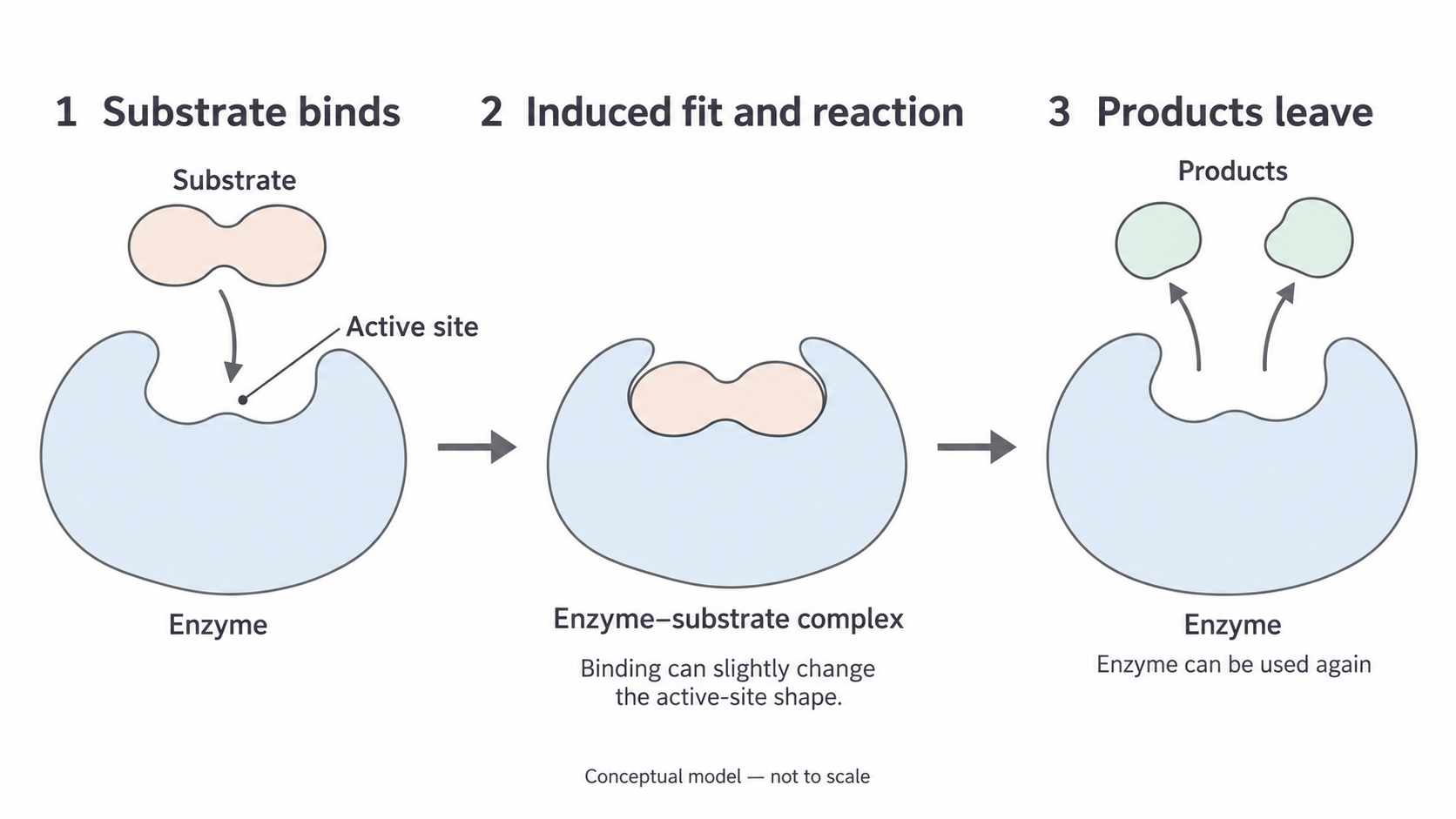
A simplified breakdown reaction: one connected substrate binds, the active site changes slightly, and two products leave. The drawing is a conceptual model, not a measured molecular structure.
Specificity means that an enzyme catalyses a particular reaction on a compatible substrate or a limited range of related substrates. For example, amylase catalyses the hydrolysis of particular glycosidic bonds in starch; it does not catalyse the hydrolysis of peptide bonds in a protein. Substrate recognition and the arrangement of catalytic groups together explain this difference. A molecule merely touching an enzyme is not enough for catalysis.
The lock-and-key model represents a substrate fitting a complementary active site. It is a useful first model of specificity, but it should not be taken to mean that every enzyme is a rigid shape. In induced fit, substrate binding changes the enzyme's conformation, bringing the active site into a more effective arrangement for reaction. Enzymes are flexible molecules; induced fit is one important model of their behaviour, rather than a claim that all binding mechanisms are identical.
Suppose a substitution in an enzyme's amino acid sequence changes the arrangement of its active-site groups. A previously suitable substrate may then bind less effectively, or the groups needed for catalysis may no longer be positioned correctly. The reaction can slow. A substitution elsewhere need not have this effect if folding and active-site function are preserved: the location and consequence of a change matter.
Lowering the energy barrier
A reaction may release energy overall and still proceed very slowly because its reactants must first pass through a less stable, higher-energy arrangement.
Activation energy
The energy barrier that reactants must overcome for a chemical reaction to occur.
The highest-energy arrangement along a simplified reaction pathway is called the transition state. Reaching it involves rearranging bonds and interactions before stable products form. If few reacting molecules have sufficient energy to overcome the barrier, successful reactions are infrequent. The energy released overall is a different quantity from the energy needed to reach this state.
An enzyme provides a reaction pathway with a lower activation energy. Interactions at its active site can position reacting groups suitably, strain particular substrate bonds, and stabilise the transition state. The details differ among enzymes, but the shared outcome is a smaller barrier to reaction. Binding and catalysis are connected: the substrate must be held in an arrangement that supports the particular chemical change, rather than simply being trapped in a pocket.
At the same temperature, a greater proportion of reacting molecules can overcome the lower barrier. More successful reactions occur per unit time, so the rate rises. The enzyme does not need to heat the mixture or supply extra kinetic energy to its molecules. This is why enzyme-catalysed reactions can proceed rapidly under conditions suitable for living cells.
The enzyme does not change the energy of the starting reactants or final products. It therefore does not change the overall energy difference between them. If a reversible reaction reaches equilibrium, its forward and reverse rates are equal and there is no net change in reactant and product amounts. A catalyst speeds both directions and helps the system approach equilibrium sooner; it does not change the equilibrium position under the same conditions. A faster appearance of product early in a reaction does not, by itself, show that there will be more product at equilibrium.
An enzyme changes the route and rate of a reaction. It lowers the activation-energy barrier while leaving the overall reaction energy change and equilibrium position unchanged.
These distinctions prevent a misleading explanation such as “the enzyme gives the reaction energy”. The reacting molecules still provide the energy needed to reach the transition state; the enzyme makes that requirement smaller.
Reading activation-energy profiles
An energy profile turns the idea of a barrier into a graph that can be read and compared numerically.
The vertical axis shows relative energy, here in kilojoules per mole. The horizontal axis shows reaction progress from reactants to products; it is not time. A steeper curve on this graph does not mean a faster reaction. Rate is inferred from the barrier height when comparing suitable pathways under the same conditions.
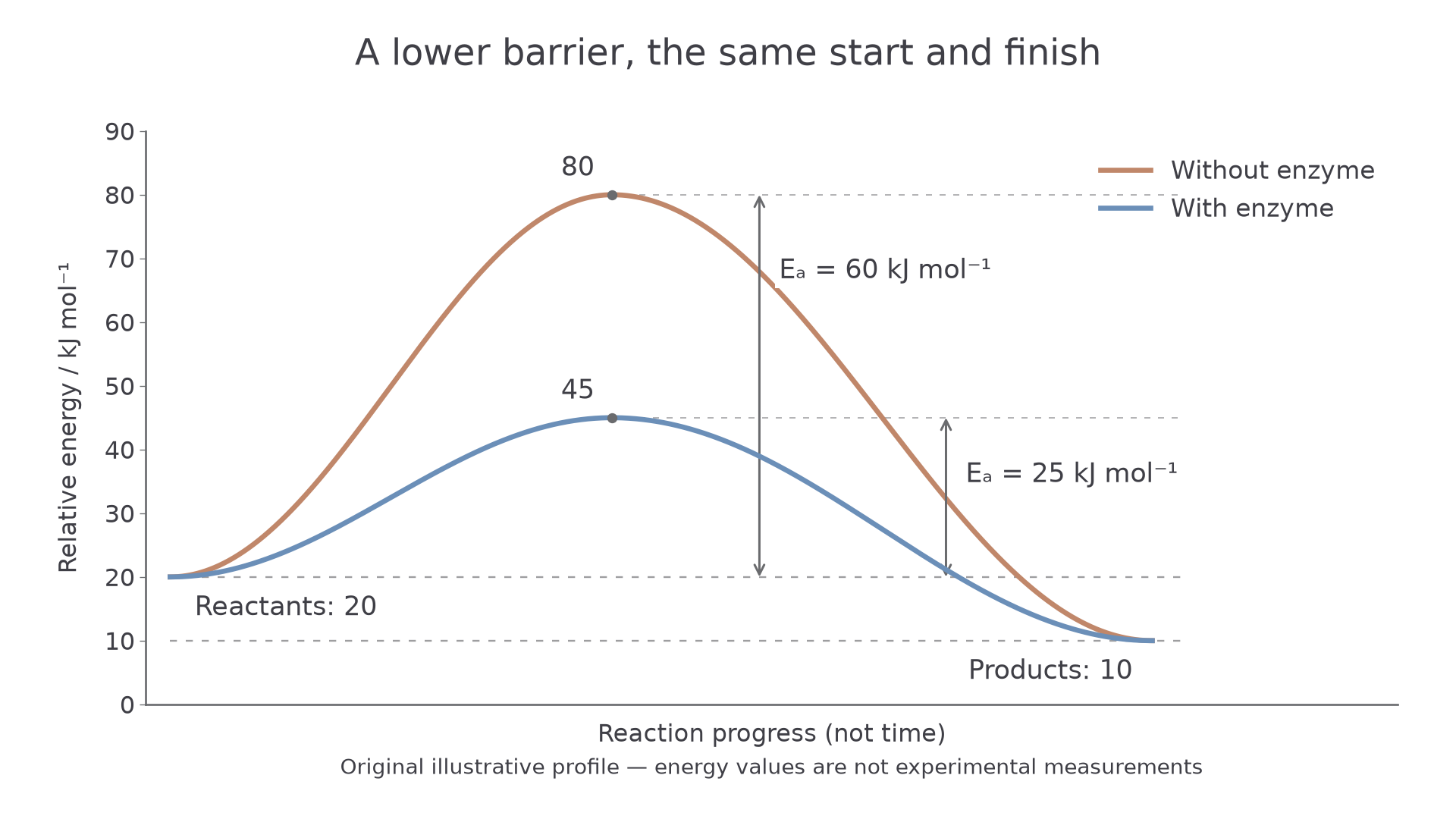
Original illustrative values, not experimental measurements. Both pathways begin and end at the same energy levels; only the peak height changes.
Read the starting level, peak and finishing level separately. Activation energy is the rise from the reactant level to the peak, not the peak's value above the graph's zero. The overall energy change is the finishing level minus the starting level.
For the forward reaction in a simplified energy profile:
All three energy readings must use the same scale and units. here denotes the overall energy difference shown by this illustrative profile.
In the graph, the reactants are at . The uncatalysed peak is at , so its activation energy is . The enzyme-catalysed peak is at , giving . The enzyme reduces the forward barrier by .
The products finish at , so the overall energy change is for both pathways. The negative sign means the products are lower in energy than the reactants in this model. The enzyme has not increased this energy release. Changing the arbitrary zero of the vertical scale would change each level's number but not these differences.
If the reaction is considered in reverse, the starting level is the product level, 10. The barriers become and . The same lowered peak reduces the reverse barrier too. Real enzyme pathways can involve several intermediate steps; this single-peak diagram isolates the principle that is being compared.
Enzymes inside and outside cells
Enzymes are made by cells, but the location where they catalyse a reaction determines whether they are described as intracellular or extracellular.
An intracellular enzyme catalyses reactions inside a cell. It may act in the cytoplasm or in an organelle. Such enzymes support the cell's own metabolism, including pathways that release energy, build molecules and remove harmful substances. Each reaction requires an appropriate enzyme; a cell does not contain one universal catalyst for every chemical change.
For example, catalase breaks down hydrogen peroxide into water and oxygen. Hydrogen peroxide can damage cell components if it accumulates. Catalase acting within cells therefore helps protect them. In many eukaryotic cells it is associated with organelles called peroxisomes; knowing that it acts within the cell is the essential location distinction here.
An extracellular enzyme is produced by a cell and released to catalyse reactions outside the cell. For example, salivary-gland cells produce amylase and secrete it into saliva. It acts on starch in the mouth, breaking some of its glycosidic bonds to form smaller carbohydrate molecules. The reaction occurs in the mouth's contents, outside the cells that made the enzyme, even though the mouth is within the organism.
Extracellular digestion is useful because large food molecules cannot generally pass intact across cell membranes. Enzymes act on them outside cells, producing smaller molecules that can be processed further and absorbed. Starch digestion is completed by other enzymes to give absorbable monosaccharides; amylase alone should not be described as converting all starch directly into glucose. Fungi also release digestive enzymes into their surroundings and absorb products of this external digestion.
| Feature | Intracellular enzyme | Extracellular enzyme |
|---|---|---|
| Where it is produced | In cells | In cells |
| Where it catalyses its reaction | Inside cells | Outside cells after release |
| Example and role | Catalase inside a cell removes hydrogen peroxide | Amylase in saliva begins starch digestion |
The classification concerns the site of action, not a different catalytic mechanism. Both types have specific active sites, form enzyme–substrate complexes and lower activation energy. An extracellular enzyme does not lose its specificity simply because it has left its producing cell. Conversely, being produced inside a cell does not make a secreted enzyme's later digestive action intracellular.