5.13 - Greenhouse gases and human climate change
Human activities can change climate by altering how energy leaves Earth. This lesson explains how carbon dioxide and methane strengthen the natural greenhouse effect, where the additional gases come from, and why several kinds of evidence support a human cause of modern global warming.
Radiation and the natural greenhouse effect
Earth receives energy from the Sun and loses energy by emitting radiation into space.
Incoming solar radiation is mainly shortwave radiation, including visible light and near-infrared radiation. Some is reflected by clouds, the atmosphere and the surface; some is absorbed. Absorption warms the surface. Because Earth is much cooler than the Sun, the radiation it emits is mainly longwave infrared radiation. This is newly emitted radiation, rather than sunlight simply reflected from the ground. These different wavelength ranges explain why radiation can enter and leave the atmosphere differently. NASA radiation budget
Greenhouse gas
An atmospheric gas that absorbs and emits infrared radiation at particular wavelengths. Carbon dioxide and methane are greenhouse gases.
Much incoming sunlight passes through the atmosphere. Greenhouse gases absorb some of the infrared emitted by the surface. Energy is also exchanged between gas molecules by collisions, and the atmosphere emits infrared in all directions. Some travels towards the surface and is absorbed there; some travels upwards and eventually escapes to space. Some surface infrared also escapes directly through wavelength ranges that the atmosphere absorbs less strongly.
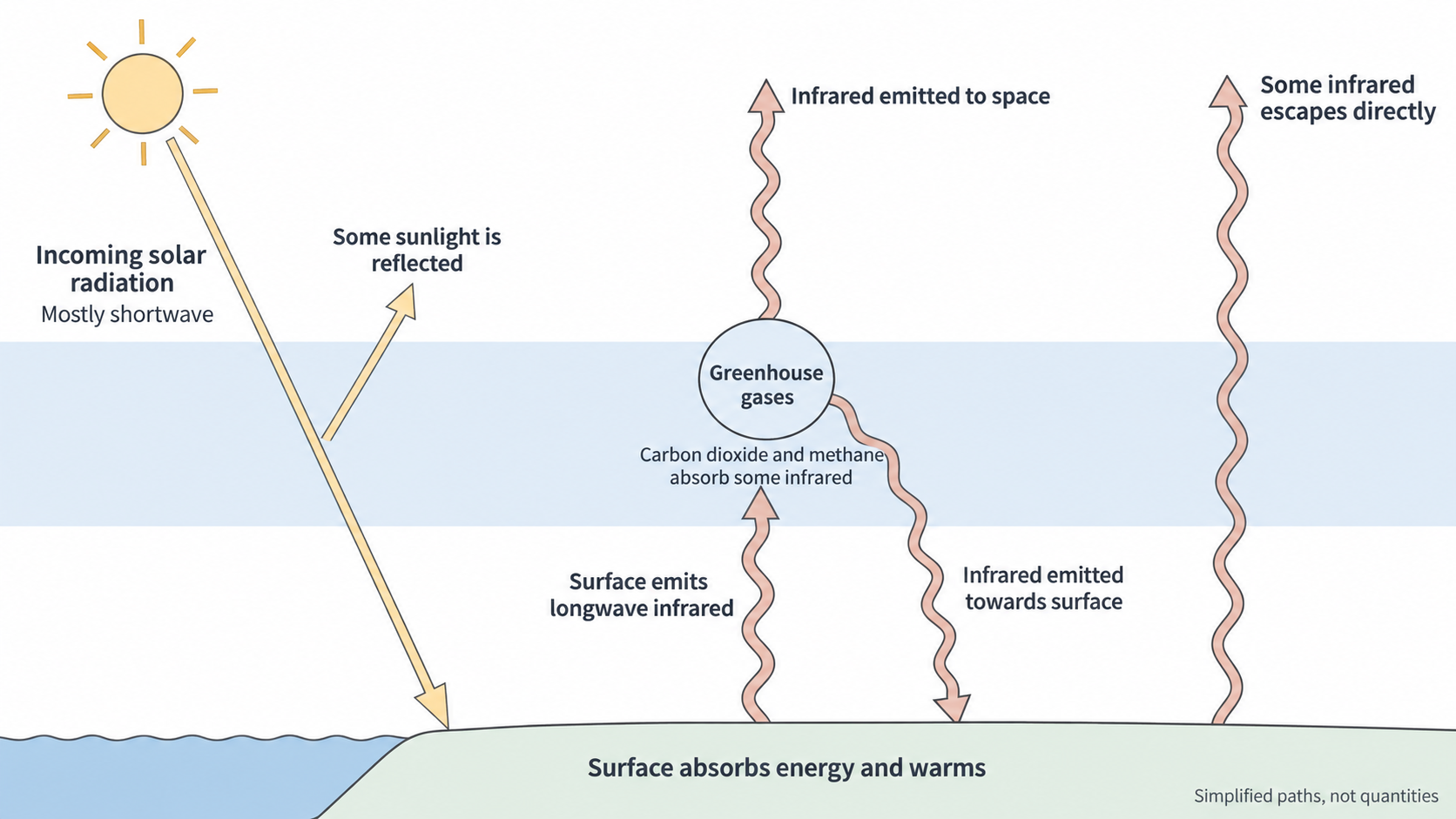
Figure 1. Simplified radiation paths in the natural greenhouse effect. The circle represents the action of many greenhouse-gas molecules, not one giant molecule or a solid layer. Arrow widths and spacing do not represent measured quantities or wavelengths.
This absorption and emission keeps the surface and lower atmosphere warmer than they would otherwise be. It is the natural greenhouse effect, and occurs without human emissions. Water vapour also contributes. Greenhouse gases do not form a reflective lid: energy continues to leave Earth. The name “greenhouse effect” describes atmospheric radiation; an ordinary glass greenhouse also works by restricting air movement. NASA energy budget
Enhancement and energy balance
Increasing greenhouse-gas concentrations changes the balance between energy absorbed by Earth and infrared energy escaping to space.
For a stable average temperature, the Earth system must, over time, emit as much infrared energy to space as it absorbs from sunlight. Reflected sunlight is excluded from the absorbed amount. This balance is radiative equilibrium; it concerns the whole Earth system, rather than requiring each place or each moment to be in balance.
Adding carbon dioxide or methane increases the atmosphere's absorption of outgoing infrared in their absorption bands. At the initial temperature, less infrared energy escapes to space. If absorbed sunlight has not changed, energy enters the system faster than it leaves: there is an energy imbalance. The surface, atmosphere and oceans gain energy, and temperatures rise. This strengthening is the enhanced greenhouse effect. It does not require the Sun to emit more energy. NASA radiation budget
As the system warms, its emission of infrared increases. If greenhouse-gas concentrations and other conditions become stable, it can approach a new radiative equilibrium, with outgoing infrared again balancing absorbed sunlight, but with a warmer surface. Added greenhouse gases therefore do not create energy or keep it trapped forever. They alter the conditions under which energy escapes. Oceans store considerable energy, so the temperature response takes time. NASA energy budget
Natural greenhouse gases help keep Earth warm. Human additions enhance that effect: reduced energy loss at the initial temperature causes warming towards a different balance.
This sequence separates the cause of the imbalance from the temperature response.
Human carbon dioxide and methane sources
People enhance the greenhouse effect by adding gases to the atmosphere and changing the processes that remove them.
Anthropogenic climate change
Climate change caused by human activities, including the warming produced by human increases in greenhouse-gas concentrations.
Carbon dioxide is released when coal, oil and natural gas are burned. Combustion combines fuel carbon with oxygen, transferring carbon from long-term geological stores to the atmosphere. Electricity generation, heating, transport and industry can therefore be sources. Cement manufacture also releases carbon dioxide when carbonate rock is heated. NOAA carbon cycle, NOAA ozone and climate assessment
Continue this lesson.
You’re previewing NovaLearn without an account. Create a free account to read the rest.
Create free account