2.9(i), 2.9(ii) - Amino acids and peptide bonds
Proteins are built from amino acids, but making a chain requires a particular chemical link. In 2.9(i), you will learn the general amino acid structure; in 2.9(ii), you will follow the condensation reactions that join these building blocks into polypeptides. Tracking the links and water molecules also helps you understand how a chain can be broken down again.
The amino acid building block
An amino acid has a common backbone and a variable side group, so different amino acids can share the same way of joining a chain.
Amino acid
A small organic molecule that can act as a building block for protein chains. In the general structure, a central carbon is bonded to an amino group, a carboxyl group, a hydrogen atom and an R group.
A monomer is a small building block that can join others to form a larger molecule. In the general amino acid structure, the central carbon has four single bonds, one to each of the following:
- The amino group, , which contains nitrogen.
- The carboxyl group, . Its carbon is double bonded to one oxygen and single bonded to an group.
- A hydrogen atom.
- The R group, the variable side chain. R stands for the side group; it is not the symbol for an element.
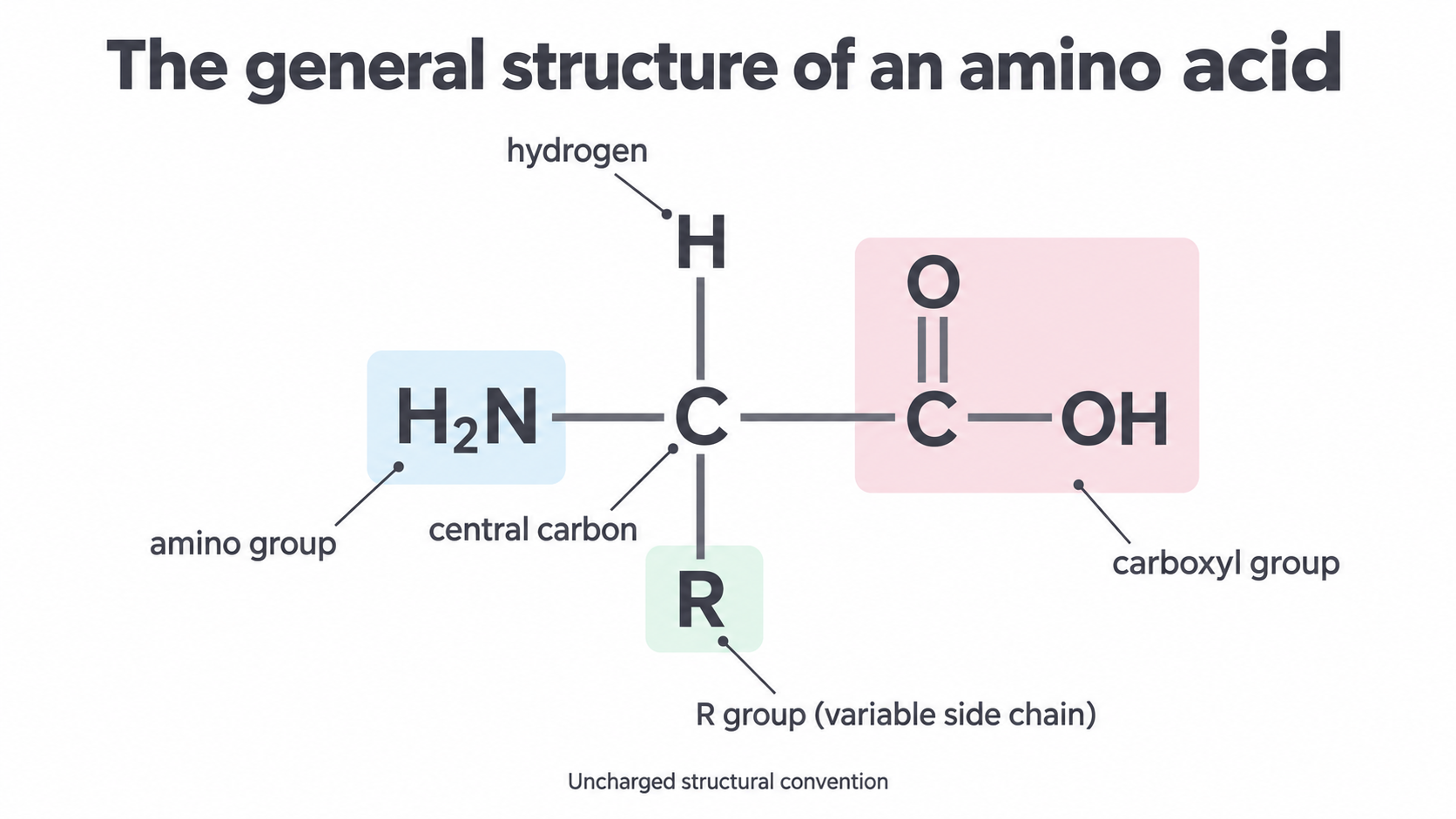
The central carbon carries an amino group, a carboxyl group, a hydrogen and a variable R group; the carboxyl carbon is a different carbon atom.
The compact formula expresses the same connectivity. The portion means that the central carbon carries both H and R. Turning the diagram around does not change which atoms are connected.
The amino acid diagrams here use the conventional uncharged formula to make the bonding clear. In water near neutral pH, the amino and carboxyl groups normally occur in charged forms. That does not change which groups form the backbone. You do not need to memorise the structures of individual amino acid side chains for this specification point.
Joining amino acids by condensation
The carboxyl group of one amino acid can link to the amino group of another, leaving their R groups attached to their own central carbons.
Peptide bond
A covalent link between the carboxyl-group carbon of one amino acid unit and the nitrogen of the next. In the chain, the link lies within the group .
The carbonyl carbon is the carbon double bonded to oxygen in the carboxyl group. The new peptide bond is its single C–N bond to the nitrogen of the other amino acid. It is neither the C=O bond nor a link between two R groups.
In the simplified overall condensation reaction, two amino acids join and one water molecule is produced. The elements of water come from the of one carboxyl group and an H from the other amino group. The carbonyl oxygen remains in the molecule, and the reacting nitrogen retains an H. Thus atoms are rearranged and conserved; an entire amino group or carboxyl group is not discarded.
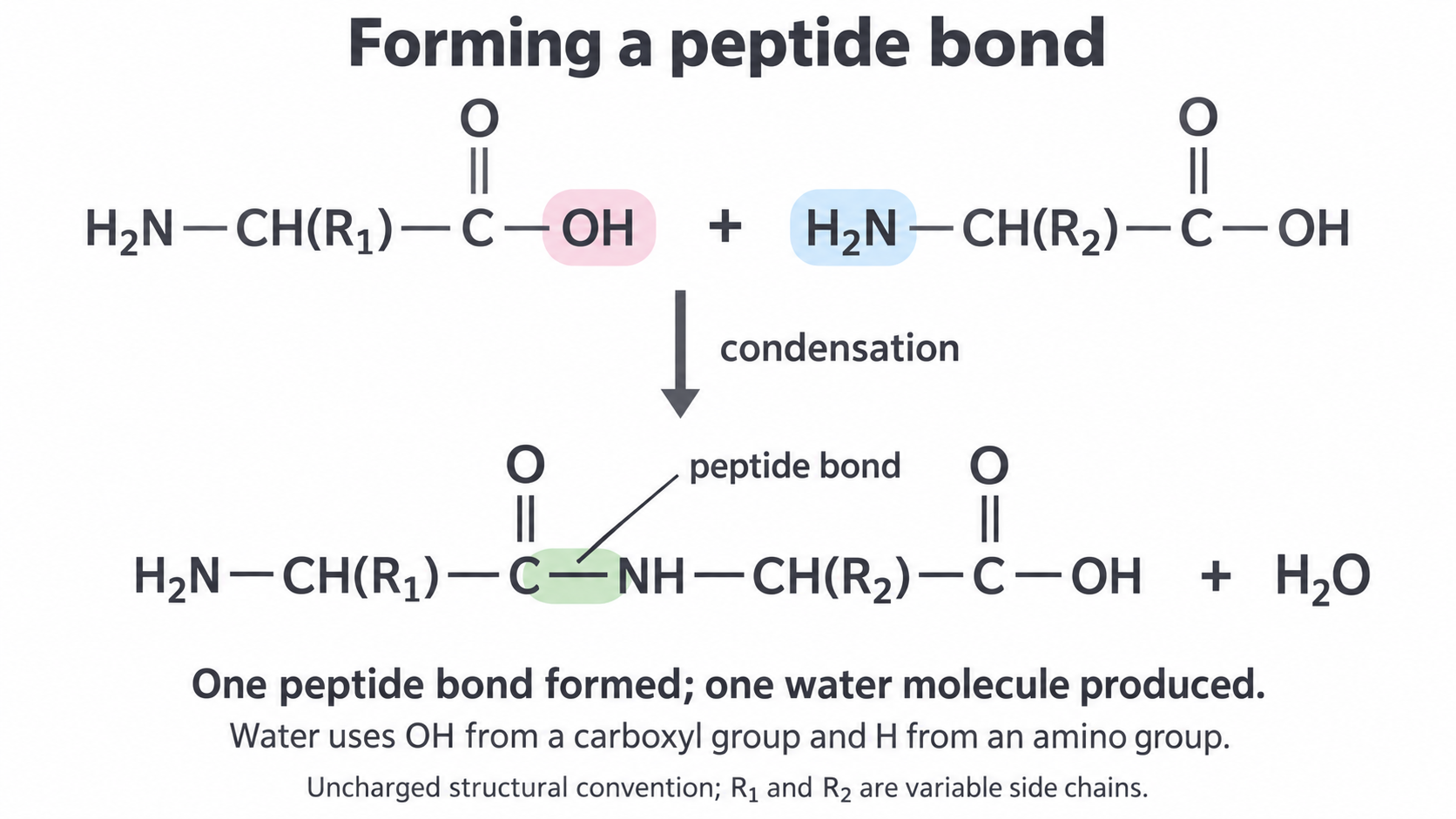
One condensation links the carboxyl carbon of one amino acid to the nitrogen of another, producing a dipeptide and one water molecule.
The product of joining two amino acids is a dipeptide: it contains two amino acid units and one peptide bond. A joined unit is called an amino acid residue, because it is what remains of an amino acid after the condensation. The dipeptide still has an amino end and a carboxyl end, so further amino acids can be linked. Adding a third residue gives a tripeptide with two peptide bonds. Repeated linking produces a polypeptide, a chain of many residues joined by peptide bonds.
A protein contains one or more polypeptide chains organised into a functional structure. Making the covalent chain supplies its backbone; the way that chain folds is the next step, explored in the following lesson. There is no useful universal number of residues at which every peptide suddenly becomes a protein.
This overall condensation model accounts for the composition of the chain. Inside cells, chain assembly is controlled and requires an energy supply; amino acids do not simply build proteins spontaneously whenever they meet in water. The detailed cellular assembly mechanism is separate from the bond accounting shown here.
Splitting a chain by hydrolysis
A peptide bond can be broken by a reaction that uses water to restore an amino group and a carboxyl group at the new ends.
Hydrolysis
Splitting a molecule by reaction with water. Hydrolysis of one peptide bond consumes one water molecule.
For a dipeptide, hydrolysis reverses the overall condensation: dipeptide + water gives two amino acids. An H from water completes the amino group at one new end, while OH completes the carboxyl group at the other. The C–N peptide link is broken; the carbonyl C=O bond is retained. Enzymes can catalyse peptide hydrolysis, as happens during protein digestion.
Hydrolysis need not break every bond at once. Imagine a four-residue chain written as A–B–C–D, where each letter is a residue and each dash is a peptide bond. Hydrolysing only the B–C link consumes one water molecule and produces two dipeptides, A–B and C–D. It does not produce four free amino acids. Complete hydrolysis breaks every peptide bond and releases all the individual amino acids.
The water is a reactant in hydrolysis, not merely the liquid surrounding the chain. Also, breaking a bond by itself requires energy. Whether an overall reaction releases energy depends on both the bonds broken and the bonds formed; peptide cleavage alone is not an explanation of energy release.
Counting peptide links and water
An open linear chain has one fewer peptide bond than residues, because a bond joins each neighbouring pair.
Start with four separate amino acids. Joining the first two forms one link. Adding the third forms a second link, and adding the fourth forms a third. There are now four residues but only three links. The same argument works for any open, unbranched chain; each added residue needs one new peptide bond.
For residues in one open linear chain:
For residues distributed among separate open linear chains:
Forming those chains from separate amino acids produces water molecules. Complete hydrolysis consumes water molecules and yields amino acids.
Here, counts amino acid residues and counts chains. These relationships assume ordinary backbone peptide links, no rings or branches, and no other reactions contributing water. A separate free amino acid can be counted as a one-residue chain with zero peptide bonds.
Worked chain count
Three separate chains contain 5, 7 and 6 residues. Their individual bond counts are 4, 6 and 5, so they have peptide bonds altogether. Equivalently, and , so . Forming them from 18 separate amino acids produces 15 water molecules. Complete hydrolysis instead consumes 15 water molecules and yields 18 amino acids. Counts of molecules have no mass unit.
The following calculated comparison shows why the number of chains matters. It is an original count example, not experimental measurements.
| Sample | Total residues, | Separate chains, | Peptide bonds, |
|---|---|---|---|
| A | 12 | 1 | 11 |
| B | 12 | 3 | 9 |
| C | 15 | 3 | 12 |
A and B have the same number of residues, yet B has two fewer bonds: its two additional separate chains leave two more connections unmade. B and C have the same number of chains, so C's three additional residues require three additional bonds. The corresponding water counts for complete hydrolysis are 11, 9 and 12. These conclusions follow from the counts and assumptions, rather than from a claim that every sample with more residues must have more bonds.
You can also work backwards. If four open chains contain 25 peptide bonds in total, then , so residues. Check the result: bonds. Knowing the bond count alone is insufficient unless you also know the number of chains.
Count the peptide bonds to count the water molecules: one water is produced per bond formed by condensation, and one is consumed per bond broken by hydrolysis. Count the residues to find the amino acids released by complete hydrolysis.
Before using either relationship, decide whether the task describes formation, partial hydrolysis or complete hydrolysis. A partial reaction uses one water for each bond actually broken and leaves some residues joined in fragments.