5.21, 5.22 - The carbon cycle and sustainable management
Carbon atoms move between air, organisms, soil, oceans and rocks, but these transfers occur at very different rates. In 5.21, use those pathways to explain how atmospheric carbon dioxide can be reduced; in 5.22, assess how reforestation and sustainable resources, including biofuels, can meet human needs while conserving ecosystems.
Carbon reservoirs and biological transfers
Following carbon atoms shows why growing a plant removes carbon dioxide, while feeding an animal does not destroy the carbon in its food.
Carbon reservoir
A store of carbon in a particular part of the Earth system. A transfer moves carbon between reservoirs; its rate is often called a carbon flux.
The atmosphere contains carbon in CO₂; organisms contain it in organic molecules such as carbohydrates, lipids and proteins. Dead organic matter and soil are further reservoirs. Oceans contain dissolved inorganic carbon and carbon in organisms, while rocks, sediments and fossil fuels hold carbon over much longer periods. A reservoir's size and its rate of change are different quantities.
Photosynthesis transfers carbon from atmospheric CO₂ into organic molecules in plants. Carbon fixation provides material for growth as well as respiratory substrates. Feeding transfers some plant carbon to consumers, and between consumers; assimilated carbon becomes the consumer's biomass. Unassimilated material, excretion and death transfer carbon into dead organic matter and soil.
Plants, animals and decomposers all respire. During aerobic respiration, organic carbon is oxidised and CO₂ is released, returning carbon to the atmosphere or surrounding water. Plants respire in light and darkness; photosynthesis is not their only carbon transfer. Decomposition involves breakdown of dead material and waste by organisms such as bacteria and fungi. Decomposers assimilate some carbon into their own biomass and release some as CO₂ through respiration. Thus decomposition is not simply the disappearance of carbon. Some organic matter remains in soil rather than being immediately respired. Low-oxygen decomposition can also produce methane, so not every decomposition pathway releases only CO₂. NOAA's carbon-cycle account identifies these reservoirs and biological exchanges.
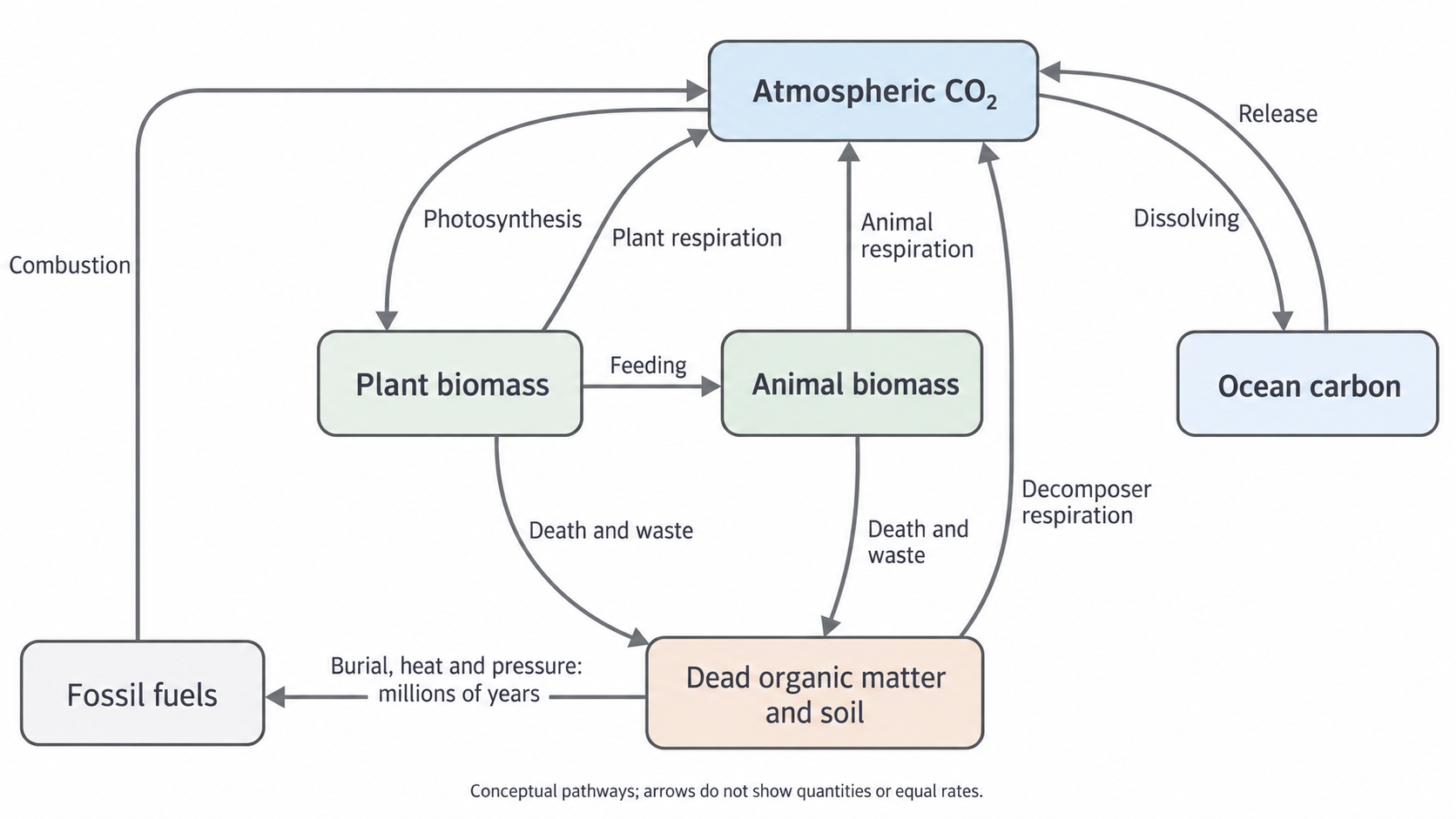
Carbon moves along the labelled pathways. The arrows are conceptual: their thickness does not show a quantity or imply equal transfer rates. Only a small fraction of dead organic carbon enters the long-term fossil-fuel pathway under suitable burial conditions.
Slow stores and atmospheric balance
A carbon cycle can conserve carbon overall while the amount in the atmosphere increases.
Under suitable burial conditions, a small proportion of organic remains escapes rapid decomposition. Over millions of years, heat, pressure and chemical change can form coal, oil and natural gas. These are finite stores on human timescales: burning them in years does not allow replacement at the rate of use. Combustion oxidises fuel carbon and releases CO₂, transferring carbon rapidly from a geological reservoir into the active atmosphere–biosphere–ocean system.
The slow geological cycle also involves carbonate sediments and rocks. Marine organisms can incorporate carbon into carbonate shells; burial and rock formation store some of it. Weathering, transport of dissolved material, burial and tectonic processes move carbon between land, ocean, rocks and atmosphere. Geological processes eventually return carbon, including CO₂ released through volcanism. These long-term transfers do not rapidly cancel human fossil-fuel emissions. CO₂ also dissolves in surface ocean water and can be released back; exchange with deeper water takes longer. NASA's carbon-cycle explanation distinguishes the fast biological and slow geological pathways.
A net sink removes more carbon from the atmosphere than it returns during a stated period; a net source does the reverse. A forest can contain a large carbon store while having little change in that store this year. Conversely, a growing forest can be a net sink even though its organisms respire. Measure the balance, rather than counting photosynthesis alone.
All terms must use the same carbon basis and time interval. A positive result is an increase; a negative result is a decrease.
For example, in an original simplified annual budget, 14 tonnes of carbon enter the atmosphere and 11 tonnes leave: the atmospheric store increases by 3 tonnes of carbon. Cutting input to 12 tonnes slows the increase to 1 tonne; it does not yet lower the atmospheric store. Reducing fossil-fuel use through less energy waste or suitable lower-emission energy reduces an input. Protecting existing vegetation and soils avoids releases. Increasing and retaining ecosystem carbon can increase removal. A combination must make total removal exceed total input to lower the atmospheric amount over that interval. A lower emission than an alternative is valuable, but is not automatically a net removal.
Reforestation and retained carbon
Reforestation can increase the amount of carbon stored on land, provided that the gain survives and exceeds associated losses.
Reforestation
Restoring forest cover to land that was previously forested, by planting trees or allowing and protecting natural regeneration.
As trees grow, photosynthesis supplies carbon for wood, leaves and roots. Litter and root inputs can also build soil organic matter. Net storage increases only after subtracting plant and decomposer respiration and other losses. Seedlings do not instantly replace the stock of a cleared mature forest. A mature forest continues photosynthesis and respiration and can retain a large store; its net annual uptake depends on its actual balance, not simply its age.
Management therefore follows the carbon beyond the planting date. Protect regenerating trees from excessive grazing and repeated clearance, use species suited to the site, and monitor survival, biomass and soil carbon over time. Avoid disturbing carbon-rich soils. If wood is harvested, track what happens next: some carbon may remain in long-lived products, whereas burning or decomposition returns it to the atmosphere. Replanting can restore uptake, but does not erase an immediate release or guarantee the same store at every point in a harvest cycle. A 2024 study of reforestation options explicitly accounts for location, alternative land uses, harvesting and carbon in wood products; it does not identify one method as best everywhere.
Permanence means how long the additional stored carbon is retained. Fire, drought, pests or later clearance can reverse a gain, so protection and continued monitoring matter. Research modelling tropical restoration under future climate change illustrates why growth and disturbance cannot be treated as fixed guarantees. Additionality asks how much more storage occurs than would have occurred without the intervention. Counting all tree growth as an intervention's benefit exaggerates it if natural regrowth would have occurred anyway.
The boundary must also include leakage: reducing clearance at one site may shift timber harvesting or farming to another site, releasing carbon there. Land has an opportunity cost because using it for one purpose removes another possible use. Reforesting productive farmland can reduce food supply or livelihoods; planting trees on a naturally open, species-rich habitat can harm its conservation value. Reforestation is therefore directed towards suitable formerly forested sites, with local land users involved in decisions. Retaining existing forests and avoiding unnecessary clearance complements restoration; replacing a diverse forest with a single-species plantation is not an equivalent conservation outcome.
Assess additional carbon retained over time across the affected land system, alongside habitat, food, water and livelihood effects. A planting count alone cannot establish successful carbon removal or conservation.
The same project can provide timber, employment and restored habitat, but meeting those needs requires a feasible harvest plan, protection and agreement over land use. Carbon and conservation goals must be checked together.
Sustainable resources and biofuel pathways
A resource can meet a recurring human need only if its supply and the ecosystem supporting it can continue.
A renewable resource can be replenished on a human timescale, provided use does not exceed replenishment. Sustainable management also maintains future resources and ecosystem functions while meeting present needs. For timber, this means more than replacing the number of trees cut: growth, age structure, soil, habitat and the quantity harvested matter. Reducing waste, reusing durable products and using appropriate residues can reduce demand for new harvest. The material-use comparisons in 4.15 provide a starting point; here the full carbon transfers and land-management consequences explain why the outcome is conditional.
Biofuel
A fuel made from recently living biological material, such as wood or crop-derived ethanol, biodiesel or biogas. The material used to produce it is its feedstock.
Photosynthesis recently removed the carbon in a biofuel from the atmosphere. Combustion returns carbon as CO₂. Replacing fossil fuel can avoid transferring additional geological carbon into the atmosphere, if the biomass is genuinely renewed and the whole system has a lower net emission for the same useful energy service. Producing a fuel is different from removing carbon and retaining it: repeated growth followed by complete return can recycle carbon without creating a lasting new store.
Continue this lesson.
You’re previewing NovaLearn without an account. Create a free account to read the rest.
Create free account