2.4 - Passive and active membrane transport
A cell must obtain useful substances, remove products and keep its internal conditions different from its surroundings. Some particles cross a membrane by following a gradient; others need an energy supply or transport inside a vesicle. Understanding the route explains why a membrane protein can speed movement without making it active transport.
Gradients and simple diffusion
Particles in a fluid move randomly, so particles can cross a permeable membrane in either direction.
Diffusion
Diffusion is the net movement of particles from a region of higher concentration to a region of lower concentration, resulting from their random motion.
A concentration gradient is a difference in concentration between two regions. Concentration means the amount of a substance per unit volume: a larger compartment does not necessarily have a higher concentration. If a membrane allows the substance through, more particles cross from the more concentrated side per unit time than cross back. This difference gives net movement down the concentration gradient. Individual particles do not all travel in the same direction.
Passive transport does not require a metabolic energy supply from the cell. The particles already have kinetic energy. If concentrations become equal, random movement continues in both directions but there is no net movement due to a concentration difference. A living cell can maintain a gradient by consuming a substance as it enters or producing it as it leaves.
In simple diffusion, particles cross directly through the phospholipid bilayer. Small nonpolar molecules such as oxygen and carbon dioxide can dissolve in its hydrophobic interior. Charged ions and large polar molecules cross this interior poorly, so a concentration gradient alone does not guarantee rapid entry. The membrane must also provide a suitable route.
For example, a respiring cell uses oxygen. If oxygen concentration is higher in the surrounding fluid than inside the cell, oxygen moves into it by simple diffusion. Consumption helps maintain the gradient. If oxygen concentration outside falls below that inside, the net direction reverses; the membrane does not impose a permanent inward direction. With other conditions unchanged, a steeper gradient gives faster net diffusion. Greater membrane area and a shorter diffusion distance also favour diffusion.
Channels and passive carriers
Transport proteins give selected substances a route across the membrane's hydrophobic interior.
Facilitated diffusion
Facilitated diffusion is passive net transport down a gradient through a specific channel protein or carrier protein in a membrane.
A channel protein spans the bilayer and forms a hydrophilic, water-filled pore. Suitable particles pass through the pore without entering the lipid interior. The pore's size and chemical properties make it selective; an ion channel does not admit every ion equally. Some channels are gated: a stimulus opens or closes the pore. An open channel provides a pathway, rather than a pump that pushes ions uphill.
A carrier protein has a binding site complementary to a particular solute. The solute binds on one side, the protein changes shape, and the solute is released on the other side. The binding site is exposed to the two sides in turn. A carrier therefore does not need a continuously open pore through the membrane. Glucose can enter many animal cells by facilitated diffusion through glucose carriers when its concentration is higher outside than inside.
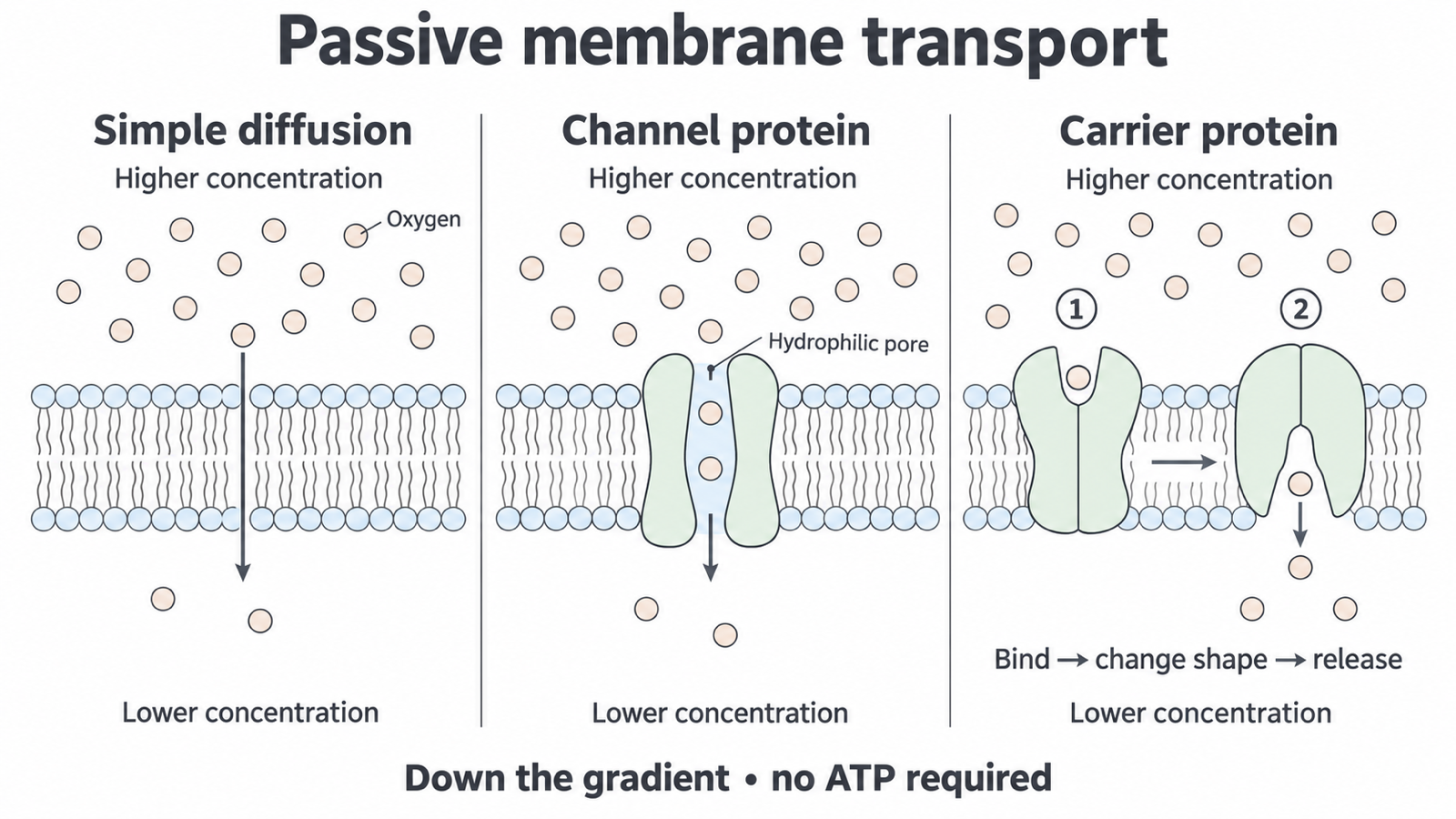
The arrows show net movement down a gradient. The two carrier drawings represent successive shapes of the same type of protein, not a passage between two different proteins. This is a schematic, not a measured image.
Both protein routes can be passive. Binding a solute or changing protein shape does not by itself establish that ATP is used. A passive carrier can transport in either net direction if the concentration gradient reverses. Its specificity means that another solute with a different structure may not bind, even if that solute also has a steep gradient.
There are finitely many carrier proteins, and each takes time to complete a binding and shape-change cycle. As solute concentration rises, a carrier-mediated rate can approach a maximum when the carriers are occupied: saturation. Adding more solute then produces little extra transport. Saturation is evidence consistent with a limited protein-mediated pathway, but it does not distinguish facilitated diffusion from active transport because both can use carriers.
For uncharged solutes, the concentration gradient determines the passive net direction. For ions, electrical attraction or repulsion can also matter: concentration and electrical effects together form an electrochemical gradient. When using ion concentrations alone in the comparisons here, assume there is no electrical potential difference across the membrane. Detailed membrane voltages are studied later.
ATP and active transport
Cells can maintain concentration differences that passive movement alone would tend to reduce.
Active transport
Active transport couples an energy supply to transport through a membrane protein, enabling a substance to move against its concentration gradient, or more generally against its electrochemical gradient.
For an uncharged solute, movement against the concentration gradient means net movement from lower to higher concentration. An ATP-driven pump is a carrier protein whose transport cycle is coupled to ATP hydrolysis. Binding, shape changes and release are organised so that the solute moves in the required direction despite the opposing gradient. The pump is selective: it does not pull every dissolved substance across the membrane.
ATP, adenosine triphosphate, is an immediate source of energy for cellular work. Its hydrolysis can be represented by this simplified word equation:
ATP + water → ADP + inorganic phosphate
Under cellular conditions the overall hydrolysis reaction makes usable energy available. Breaking a chemical bond alone requires energy; it is the net reaction, including the formation and stabilisation of products, that can supply energy to a coupled process. A pump can couple ATP hydrolysis to changes in its protein shape, so energy is transferred to transport rather than simply dissipated. ATP is continually regenerated, including during respiration. Respiration supplies energy to regenerate ATP; the transport machinery uses ATP at the point of work.
One example is the sodium–potassium pump in animal cell membranes. It uses ATP to transport sodium ions out and potassium ions in, helping maintain the different ion distributions. Its role differs from an open ion channel: the pump establishes or maintains gradients, while an open channel allows passive movement down the relevant electrochemical gradient.
Consider an artificial membrane containing an ATP-driven carrier for an uncharged solute X. X concentration is 1 mmol dm⁻³ outside and 8 mmol dm⁻³ inside. Net entry of X moves it from lower to higher concentration, so facilitated diffusion cannot explain that entry. If supplying ATP permits entry and removing ATP stops it, while the membrane and gradient remain intact, the observations support ATP-driven active transport. Once ATP is unavailable, any separate passive pathway would still favour movement of X outwards.
ATP use and gradient direction must be considered together. Transport observed from high to low concentration does not prove that the route is passive: an active pump can operate while a gradient happens to favour that direction. Conversely, a fall in uptake after a respiration inhibitor is added to a whole cell is not conclusive evidence of a directly ATP-driven carrier. Other cell processes and maintained gradients may also change. Controlled observations give a stronger inference.
A carrier can mediate facilitated diffusion or active transport. Decide from the gradient and evidence of energy coupling, not from the presence of a carrier alone.
The same reasoning applies to uptake and export: active transport is defined by its energy-coupled mechanism, not by whether the substance enters or leaves a cell.
Endocytosis and exocytosis
Large molecules and particles can be moved into or out of cells inside membrane-bound compartments.
A vesicle is a small sac surrounded by a membrane. Vesicle transport can carry substances that cannot pass through the lipid bilayer or fit through a channel or carrier. Its direction is described relative to the cell, and it does not depend on the cargo following a concentration gradient.
In endocytosis, the cell surface membrane surrounds material outside the cell. It folds inward, forming a pocket, and the pocket pinches off to become a vesicle inside the cell. The material is enclosed in the vesicle's lumen, the space inside it. It has entered the cell without crossing the hydrophobic part of a bilayer and without being released straight into the cytoplasm.
Engulfing a large particle, such as a bacterium, is phagocytosis, a form of endocytosis. Uptake of small volumes of extracellular fluid and its dissolved substances is often called pinocytosis. These examples use the same central principle of enclosure by membrane; particular receptors can also make uptake selective.
In exocytosis, a vesicle inside the cell approaches the cell surface membrane. Its membrane fuses with the cell surface membrane, opening the vesicle's lumen to the outside. Its contents are released, and in the full-fusion model shown below its membrane becomes part of the cell surface membrane. The intact vesicle does not travel through a hole in the bilayer. Cells secrete proteins such as digestive enzymes by exocytosis; nerve cells also release neurotransmitters from vesicles.
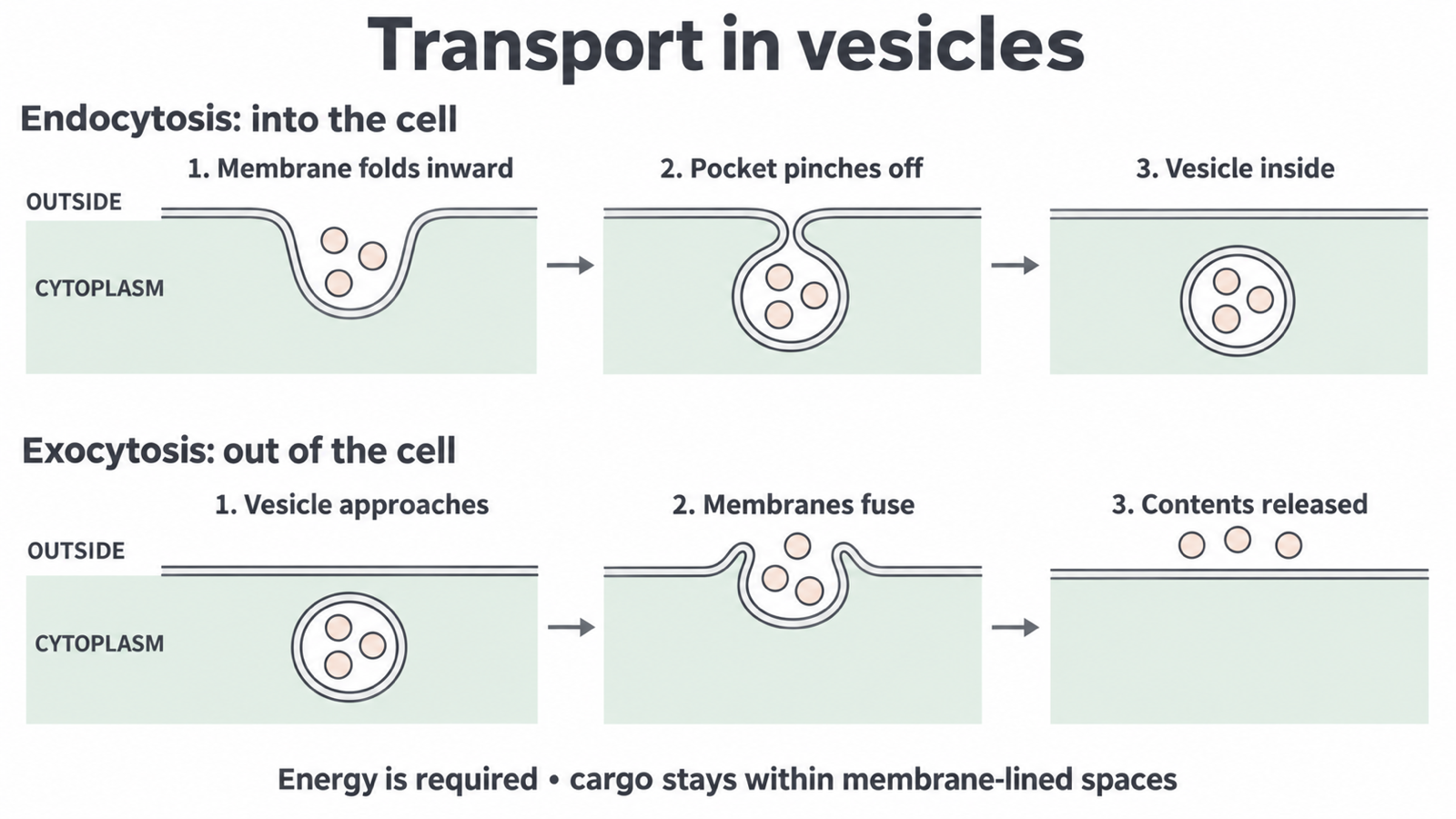
Follow each row from left to right. In endocytosis, the pocket closes around the cargo; in exocytosis, fusion makes the vesicle's interior continuous with the outside. Double lines represent one bilayer membrane, not two separate membranes. The figure shows a simplified full-fusion sequence.
Both processes require energy for cellular machinery that organises membrane deformation, vesicle movement and preparation for fusion or separation. ATP supplies energy for this machinery; other energy-coupled proteins also participate. This is bulk transport using vesicles, distinct from pumping individual ions or small solutes through an ATP-driven carrier. Endocytosis removes surface membrane into the cell, while full-fusion exocytosis adds vesicle membrane to the surface; their balance helps maintain the surface.
Inferring transport mechanisms
Observations can identify a transport mechanism only when they distinguish it from plausible alternatives.
Start with what moves and where it is found. Small nonpolar molecules can use the bilayer; ions need a suitable protein route; a large particle enclosed in a newly formed vesicle indicates endocytosis. Next compare concentrations and the net direction. Finally ask whether transport depends on an energy supply and whether proteins or membrane rearrangements are involved. A single observation often leaves several possibilities.
For example, loss of a suitable channel reduces passive ion movement because it removes the hydrophilic pathway. It does not show that the channel normally used ATP to pump ions. A blocked ATP-driven pump can reduce active uptake even while channels still allow movement in the opposite direction. A defect in vesicle fusion can prevent protein secretion without preventing oxygen diffusion. Different transport routes can therefore respond differently to the same change in a cell.
The table below is an original model experiment with identical artificial membranes containing a purified carrier for an uncharged polar solute Z. Surface area, temperature and initial concentrations are the same in each preparation. Z initially has a concentration of 10 mmol dm⁻³ outside and 2 mmol dm⁻³ inside. The initial entry rate is measured before these concentrations appreciably change.
| Preparation | ATP supplied? | Initial entry rate / arbitrary units |
|---|---|---|
| No carrier | No | 0 |
| Carrier present | No | 5 |
| Carrier present | Yes | 5 |
The carrier is necessary for measurable entry under these conditions: adding it changes the rate from 0 to 5. Entry is down the concentration gradient, and occurs at the same rate without ATP as with it. Together these observations support facilitated diffusion by the purified carrier. They do not show that every transport protein in a living cell is passive.
Suppose a second experiment increases external Z while internal Z remains low. If entry initially rises then approaches a maximum, that is consistent with the carriers becoming saturated. However, a plateau alone does not establish the energy source. Enough information about gradients, ATP dependence and whether the membrane remains intact is still needed.
A connected explanation links each route to the barrier it overcomes. Oxygen can dissolve in the lipid interior and diffuse down its gradient. A polar solute may use a specific channel or a binding-and-shape-change carrier while still moving passively. Accumulating a solute against its gradient requires an energy-coupled transport mechanism. Exporting a protein in a vesicle requires membrane fusion and energy-dependent machinery. These are different solutions to different transport demands, even within the same cell.