3.9 - Meiosis and genetic variation
Meiosis produces cells with one set of chromosomes while reshuffling the genetic information they carry. You will follow how independent assortment and crossing over produce different allele combinations, then calculate the chances of particular gametes without confusing chromosome number with DNA amount.
Chromosomes, copies and sets
A chromosome can be copied without increasing the number of chromosome sets in a cell.
In a homologous pair, the two chromosomes carry the same genes at corresponding loci, although their alleles can differ. In an ordinary autosomal pair, one homolog was inherited from each parent. For example, one homolog may carry allele A at a locus and the other allele a. Homologous chromosomes are not the two copies made when one chromosome replicates.
Sister chromatids
The two copies of one chromosome produced by DNA replication, held together at the centromere region before they separate. Each chromatid contains one DNA double helix. Newly replicated sisters have the same allele sequence, apart from replication errors; crossing over can subsequently make their allele combinations differ.
An X-shaped drawing represents one duplicated chromosome, with two chromatids, rather than two homologous chromosomes. Once its sister chromatids separate, each becomes a chromosome in its own right.
Diploid, written , means two chromosome sets; haploid, written , means one set. Meiosis has one DNA replication followed by two divisions. The first separates the homologous chromosomes into different cells, leaving one of each pair in each cell. The second separates the sister chromatids. There is no further DNA replication between the divisions. The general outcome is four haploid cells. In mammalian egg formation, unequal division means only one becomes a functional egg; “four cells” does not mean four functional eggs.
Consider an illustrative organism with : two homologous pairs. Count at the completed steps below, not while chromatids are moving apart.
| Completed step | Chromosomes per cell | DNA double helices per cell | Chromosome sets |
|---|---|---|---|
| Before DNA replication | 4 | 4 | Diploid, |
| After replication, before either division | 4 duplicated chromosomes | 8 | Diploid, |
| After the first division | 2 duplicated chromosomes | 4 | Haploid, |
| After the second division | 2 unduplicated chromosomes | 2 | Haploid, |
Replication doubles DNA amount, not ploidy. Separating homologs halves ploidy even though each chromosome still has two chromatids. In mammals, haploid gametes fuse at fertilisation to restore the diploid number. This maintains chromosome number across generations; variation depends on which allele combinations enter those gametes. NHGRI: meiosis provides the human chromosome-set context.
Independent assortment
The orientation of one homologous pair does not determine the orientation of another pair.
Before the first division, the two homologs in each pair face opposite poles of the cell. Either homolog can face either pole. Different pairs orient independently, so the homolog inherited from the organism's mother in one pair need not move with the maternally inherited homolog in another pair. Spindle action then separates the homologs according to these orientations. This independent assortment produces different combinations of chromosomes in the haploid cells.
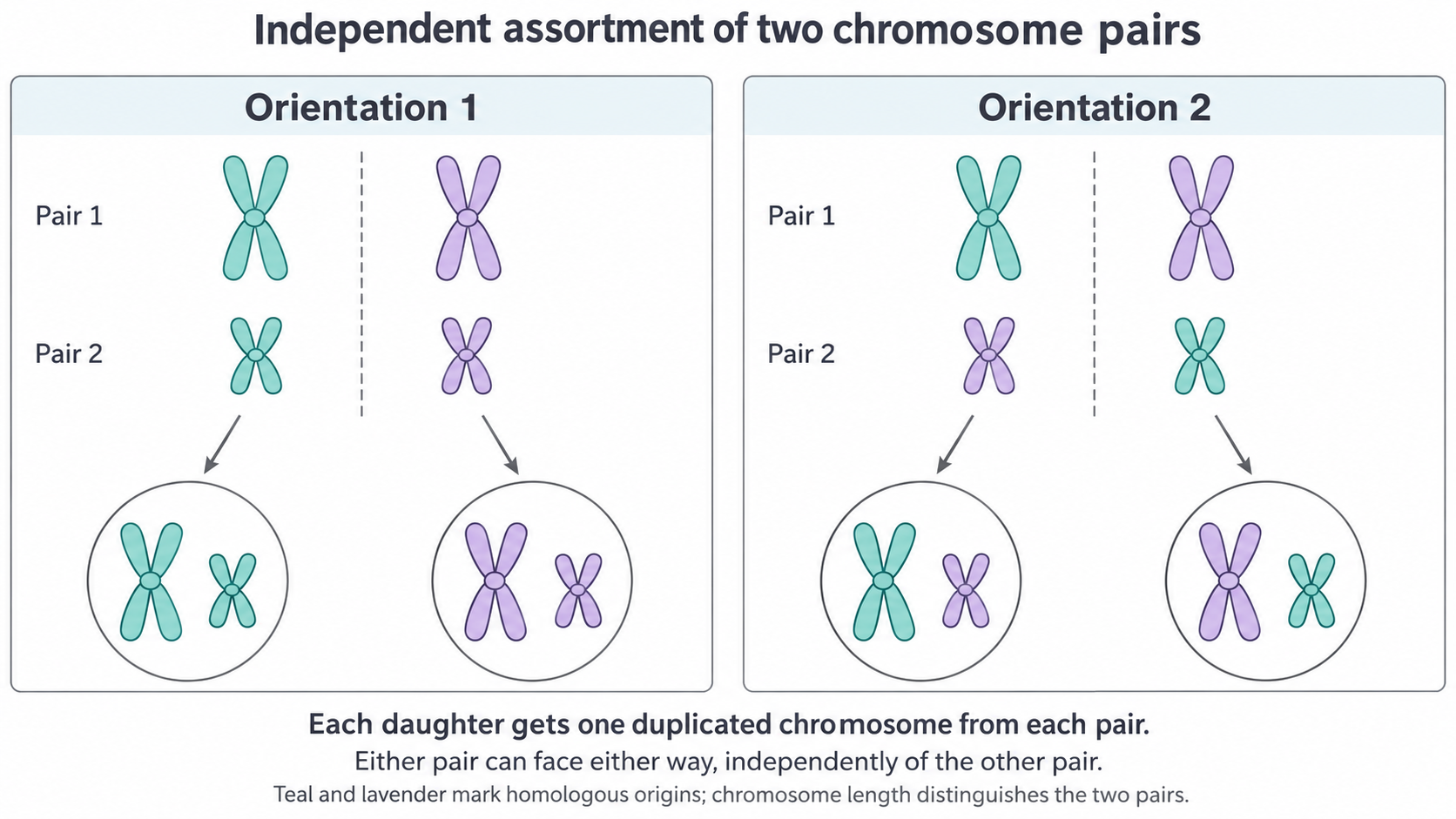
Two chromosome pairs can orient differently relative to each other. These are first-division daughters: sister chromatids are still joined, but each daughter has only one chromosome from each pair.
For example, let one pair carry A or a and a different pair carry B or b. Ignoring crossing over, the possible gamete allele combinations across many meioses are AB, Ab, aB and ab. AB and ab can result from one relative orientation; Ab and aB can result from the other. A single meiosis in this simplified model produces two of each of two complementary types, rather than necessarily producing all four types. Across many meioses, all four are expected in equal proportions if segregation is unbiased.
The important random event is the orientation of whole homologous pairs, not each gene choosing a destination independently. Genes on the same chromosome are linked and travel together unless recombination separates their allele combinations. The next part explains that second source of variation.
Crossing over recombines linked alleles
Crossing over can change the allele combinations along a chromosome before the homologs separate.
After replication, homologous chromosomes pair closely with corresponding loci aligned. Each homolog consists of two sister chromatids, so the pair contains four chromatids. Non-sister chromatids are chromatids belonging to the two different homologs. During crossing over, corresponding DNA segments are exchanged reciprocally between non-sister chromatids. DNA is broken and rejoined to the other chromatid; alleles move with the exchanged DNA rather than jumping individually between unrelated loci. The result can be a recombinant chromatid carrying a new combination of existing alleles. NHGRI: crossing over explains the exchange between homologs and its role in allele variation.
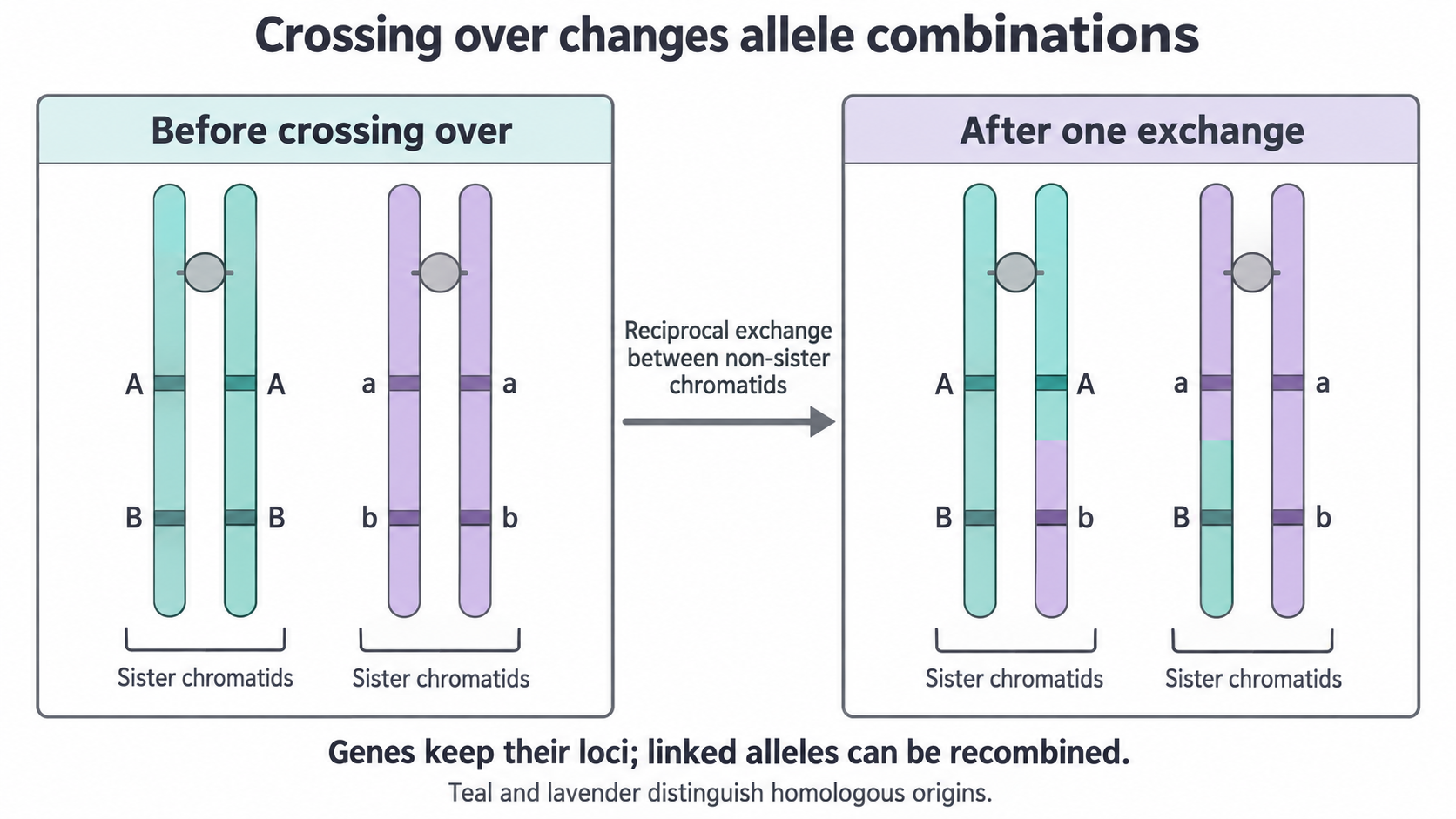
One exchange between the A/a and B/b loci produces two recombinant chromatids, Ab and aB, and leaves AB and ab unchanged. The four rods are four chromatids belonging to two duplicated homologs; the loci stay aligned.
In this example, one homolog originally carries A and B together, while the other carries a and b together. Replication initially gives two AB chromatids and two ab chromatids. A single exchange between the two gene loci involving one chromatid from each homolog gives:
| Chromatid | Allele combination after this exchange | Status relative to the starting homologs |
|---|---|---|
| Uninvolved chromatid of the first homolog | AB | Parental combination |
| Participating chromatid of the first homolog | Ab | Recombinant combination |
| Participating chromatid of the second homolog | aB | Recombinant combination |
| Uninvolved chromatid of the second homolog | ab | Parental combination |
The genes keep their corresponding positions. Each chromatid still has one allele at each of these loci, and normal reciprocal exchange does not add a chromosome or remove a gene. Sisters are still called sisters because they arose by copying the same chromosome, even if one has since exchanged DNA. Exchanges between initially identical sisters would not produce the illustrated new combinations.
Continue this lesson.
You’re previewing NovaLearn without an account. Create a free account to read the rest.
Create free account