8.3 - Action potentials and saltatory conduction
A nerve impulse can travel along an axon without fading away. This lesson explains how changes in membrane permeability create that impulse, how one region excites the next, and why myelin makes conduction faster.
The resting membrane potential
An axon has a potential difference across its cell surface membrane even when it is not carrying an impulse.
Membrane potential
The electrical potential inside a cell relative to the potential outside it. A negative membrane potential means that the inside is at a lower electrical potential than the outside.
A typical resting potential is about , although the value varies between neurones. It is a difference across a very thin membrane, not a voltage that steadily falls along the length of the axon. Sodium ions, , are more concentrated outside the axon; potassium ions, , are more concentrated inside. Both ions carry positive charge.
The sodium–potassium pump uses energy supplied by ATP hydrolysis to move three sodium ions out for every two potassium ions moved in. These movements oppose the ions' concentration gradients and maintain the unequal concentrations over time. The pump operates at rest and during activity; it does not wait until an impulse has ended.
The membrane's permeability describes how readily a substance can cross it. Ions cannot readily pass through the hydrophobic part of the phospholipid bilayer, so ion channels matter. At rest, potassium leak channels make the membrane much more permeable to potassium than to sodium. Potassium tends to diffuse out down its concentration gradient, leaving relatively more negative charge just inside the membrane. The increasingly negative inside electrically attracts potassium back in, opposing further outward movement. The resting potential reflects these concentration and electrical effects, together with the membrane's relative permeabilities. The pump maintains the gradients on which this depends and also moves a small net positive charge out.
Only a small fraction of the ions need to move to change the membrane potential. An impulse does not empty the axon of potassium or exchange all its sodium and potassium. The bulk fluids on either side remain approximately electrically neutral; the relevant charge separation is close to the membrane.
Threshold, depolarisation and repolarisation
An action potential begins when a depolarisation is large enough to trigger a self-amplifying increase in sodium permeability.
Depolarisation means that the membrane potential becomes less negative than it was. A stimulus, or current from an already active region, can produce an initial small depolarisation. Voltage-gated channels change their state in response to membrane potential. If the potential reaches threshold, enough voltage-gated sodium channels open for sodium entry to cause further depolarisation. This opens more sodium channels: a positive feedback process. A typical illustrative threshold is about ; it is not a universal fixed value for every neurone.
Action potential
A brief, self-regenerating change in membrane potential involving rapid depolarisation followed by repolarisation.
The sequence depends on different changes in sodium and potassium permeability:
| Stage | Channel and permeability change | Ion movement and voltage consequence |
|---|---|---|
| Rapid depolarisation | Voltage-gated sodium channels open rapidly; sodium permeability rises sharply. | Sodium enters down its electrochemical gradient, carrying positive charge in. The inside can become positive relative to the outside. |
| Peak and repolarisation | Sodium channels become inactivated, stopping their rapid inward current. Delayed opening of voltage-gated potassium channels raises potassium permeability. | Potassium leaves the axon, carrying positive charge out. The potential becomes negative again: repolarisation. |
| Brief hyperpolarisation and recovery | Some voltage-gated potassium channels remain open after the resting value is passed, then close. Sodium channels recover from inactivation to a closed state that can open again. | Continued potassium efflux can make the potential more negative than rest: hyperpolarisation. As potassium permeability returns towards its resting pattern, the potential returns towards rest. |
Inactivation is different from a resting sodium channel simply being closed: an inactivated channel cannot immediately reopen in response to another depolarisation. Sodium channel inactivation and the delayed potassium response end the spike; sodium does not stop entering because its entire concentration gradient has disappeared.
The sodium–potassium pump maintains and gradually corrects the ion gradients that repeated impulses would otherwise erode. The immediate falling phase of an action potential is caused mainly by potassium leaving through channels, not by the pump suddenly pumping sodium out. The return of voltage and the maintenance of ion concentrations are related but different processes.
An action potential is all-or-nothing: below threshold there is no full regenerative spike; once threshold is reached, a full spike is generated under those conditions. A stronger stimulus does not normally make each spike taller. It can produce more frequent impulses, provided the membrane has recovered sufficiently between them.
Reading a voltage–time trace
A voltage–time trace records how the potential at one small region of membrane changes as an action potential passes it.
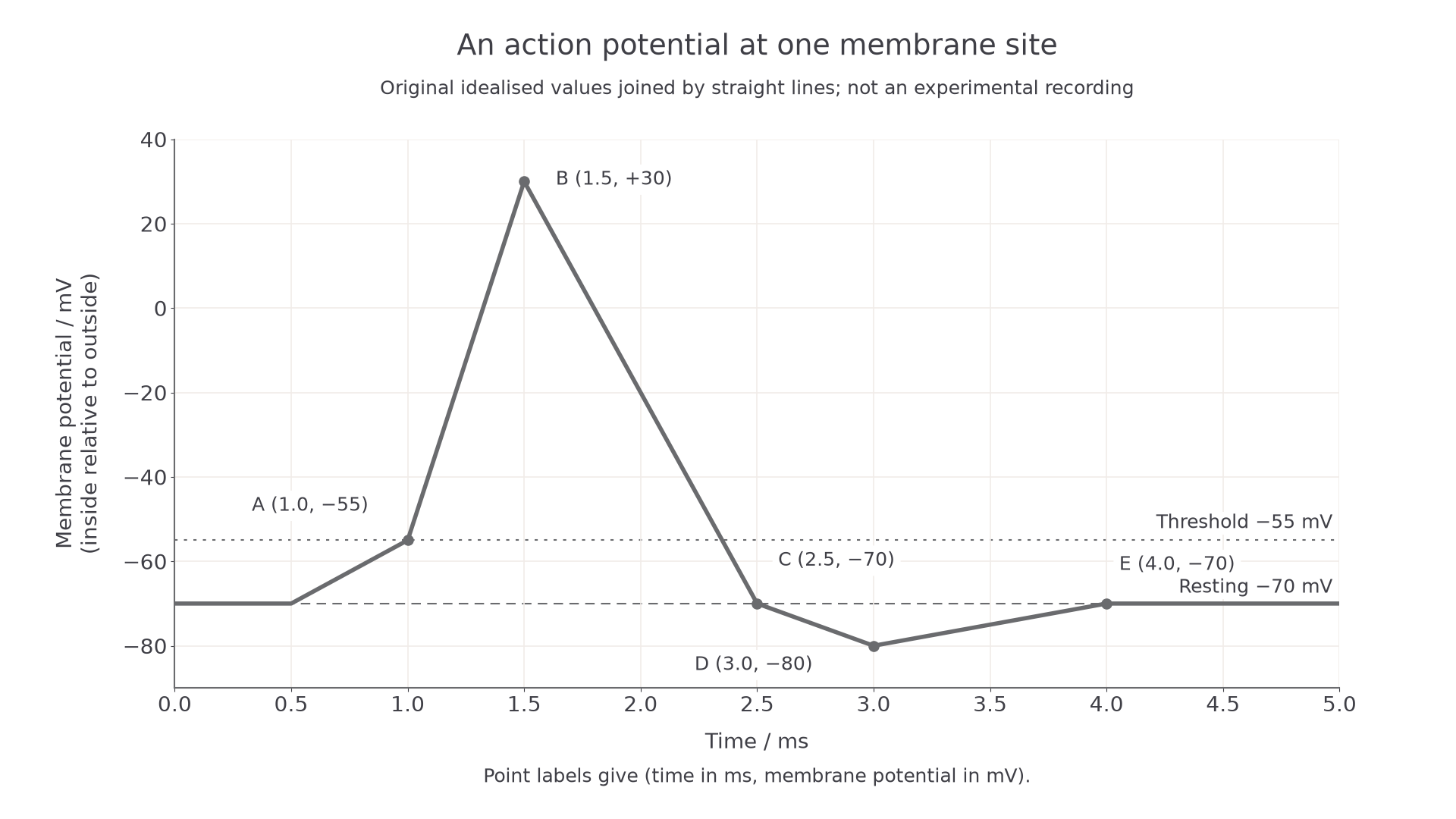
The original idealised trace uses straight lines between selected values to make the readings unambiguous. It is not an experimental recording or a claim that every neurone has these exact timings and voltages.
Read the horizontal axis as time, measured in milliseconds, and the vertical axis as membrane potential, measured in millivolts with the outside as reference. At , the inside and outside have the same potential; this does not mean that all ions have equal concentrations. A value of means that the inside is at a higher potential than the outside. A value of is more negative than the resting value of .
The graph can be translated into numerical statements: A is , B is , C is , D is , and E is . A to B is rapid depolarisation; B to C is repolarisation; the dip below rest reaches D. The smaller rise from D to E is recovery from hyperpolarisation, not another action potential: it only reaches rest and remains below threshold.
Use matching units within each subtraction. and .
Continue this lesson.
You’re previewing NovaLearn without an account. Create a free account to read the rest.
Create free account