5.4 - Succession and climax communities
A newly exposed surface and an abandoned field can both develop changing communities, but they do not begin with the same resources. In 5.4 you will explain how colonising organisms alter their surroundings, why different species become successful, and what a climax community means in a changing environment.
Colonisation and starting conditions
Succession begins with the arrival and establishment of organisms, but the starting conditions strongly influence what can establish.
Ecological succession
A change in the species composition and structure of a community over time, as organisms establish and conditions and interactions change.
Colonisation means establishing a population in an area. Seeds, spores and other dispersing organisms must arrive, survive and reproduce; arrival alone does not guarantee establishment. The early successful colonisers form a pioneer community. Pioneers tolerate the particular starting conditions, such as exposure, drying or an unstable surface. They are not one universal set of species.
In primary succession, development begins on a newly available surface without developed soil, such as exposed rock after lava has cooled. Water and mineral particles may be present, but there is little accumulated organic matter. In some rocky habitats lichens and mosses are conspicuous early colonisers; on other surfaces microorganisms or seed-bearing plants may establish early. The identity and order depend on the substrate, climate and sources of colonists.
In secondary succession, a previous community has been disturbed but soil remains. An abandoned cultivated field may retain organic matter, mineral nutrients, microorganisms, seeds and surviving roots. Plants can establish without first developing soil from a bare mineral surface, so recovery can often proceed more rapidly than primary succession under comparable conditions. This is not a fixed timetable: severe disturbance, continued grazing or lack of arriving seeds can slow it.
For example, new vegetation on cooled bare lava is primary succession. Vegetation returning after a fire that leaves soil and some buried seeds is secondary succession. Classify the process from what remains, rather than assuming every fire or every volcanic event has the same effect.
Organisms change abiotic conditions
Once organisms establish, their activities can change the non-living conditions experienced by later arrivals.
On a bare mineral surface, weathering produces small particles. Colonising organisms can contribute to weathering, while roots and low vegetation can hold or trap loose particles and reduce their loss by erosion. Dead organisms, shed leaves and other remains add organic matter. Decomposers break down this material; some becomes longer-lasting soil organic matter, while decomposition releases mineral nutrients that plants can take up. Decomposition recycles nutrients already in the material: it does not create mineral elements from nothing.
As mineral particles and organic matter accumulate, a more developed soil can support roots. Organic matter can improve water retention, so the rooting zone may remain moist for longer between rainfalls. Recycling of mineral nutrients can reduce a limitation on growth. These changes can allow plants with larger root systems or greater water and nutrient requirements to establish. Nutrient availability does not necessarily rise throughout all succession: uptake, leaching, soil chemistry and decomposition also affect it.
Vegetation also changes the microclimate, the conditions close to the ground or within the vegetation. Leaves intercept light; stems and foliage reduce wind speed; shelter and shading can reduce evaporation and extremes of temperature near the ground. Conditions can become shadier, less exposed and more humid. These are local effects, not a change in the region's climate. Their size and even their consequences depend on the habitat: retaining more water may help a dry site, whereas waterlogging can restrict some plants.
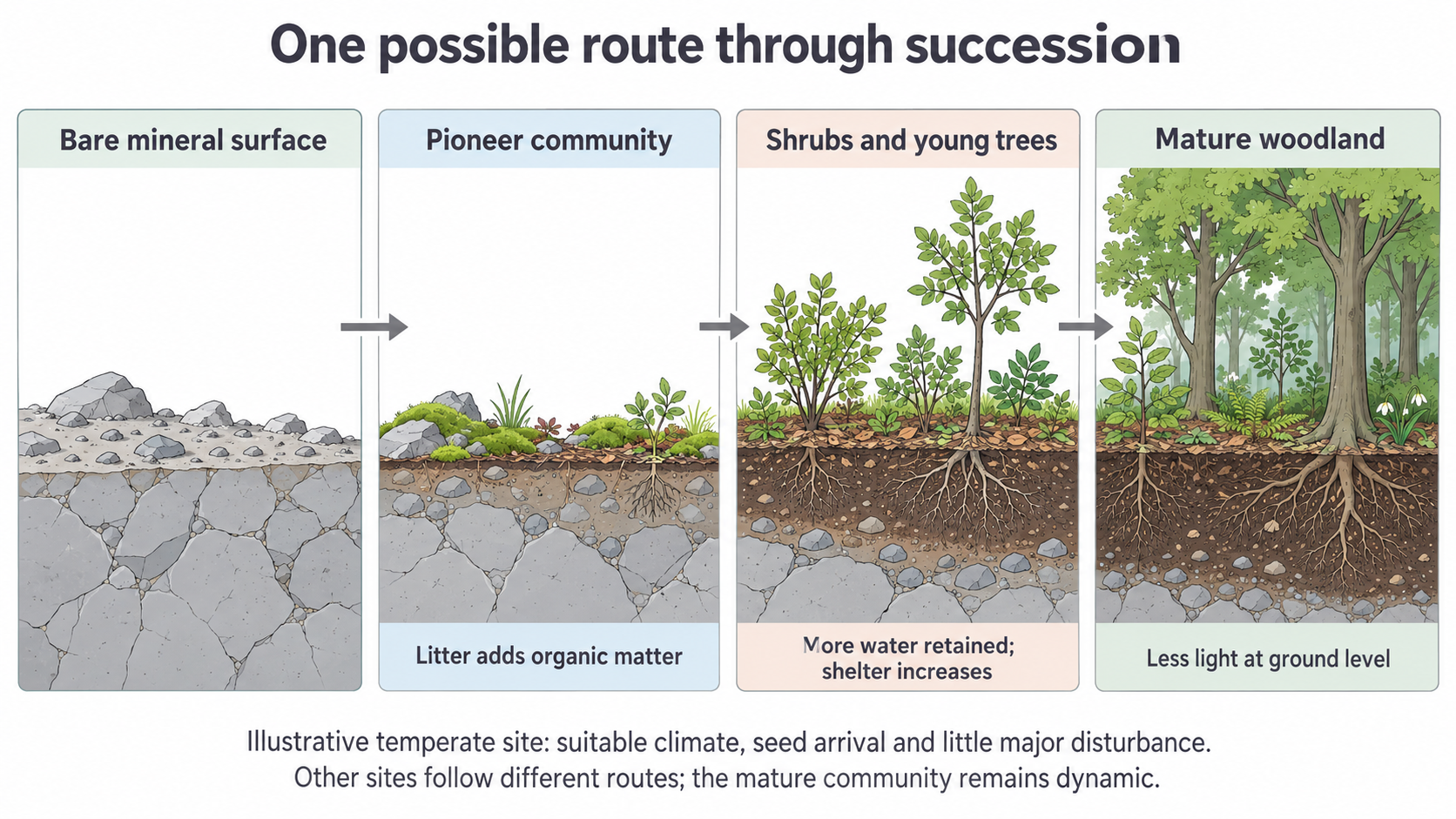
This conceptual sequence shows one possible route where climate, colonist arrival and disturbance allow woodland to develop. The stages have no fixed durations, and the mature community is still changing.
When an organism makes conditions more suitable for another species, this is facilitation. It has no purpose or foresight: litter and shelter arise from the first organism's normal activities. Early vegetation can also hinder establishment by taking resources or physically covering the surface. Succession is therefore more than a sequence of ever-improving conditions for every species.
Changing competition and replacement
As conditions change, the traits that made a pioneer successful may no longer give it an advantage.
Competition occurs when organisms use a shared resource whose supply limits their growth or reproduction. Plants may compete for light, water, mineral nutrients and space. A species able to tolerate bare, exposed ground is not necessarily able to reproduce successfully beneath a dense canopy. Conversely, a later tree may require developed soil and a seed source before it can establish, even if it could eventually dominate the canopy.
Consider a possible temperate sequence. Low plants first establish in suitable patches. Their remains and roots help develop the soil. Shrubs and young trees can then establish where seeds arrive and conditions permit. As taller plants grow, they intercept more light above the low plants. Shade-intolerant pioneers then photosynthesise less, grow less or leave fewer surviving offspring. More shade-tolerant species can persist beneath the canopy, and the relative abundance of species changes. A transition need not eliminate every pioneer: some remain in gaps or exposed patches.
The successive recognisable communities are sometimes called seral stages. Their boundaries overlap: seedlings of a later dominant may already be present among earlier vegetation. Do not imply that all plants of one stage die before the next species arrives. Nor do individual pioneer plants transform into shrubs or trees; populations change through establishment, growth, reproduction and death.
Animals, fungi and microorganisms also change as food, shelter, litter and other habitats change. New resources can provide additional niches, but competition can remove species too. Species richness, the number of species present, may rise, fall or level off during different stages. Increasing plant height or biomass does not prove a continuous increase in biodiversity.
A useful causal explanation identifies the changed resource and its effect. “Trees replace herbs because trees are better adapted” is incomplete. “A growing tree canopy intercepts light, reducing the growth and reproduction of shade-intolerant herbs” explains a mechanism under specified conditions.
Continue this lesson.
You’re previewing NovaLearn without an account. Create a free account to read the rest.
Create free account