1.2 - Water as a transport solvent
Blood transports nutrients and wastes over distances that diffusion alone cannot cover quickly enough. Water makes this possible for many substances because its molecules interact with their particles and keep them dissolved. This lesson links the charge distribution in a water molecule to its role as a transport solvent.
Water has two partially charged ends
A water molecule contains one oxygen atom joined to two hydrogen atoms by covalent bonds, in which electrons are shared.
Oxygen attracts the shared electrons more strongly than hydrogen does. This unequal sharing makes each oxygen–hydrogen bond polar: the oxygen region has more electron density and a small negative charge, while the hydrogen regions have small positive charges. We write these as and ; the symbol means partial, not a full ionic charge.
The molecule is bent. Its oxygen end and hydrogen end therefore have different charge distributions, giving it a permanent dipole.
Dipole
A separation of positive and negative charge within a particle. In water, the oxygen end is partially negative and the hydrogen end is partially positive.
Water is still electrically neutral overall. Its partial charges describe an uneven distribution of electrons within the molecule, rather than a gain or loss of electrons by the whole molecule. An ion, by contrast, is a particle with an overall electrical charge: a sodium ion has a full positive charge, , and a chloride ion has a full negative charge, .
This distinction matters when predicting attraction. The partially negative oxygen end can be attracted to a positive ion even though the water molecule itself is not a negative ion.
How water surrounds dissolved particles
The opposite partial charges of water allow it to interact with many ions and polar molecules, making it a useful solvent.
Solvent, solute and solution
A solvent is the substance in which a solute dissolves. A solution is the uniform mixture formed when the solute's particles are dispersed among those of the solvent. In an aqueous solution, water is the solvent.
Dissolving ions
In a sodium chloride crystal, positive sodium ions and negative chloride ions attract one another. When the salt dissolves, water molecules orient around these ions: their partially negative oxygen ends face , and their partially positive hydrogen ends face . These are attractions between an ion and a dipole, rather than new covalent bonds within water.
Attractions between water and the ions help separate ions from the crystal and stabilise them among the water molecules. Surrounding a particle with water molecules is called hydration. The ions remain charged ions in solution; they do not become neutral sodium or chlorine atoms. The water molecules around an ion continually move and exchange with other water molecules, so a hydration shell is not a rigid casing.
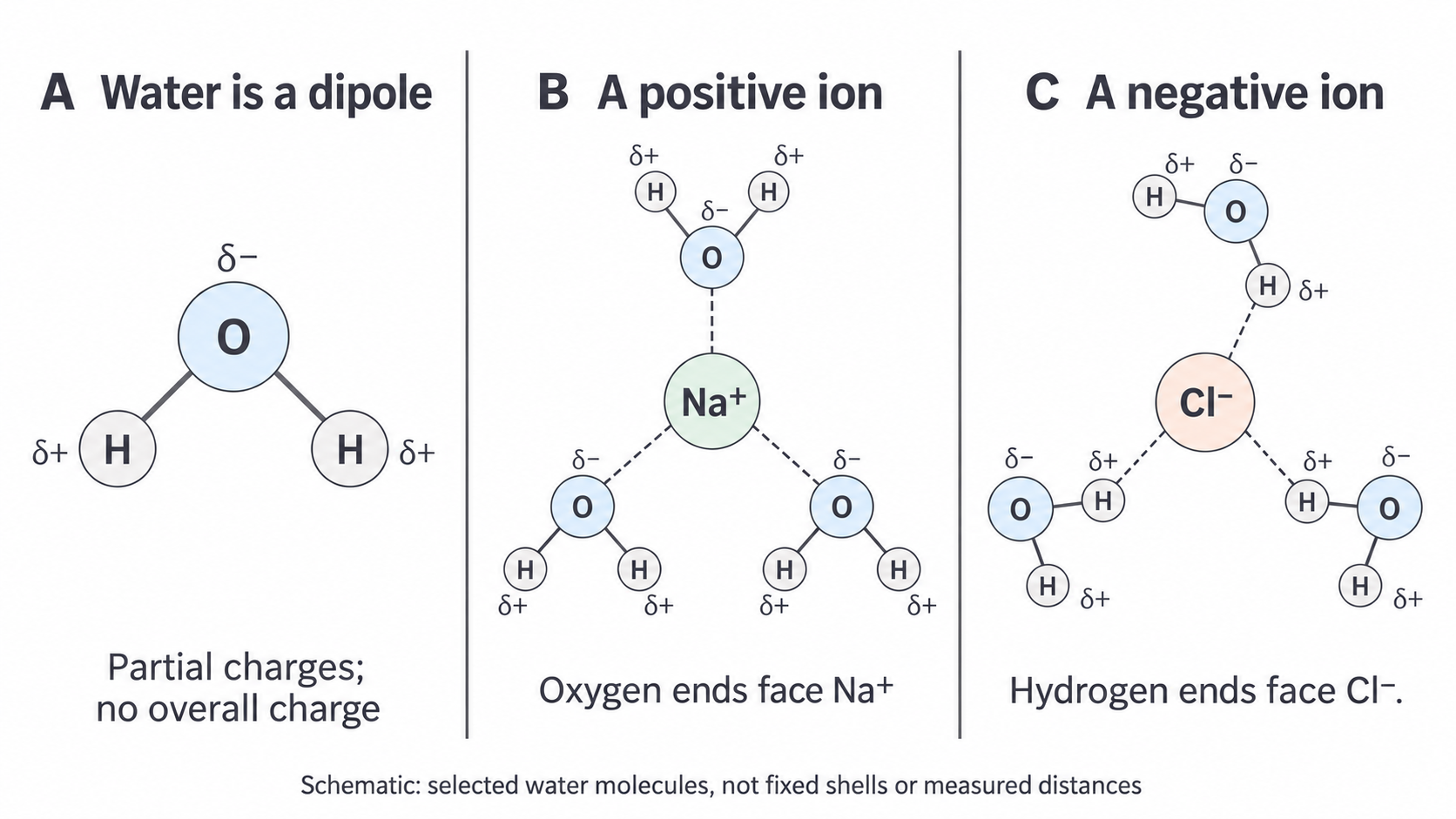
Water's partial charges determine which end faces each ion. Solid lines represent the covalent bonds within each water molecule; dashed lines represent selected attractions to an ion. This conceptual schematic shows only some surrounding water molecules, with no fixed hydration number or measured distances.
Dissolving polar molecules
Water also dissolves many uncharged polar molecules, including glucose. Glucose has several polar hydroxyl groups, each containing an oxygen bonded to a hydrogen. These groups can form hydrogen bonds with water: attractions involving a partially positive hydrogen and a nearby electronegative atom, such as oxygen. Water surrounds and interacts with individual glucose molecules, allowing them to disperse through the solution. Dissolving glucose does not break it into ions or break the covalent bonds holding the glucose molecule together.
Hydrophilic particles or regions interact favourably with water; ions and many polar groups are hydrophilic. Hydrophobic regions, such as the non-polar hydrocarbon chains in oils, do not interact favourably enough to dissolve readily in water. Oil therefore tends to remain as a separate phase. This does not mean that water actively repels every oil molecule. Water is a good solvent for many substances, not a solvent that dissolves everything; even some ionic solids have low solubility.
For example, both glucose and sodium chloride can form uniform aqueous solutions, although one supplies molecules and the other supplies ions. Observing a uniform solution alone cannot tell us which kind of solute particle is present. A separate oil layer supports poor mixing under the conditions tested; it does not show that the particles have stopped moving. These observations must be interpreted using the solute's structure, rather than assuming that anything soluble is ionic.
Dissolved substances travel with plasma
Blood plasma is the liquid component of blood, and water makes up most of it.
Because water is a polar solvent, many nutrients, ions and metabolic wastes can remain dispersed in plasma as dissolved particles. When plasma flows along a blood vessel, these substances move with it. This mass transport carries material over long distances; exchange over the short distances between blood and nearby tissues then allows substances to reach or leave cells.
| Dissolved substance | Why transport is useful |
|---|---|
| Glucose | Delivered from absorption sites to tissues, where cells can use it in respiration. |
| Amino acids | Delivered to cells for protein synthesis. |
| Mineral ions, such as sodium and chloride ions | Distributed to tissues where they contribute to cell functions and the composition of body fluids. |
| Urea | Carried from the liver to the kidneys for excretion. |
Solubility and movement have different roles. Water's molecular interactions allow glucose or ions to stay dissolved; they do not supply the force that pumps blood. The heart creates pressure differences that drive blood flow, carrying the aqueous solution and its solutes together. Glucose does not travel purposefully towards a cell because that cell needs it.
The solvent model also has limits. Hydrophobic lipids are not freely dissolved in plasma water in the same way as glucose; their transport involves carriers, including lipoprotein particles. Oxygen has limited solubility in water, and most oxygen in blood is carried bound to haemoglobin in red blood cells. The detailed carrier mechanisms come later: here they show why “water transports every substance by dissolving it” is too broad a claim.
Water's dipole nature allows many ions and polar molecules to dissolve. Flowing plasma then carries those dissolved substances through the circulation.
The same distinction lets us explain a change in the system: stopping blood flow does not instantly make dissolved glucose insoluble, but it stops its long-distance delivery by the moving plasma.