3.14, 3.15 - Genotype, epigenetics and continuous variation
A DNA sequence does not, by itself, specify exactly what an organism will look like. In 3.14 we will connect genotype, environment and epigenetic control of gene activity; in 3.15 we will explain how alleles at many loci and environmental differences produce continuous variation. We will then organise and summarise plant-height data to see what a distribution can tell us.
Genotype and environment shape phenotype
An organism's characteristics develop as its inherited information operates in a particular environment.
Genotype and phenotype
Genotype is an organism's genetic constitution, or its combination of alleles at specified loci. Phenotype is its observable or measurable characteristics, including biochemical and physiological features as well as appearance.
Genes can influence which proteins are made and how they function. Those proteins affect processes such as growth or pigment production. Environmental conditions can alter the resources available, enzyme activity or gene expression, so the same genotype can produce different phenotypes in different conditions. For example, nutrition during growth affects adult human height alongside inherited differences. An environmental effect does not necessarily change the DNA base sequence.
Consider this original illustrative experiment, in which genetically identical cuttings of each of two plant genotypes are grown under two watering treatments. Light, soil and growth time are kept the same.
| Plant genotype | Mean height with adequate water / cm | Mean height with limited water / cm |
|---|---|---|
| G1 | 28 | 18 |
| G2 | 24 | 21 |
Within G1, changing the water supply changes height by 10 cm; within G2, it changes height by 3 cm. Comparing the genotypes under the same watering treatment also reveals an inherited contribution. Here, the effect of water depends on genotype: G1 is taller in adequate water, but G2 is taller in limited water. This is a genotype–environment interaction. The phrase does not mean multiplying a genotype value by an environment value, or that genetic and environmental contributions must always be separable percentages.
Chemical marks alter gene activity
One way to change a phenotype without changing the DNA sequence is to change how readily particular genes are transcribed.
Epigenetic change
An epigenetic change alters gene activity through changes associated with DNA or its packaging, without changing the DNA base sequence. Some such states can be maintained through cell division.
In eukaryotic cells, DNA winds around histone proteins to form nucleosomes. DNA and its associated proteins make up chromatin. Transcription requires regulatory proteins and RNA polymerase to gain access to the appropriate DNA. Changes in chromatin packaging or in the proteins recruited to a region can make transcription more or less likely.
DNA methylation adds methyl groups to DNA, commonly to cytosine at particular sites. At many gene promoters, increased methylation can reduce transcription: it can interfere with regulatory-protein binding or recruit proteins that favour a less active chromatin state. Less mRNA is then available for translation, so less of the gene's protein may be produced. Removing methylation at an appropriate regulatory site can permit increased activity. Methylation does not remove the gene or rewrite its base sequence, and its effect depends on where it occurs; it is not a universal instruction to switch off every nearby gene.
Histone modification adds or removes chemical groups on histone proteins. For example, acetylation of certain histone tails can weaken interactions that favour compact chromatin and help recruit proteins associated with transcription. The DNA can become more accessible, increasing the opportunity for transcription. Removal of these acetyl groups can favour reduced activity. Other histone modifications can promote or inhibit expression depending on the group, its position and the proteins that recognise it. Therefore, “histone modification activates genes” is too broad.
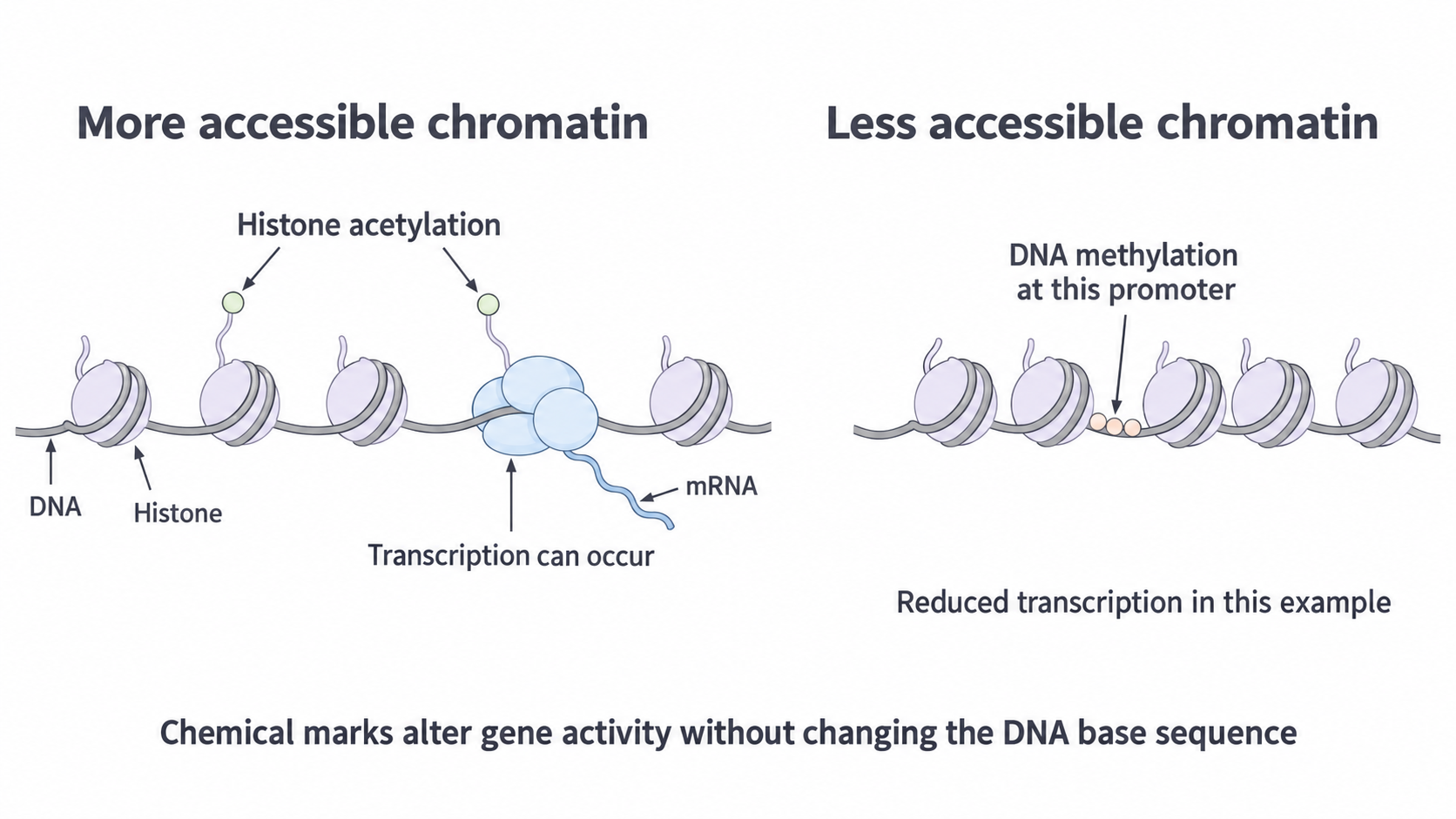
Chemical marks on DNA and histones can change access and protein recruitment at a gene. The two panels show examples, not a universal rule for every methylated site or modified histone.
These mechanisms help explain how cells containing the same genes maintain different patterns of protein production. Environmental signals can also influence epigenetic states, but not every environmental effect on phenotype is epigenetic: limited water can constrain growth directly through physiology.
Maintaining states through cell division
A specialised cell can pass aspects of its gene-activity pattern to daughter cells when it divides.
Before mitosis, DNA is replicated. Each new DNA molecule contains one old strand and one newly synthesised strand. At a previously methylated site, the old strand can retain its methyl group while the corresponding new strand initially lacks one. Maintenance enzymes recognise these partly methylated sites and add methyl groups to the new DNA strand. Thus a pattern of chemical marks can be restored on both DNA molecules rather than being lost by dilution at every division.
Chromatin is also reassembled after replication. Existing histones are distributed to daughter DNA molecules together with newly made histones. Retained marks and associated proteins can help recruit enzymes that restore particular histone modifications locally. This is an actively maintained pattern, not a claim that every original histone or mark is copied perfectly to both daughters.
If a gene remains relatively inactive after division, daughter cells may continue producing little of its protein. This helps a cell lineage retain specialised functions even though its DNA sequence contains genes used in other cell types. Epigenetic states can nevertheless change or be reset; their persistence is not absolute.
Inheritance of a gene-activity state by daughter cells is different from a DNA-sequence mutation. Persistence through mitosis also does not establish that an environmental change will pass through gametes to children or later generations.
Some epigenetic marks are reset during reproduction and early development. Evidence of persistence in dividing body cells alone therefore cannot justify a claim of inheritance across generations of organisms.
Many loci contribute to continuous variation
Many measurable phenotypes reflect the combined effects of alleles at numerous loci rather than one pair of alleles at one locus.
Continue this lesson.
You’re previewing NovaLearn without an account. Create a free account to read the rest.
Create free account