2.13 - Monohybrid inheritance and pedigrees
Inheritance can hide an allele for a generation without losing it. You will learn how genes, alleles and dominance connect a parent's genotype to possible offspring, then use crosses and family pedigrees to calculate probabilities and distinguish a certain deduction from an unresolved possibility.
Genes, alleles and genotypes
An inherited characteristic depends on DNA information, but the characteristic itself is not a piece of DNA.
Gene and allele
A gene is a sequence of DNA that provides information for a functional product, such as a polypeptide or a functional RNA. An allele is an alternative version of a gene, differing in its DNA sequence.
For the single-gene examples in this lesson, a diploid organism has two copies of an autosomal gene: one inherited from each parent, at corresponding positions on a pair of homologous chromosomes. Autosomal means on a chromosome other than a sex chromosome. A population can contain more than two alleles of a gene, although one diploid individual has only two at this locus. We will follow two specified alleles at a time.
The genotype is the allele combination an organism possesses; here it means the combination at the gene being studied. The phenotype is the observable or measurable characteristic, such as seed shape, flower colour or a biochemical property. Phenotype results from genotype interacting with the environment. These simple crosses use conditions in which the specified genotypes reliably give the stated phenotypes; they do not imply that every characteristic is controlled by one gene.
For example, use the symbols R and r for two alleles of the pea seed-shape gene. Each letter represents an allele, so a diploid parent's genotype contains two letters.
| Genotype | Relationship between its two alleles | Description of the organism |
|---|---|---|
| RR | Both alleles are R | A homozygote, homozygous for R |
| Rr | One allele is R and the other is r | A heterozygote, heterozygous at this gene |
| rr | Both alleles are r | A homozygote, homozygous for r |
The order Rr or rR does not change the allele combination. “Homozygous” does not tell you which phenotype is present: both RR and rr are homozygous. Likewise, two organisms with the same phenotype need not have the same genotype. To connect these two kinds of information, we need the relationship between the alleles.
Dominance is a relationship
Dominance describes how a pair of alleles affects a particular phenotype in a heterozygote.
Dominant and recessive
A dominant allele gives its associated phenotype when paired with the other allele in a heterozygote. A recessive allele's associated phenotype is absent in that heterozygote and appears when the organism is homozygous for that recessive allele, under the stated model.
In Mendel's pea seed-shape example, R is dominant to r for the shape of mature seeds. RR and Rr seeds are round; rr seeds are wrinkled. The distinction has a molecular basis: the r allele disrupts a gene involved in producing a starch-branching enzyme. The amount and organisation of starch affect the developing seed and its shape after drying. An Rr seed can show the round phenotype even though it also possesses r. This biological example links an allele's DNA sequence to a protein and ultimately to an organism's visible characteristic. The original pea study established the gene defect and the RR/Rr versus rr distinction.
“Dominant” does not mean more common, stronger, healthier or better for survival. It concerns the phenotype of a particular heterozygous combination. Allele frequency is a separate population measurement. A rare allele can be dominant, and a common allele can be recessive. Nor does dominance mean that the recessive DNA is destroyed, removed or necessarily never transcribed: its effect on the specified phenotype is masked. An Rr parent still has r and can transmit it.
Letters are a notation convention, not the cause of dominance. For complete dominance, using the same letter in upper and lower case helps show that R and r are alleles of one gene. Always read the allele key supplied by a question; do not change its symbols or assume that the first named allele is dominant.
The inference from phenotype is asymmetric. A wrinkled pea in this model must be rr. A round pea could be RR or Rr. If there is no further evidence, write “RR or Rr”, or R– with the dash explicitly meaning an unresolved second allele. Giving a round pea RR as a certainty would claim information that its appearance does not provide.
Building monohybrid crosses
A monohybrid cross follows inheritance at one gene, rather than treating every visible characteristic as part of the same cross.
A gamete is a haploid reproductive cell. During gamete formation, the two alleles of the gene separate, so each gamete receives one of them. In the simple model, a heterozygote Rr produces R-bearing and r-bearing gametes with equal probability, each. A homozygote RR produces only R-bearing gametes at this gene; rr produces only r-bearing gametes. A gamete is therefore labelled R or r, never Rr. Fertilisation combines one gamete from each parent and restores a two-allele genotype.
To predict a cross, state the allele key and parental genotypes, list each parent's possible gametes, combine one allele from each parent, then translate each offspring genotype into a phenotype. A Punnett square displays these possible combinations. Its cells are equally probable only when the gametes represented by its rows and columns are equally probable and fertilisation is random with respect to this gene.
From homozygous parents to heterozygous offspring
For RR × rr, the RR parent supplies R and the rr parent supplies r. Every offspring is Rr, so every offspring has the round phenotype. Each still carries r; the recessive allele has not disappeared.
Crossing two heterozygotes
For Rr × Rr, both parents have the same two possible gamete alleles. Each cell below combines its row and column labels.
| Gamete from one parent ↓ / gamete from the other → | R (probability 1/2) | r (probability 1/2) |
|---|---|---|
| R (probability 1/2) | RR | Rr |
| r (probability 1/2) | Rr | rr |
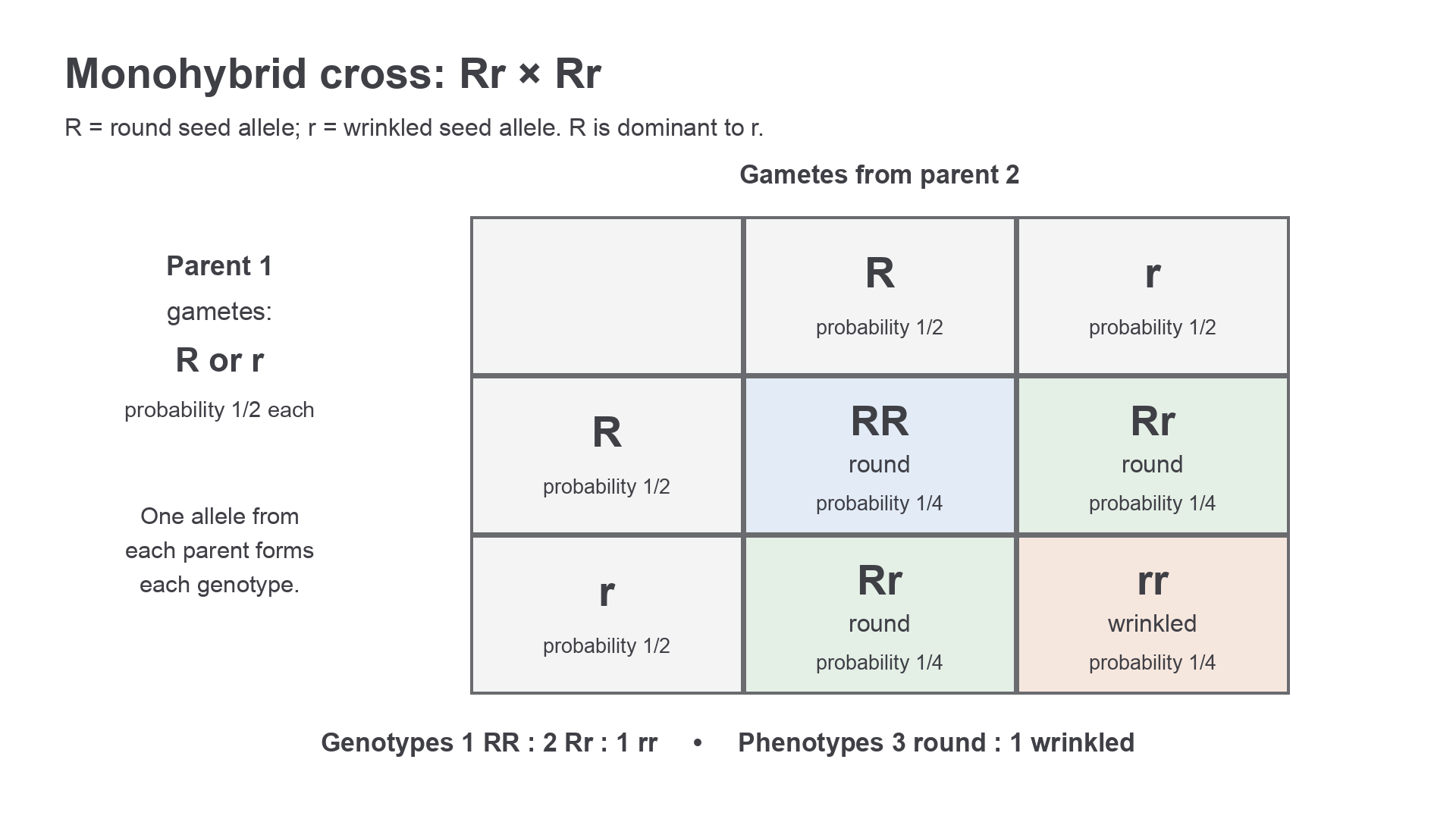
Each cell has probability 1/4. The two Rr cells are two different gamete combinations leading to the same genotype.
The genotype ratio is 1 RR : 2 Rr : 1 rr. The phenotype ratio is 3 round : 1 wrinkled because both RR and Rr are round. Thus , while . The notation means probability. Fractions or ratios must name their categories and preserve their order: “3:1” alone does not say which phenotype is predicted three times as often.
A cross with a known recessive homozygote can help resolve a dominant-phenotype plant. RR × rr predicts only Rr, round offspring. Rr × rr predicts Rr and rr equally often. A wrinkled offspring therefore shows that the round parent supplied r and is Rr. A finite sample of all-round offspring does not prove RR: an Rr parent can happen to produce only round offspring in a small sample.
Probability across offspring
An expected inheritance ratio describes probabilities, not a quota that a family or a tray of seedlings must fulfil.
For a fixed Rr × Rr cross, each fertilisation is a new event with . Under the model of independent offspring, getting a round seed does not change the parents' genotypes or the allele probabilities in later gametes. Four offspring need not include exactly one rr offspring. In a large sample the proportions tend to approach the model's expectations, but the observed counts can differ by chance. Calculating a statistical test of the difference is a separate skill.
For independent events, multiply probabilities when both must occur: .
For complementary outcomes, .
For two successive offspring from Rr × Rr, the probability that both are rr is . This differs from the chance for a single offspring, which stays 25%. If the order is specified as first wrinkled, then round, the probability is . Do not add these probabilities: both specified events must occur.
For at least one rr offspring among three, it is easier to calculate the complementary event, no rr offspring. Each non-rr offspring has probability , so:
The final percentage is rounded to three significant figures; the exact fraction is retained in the working. “At least one” includes one, two or three rr offspring. Simply multiplying 25% by three would incorrectly add outcomes that overlap.
Expected counts use the same probabilities. For 80 offspring from Rr × Rr, the expected counts are round and wrinkled. These are a prediction, not a claim that 60 and 20 were observed. Neither offspring counts nor inheritance probabilities have physical units.
Continue this lesson.
You’re previewing NovaLearn without an account. Create a free account to read the rest.
Create free account