7.1 - Muscles, bones and antagonistic movement
Moving a limb depends on muscles pulling through attachments onto a stable, jointed skeleton. Learn how bones, tendons and ligaments work together, why flexors and extensors act antagonistically, and why a muscle can contract without shortening.
Support, attachment and stability
A muscle can produce force, but it needs attachments and a skeleton to turn that force into useful limb movement. The skeleton supports the body and provides attachment sites. Its rigid bones act as levers: a pull on one part of a bone can move another part, such as the hand carrying a load. A joint is where bones meet. At a movable joint such as the elbow, the bones can change their angle relative to one another.
Skeletal muscles generate tension when activated. Tension is a pulling force transmitted along a structure. Muscles do not actively push on bones to reverse a movement. A shortening muscle pulls its attachments towards one another; which bone moves depends on which attachment is more firmly stabilised.
Tendons and ligaments
A tendon connects a muscle to a bone and transmits the muscle's pulling force. A ligament connects bone to bone at a joint, helping to stabilise the joint and limit excessive movement.
Both structures contain strong collagen fibres, but their attachment and function differ. Tendons resist tensile forces so that muscle tension can reach the skeleton. Ligaments resist displacement of the bones from their normal relationship while allowing the joint's normal range of movement. They are not rigid glue holding a movable joint completely still.
The roles therefore fit together: muscle supplies active force, tendon transmits it, bone acts as a lever, and the joint permits rotation while ligaments help keep the bones aligned. Tendons and ligaments do not actively contract like skeletal muscle. A ligament's resistance can restrain movement, but it is not the active motor driving a limb.
Attachments and turning effects
The position of a muscle's attachments determines which way its pull can turn a bone. To move a bone about a joint, a muscle must act across that joint, with its line of pull passing to one side of the joint's axis of rotation. With the other attachment stabilised, tension transmitted by the tendon produces a turning effect. A tendon does not push the bone away from the muscle.
Consider the elbow. The humerus is the upper-arm bone; the radius and ulna are the forearm bones. The biceps brachii lies at the front of the upper arm. Its upper attachments are on the scapula at the shoulder, and its distal tendon crosses the front of the elbow to attach to the radius, at the radial tuberosity. Its pull can bend the elbow. Do not infer that biceps attaches to the humerus simply because its muscle belly lies over it.
The triceps brachii lies at the back of the upper arm. Its upper attachments include the humerus and scapula, and its distal tendon attaches to the olecranon, the projection of the ulna at the back of the elbow. Its pull behind the elbow can straighten the joint. Thus the two muscles act on opposite sides of the elbow's axis; they do not pull directly on each other. Other muscles also assist elbow movements, so this pair is a useful simplified example rather than the complete anatomy of the limb.
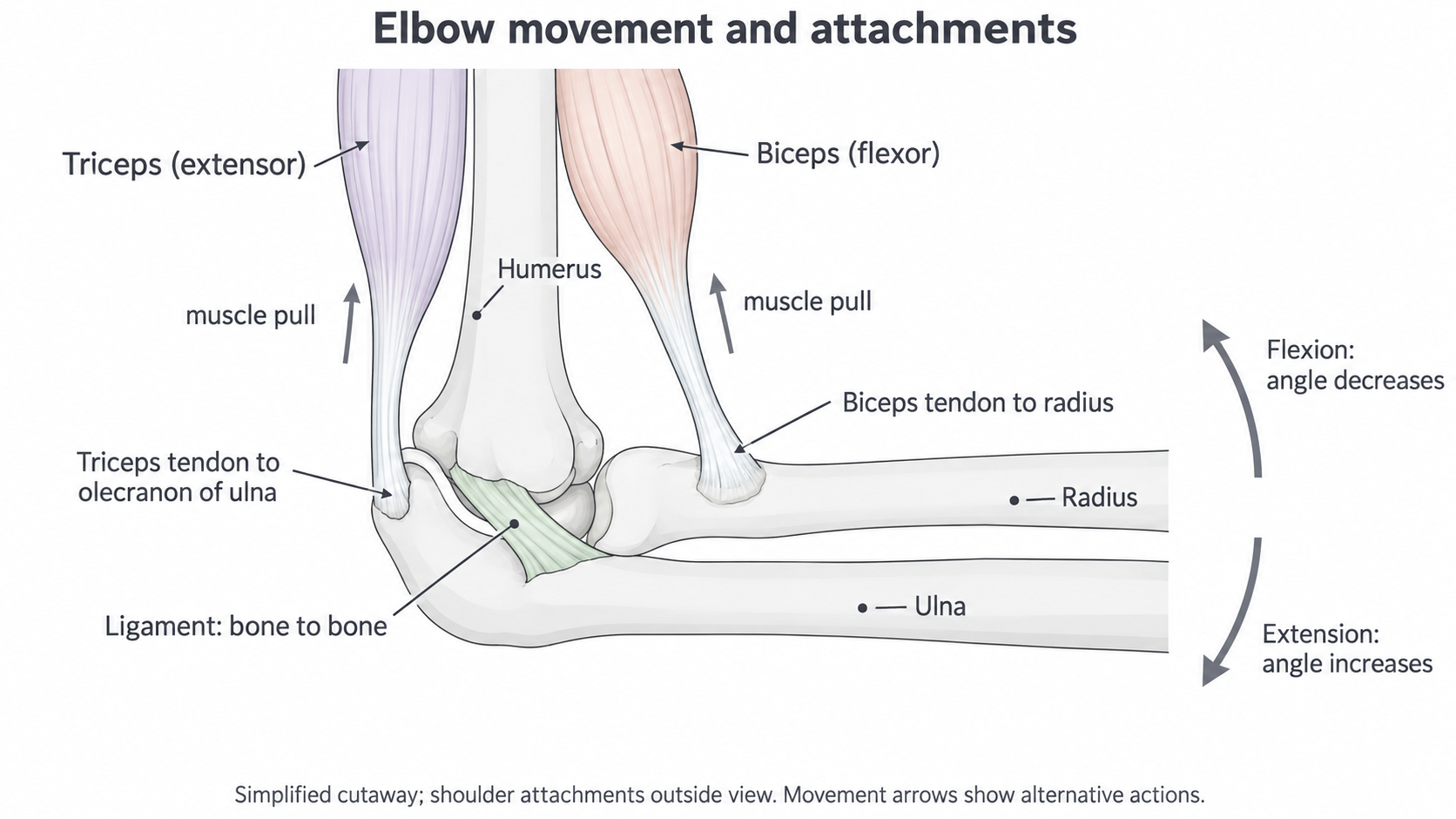
The straight arrows indicate the direction of each muscle's pull on its forearm attachment. The curved arrows show alternative bending and straightening movements. Shoulder attachments lie outside this simplified view; the pale green ligament joins bones, independently of the muscle-to-bone tendon paths.
The same mechanical reasoning predicts the effect of a broken attachment: if a muscle contracts but its tendon no longer connects it to the moving bone, the usual force-transmission route is interrupted. Intact ligaments may still stabilise the joint, but cannot replace that muscle's tendon. Other intact muscles might still move the joint, so loss of one tendon need not abolish every movement.
Flexors, extensors and antagonists
Bending and straightening a joint require pulls with opposite turning effects. Flexion decreases the angle between the bones at a joint such as the elbow or knee. Extension increases that angle. A muscle that produces flexion is a flexor at that joint; one that produces extension is an extensor there.
Continue this lesson.
You’re previewing NovaLearn without an account. Create a free account to read the rest.
Create free account