7.6 - Oxidative phosphorylation
The link reaction and Krebs cycle transfer much of the energy from respiratory substrates to reduced NAD and reduced FAD. Oxidative phosphorylation uses their electrons to build a proton gradient across the inner mitochondrial membrane, then couples proton return to ATP synthesis. Following electrons and protons separately explains both how the process works and why oxygen is needed.
A membrane separates two proton environments
The inner mitochondrial membrane provides both a working surface for respiratory proteins and a barrier between two compartments.
The matrix is the compartment enclosed by the inner membrane. The intermembrane space lies between the inner and outer mitochondrial membranes; the spaces inside the folds of the inner membrane connect with it. Those folds are the cristae. They increase the inner membrane's surface area, providing room for more electron transport proteins and ATP synthase molecules in a mitochondrion of a given size. More working proteins can support a greater rate of ATP synthesis when substrates and oxygen are available.
The lipid bilayer of the inner membrane has very low permeability to protons, which are hydrogen ions, . This allows the two sides to maintain different proton concentrations and electrical potentials. If protons could freely cross the bilayer, the difference would rapidly dissipate. The outer membrane is not the barrier across which this ATP-producing gradient is maintained.
Oxidative phosphorylation
ATP synthesis from ADP and inorganic phosphate, coupled to the oxidation of reduced electron carriers through an electron transport chain and the resulting proton gradient.
Phosphorylation means adding a phosphate group. Here, energy transfer makes it possible to add inorganic phosphate, , to ADP to form ATP. This differs from the substrate-level phosphorylation in glycolysis and the Krebs cycle, where a phosphate is transferred directly from a phosphorylated substrate to ADP.
Electron transfer powers proton pumping
Reduced NAD and reduced FAD supply electrons to the electron transport chain rather than supplying ready-made ATP.
NAD and FAD are coenzymes that accept electrons during earlier respiratory reactions. Reduced NAD, also written NADH, carries electrons from reactions including the link reaction and Krebs cycle. Reduced FAD, also written FADH₂, carries electrons while associated with its enzyme. When these reduced carriers donate electrons to the respiratory chain, they are oxidised: oxidation is loss of electrons. Oxidised NAD and FAD can accept electrons again in earlier reactions, so the carriers are recycled.
The electron transport chain is a sequence of electron carriers associated with the inner mitochondrial membrane. A carrier accepts electrons and then passes them to another carrier, undergoing reduction and oxidation in turn. Reduced NAD and reduced FAD feed electrons into different positions in this system. Their electrons do not all follow an identical route, so it is misleading to assume that both reduced carriers must support the same ATP yield.
Electron transfer along the chain releases energy through the overall oxidation–reduction reactions. Some respiratory complexes couple this energy transfer to pumping protons from the matrix into the intermembrane space, against their electrochemical gradient. Not every electron carrier is a proton pump. The pumped protons are drawn from the matrix proton pool: an electron is not turned into a proton, and the chain does not pump electrons into the intermembrane space in place of protons.
This pumping raises proton concentration outside the matrix and makes that side more positive relative to the matrix. The electrochemical gradient combines a concentration difference and an electrical potential difference. It stores energy that can subsequently drive proton return. Energy is transferred through these coupled reactions; breaking a chemical bond alone requires energy and is not the explanation for the energy supplied.
Proton return drives ATP synthase
ATP synthase provides a route for protons to return to the matrix while coupling that movement to ATP production.
Chemiosmosis
The coupling of ATP synthesis to the movement of protons down their electrochemical gradient through ATP synthase across a membrane.
During ATP synthesis, protons move from the intermembrane space into the matrix, down their electrochemical gradient, through the membrane portion of ATP synthase. This direction is the reverse of respiratory proton pumping. Because the inner membrane's lipid bilayer has low proton permeability, protons cannot freely bypass the enzyme and dissipate the gradient. The proton flow drives rotation and changes in the enzyme's shape, coupling energy from the gradient to the formation and release of ATP from ADP and inorganic phosphate. Its catalytic head faces the matrix, so ATP is synthesised on the matrix side of the inner membrane.
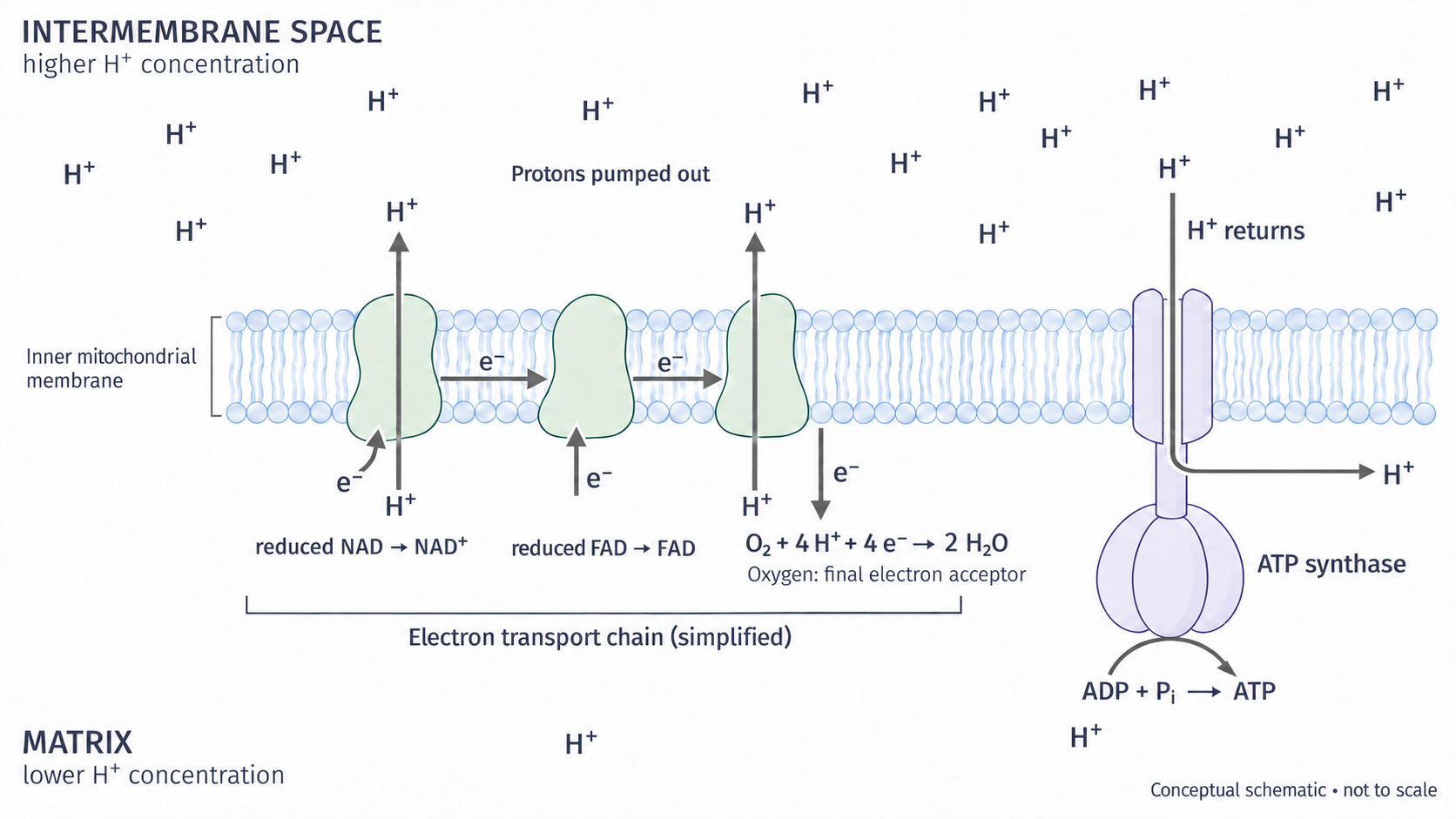
The conceptual schematic separates horizontal electron transfer from proton movement across the membrane. The green shapes simplify the carrier sequence; they do not represent a complete numbered set of respiratory complexes. The proton return arrow exits into the matrix beside the ATP synthase head; ATP is formed at the head, rather than passing through the proton channel. The drawing is not to scale and does not specify a proton-to-ATP ratio.
Continue this lesson.
You’re previewing NovaLearn without an account. Create a free account to read the rest.
Create free account