Core practical 2 - Vitamin C in food and drink
A colour change can turn a comparison between foods into a quantitative investigation. In Core practical 2, you will use a vitamin C standard to calibrate DCPIP, measure food and drink samples, and decide how confidently the results support a claim.
DCPIP and the endpoint
Vitamin C, also called ascorbic acid, can reduce a coloured dye and so provide a measurable chemical endpoint.
Reducing agent
A substance that donates electrons to another substance. The reducing agent is itself oxidised.
DCPIP is a redox dye: its oxidised form is blue in approximately neutral water, while its reduced form is colourless. Vitamin C donates electrons to DCPIP. As the dye is reduced, its blue colour disappears. This is a chemical test for reducing activity, which we use to estimate vitamin C under controlled conditions.
In this lesson, vitamin C solution or food extract is added to a fixed amount of DCPIP. The added sample gradually reduces the dye. The endpoint is the first point at which the dye's colour has disappeared after gentle mixing, using the same observation rule in each trial. For a colourless vitamin C standard, the final mixture is colourless. A juice can retain its own yellow or orange colour even after the DCPIP has been reduced.
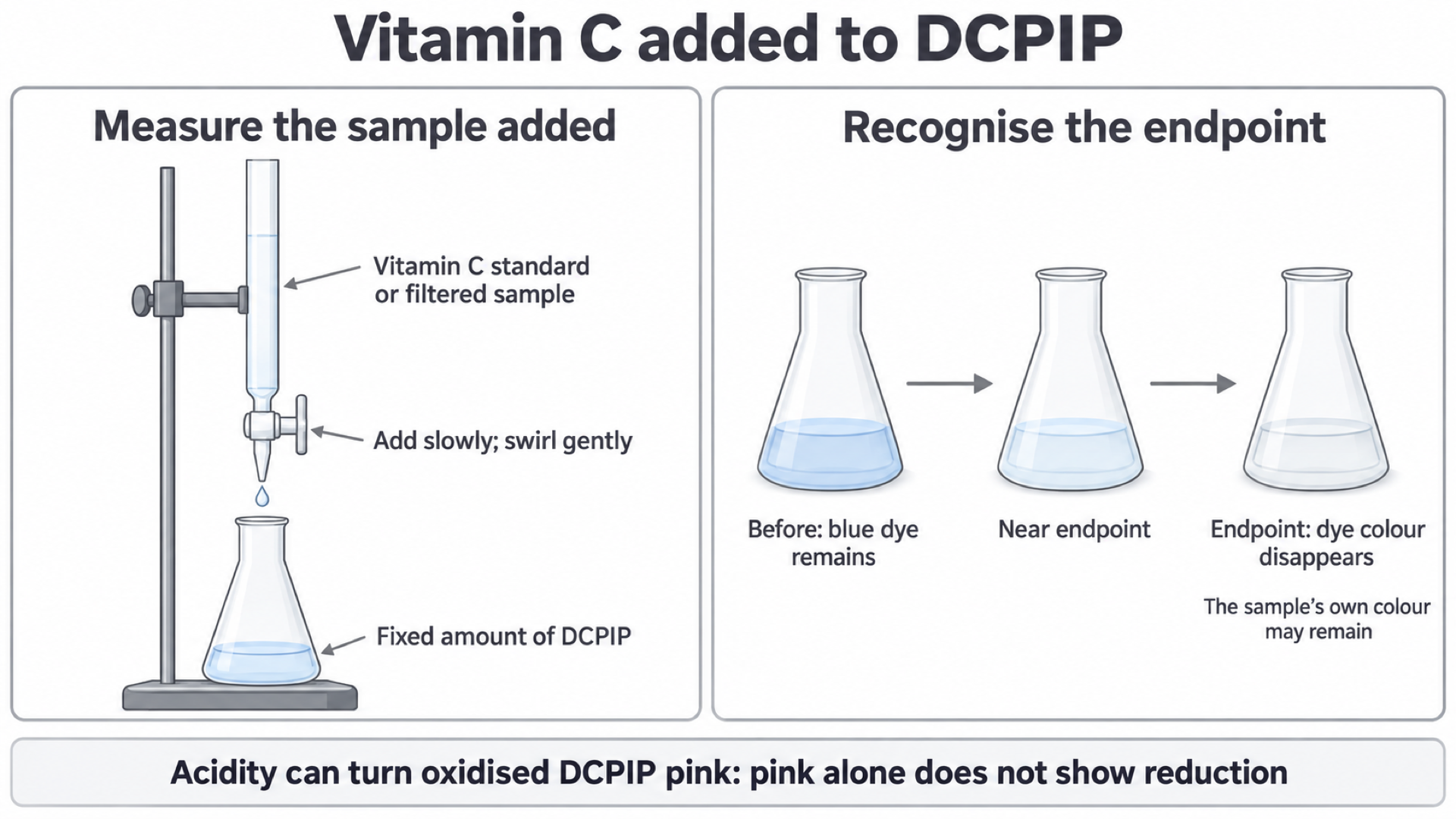
The sample is added to the dye in this method. The illustration is an apparatus and colour-change schematic, with no measured scale.
For the same amount of DCPIP, a more concentrated vitamin C solution supplies the required reducing activity in a smaller volume. A larger sample volume therefore indicates a lower concentration, provided the samples have comparable interfering effects. Counting drops is less useful than measuring volume: drops can differ in size.
Acidity matters. Oxidised DCPIP can become pink in acidic conditions, so a blue-to-pink change alone does not demonstrate that it has been reduced. Compare with a sample-only colour blank and a teacher-demonstrated endpoint; use clear, suitably diluted samples. If colour, cloudiness or an acidic colour shift makes dye disappearance impossible to judge, report that limitation and use a validated modified method. Do not call every pink tube an endpoint.
There is a valid reverse method in which DCPIP is added to a fixed sample volume. Its endpoint is the first persistent excess dye colour, because the sample can no longer reduce all the added dye. Its volume comparison is also reversed. A method must state which liquid is being added; the calculations below apply to sample added to fixed DCPIP.
Standards and sample preparation
A known vitamin C standard makes a dye endpoint useful as a concentration measurement, while careful preparation makes different samples comparable.
Standard solution
A solution with a known concentration, used as a reference for a measurement.
Use freshly prepared pure ascorbic acid rather than assuming that a vitamin tablet contains only vitamin C. For example, dissolve a measured of ascorbic acid in a little distilled water, transfer it quantitatively into a volumetric flask, rinse the original vessel into the flask, and make up to the mark. Mix thoroughly. Since , the stock concentration is . Quantitative transfer means transferring all the dissolved material, including the rinsings, rather than leaving some behind.
Make up to a final volume is different from adding that volume of water. To prepare , pipette of a stock into a volumetric flask and make up to its mark with distilled water. Mix by repeated inversion with the stopper in place. Half the final solution comes from the stock, so its concentration is halved. The number of significant figures used for a supplied standard should reflect its preparation and stated uncertainty, rather than treating all trailing zeros as proof of accuracy.
A serial dilution uses one diluted solution to prepare the next. Transfer of this mixed working standard into another volumetric flask and make up to its mark. Its concentration is . Each step is twofold, so the total dilution from the original stock is , rather than two. Mix before each transfer and use clean equipment to prevent carry-over changing the next concentration. The same weaker standard can be made directly from stock, as shown in the table below; serial preparation saves stock but carries the earlier preparation uncertainty into the next step.
For a dilution in which no vitamin C is lost:
is concentration in , is volume in , and is the unitless dilution factor.
For a drink, mix the container's contents gently before sampling. Filter pulp if necessary, using the same procedure for each comparable sample. For a fivefold dilution, transfer of drink into a volumetric flask and make up to the mark. The drink-to-water ratio is approximately , while the drink-to-final-solution ratio is . Record the actual aliquot and final volume so that an ambiguous label such as “1 in 5” cannot change the calculation.
For a solid food, first define what is being compared: for example, the vitamin C extracted from of edible tissue. Weigh the tissue and grind it thoroughly with a measured portion of cool distilled water. Filter the slurry, collecting the liquid in a volumetric flask. Rinse the preparation vessel and retained tissue with small portions of water into the same flask, then make the collected liquid up to the mark and mix. Choose extraction and rinse volumes that fit within the final volume. Apply the same extraction time, degree of grinding and handling to each food. This measures the vitamin C recovered by that extraction. Incomplete extraction or vitamin C retained in discarded material can make the estimate lower than the food's true content.
Prepare standards and extracts shortly before testing. Keep them cool, covered and away from strong light, then test after a standardised delay. Vitamin C can be oxidised during exposure to air and during handling; a sample left open for longer may appear to have less vitamin C because of the preparation, rather than the food being compared. Do not vigorously aerate the samples.
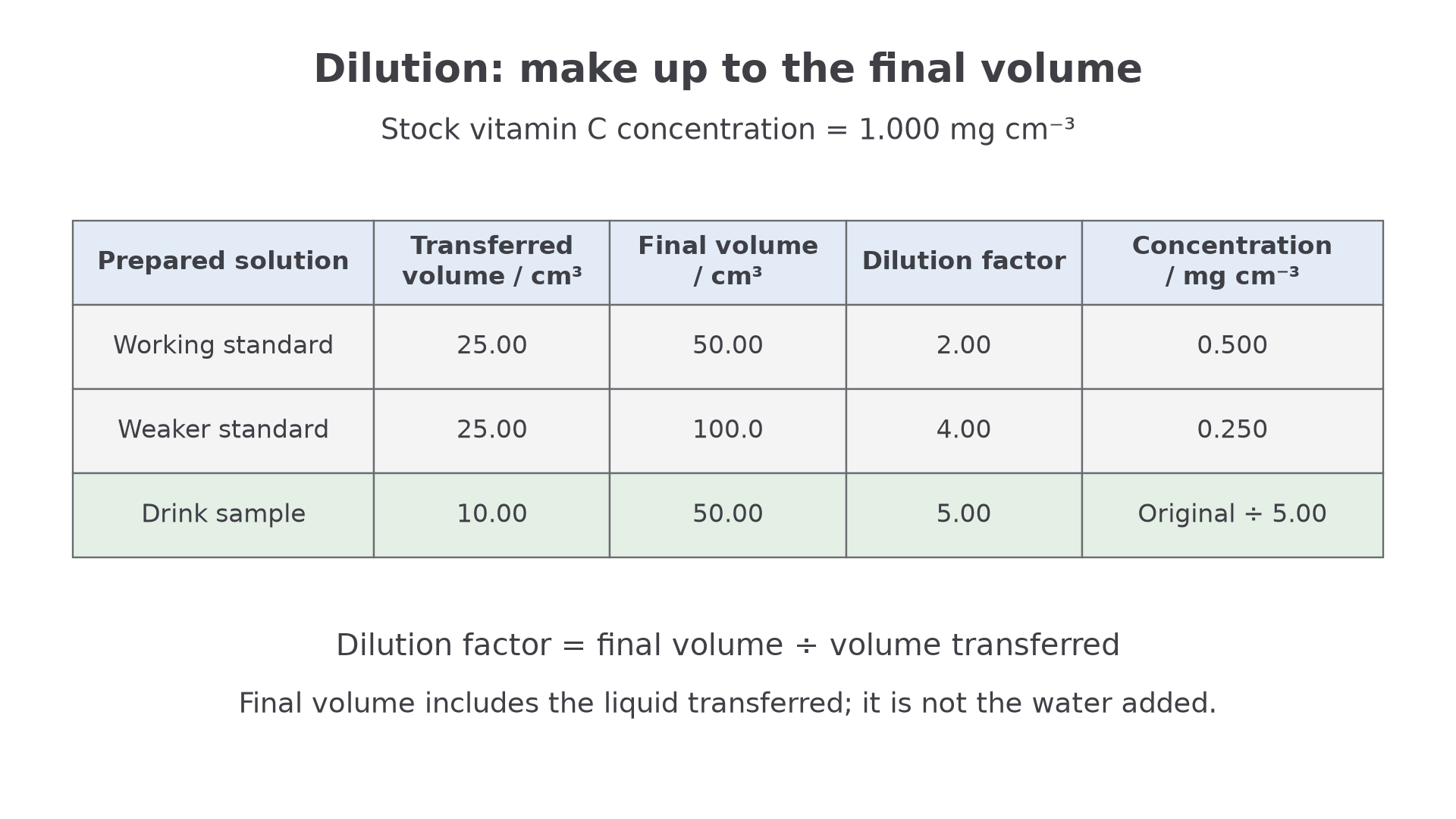
The final volume includes the stock or drink transferred. The table gives calculated concentrations for standards; the drink's original concentration remains unknown until titration.
Controlled titration method
A useful comparison changes the food or treatment while keeping the dye measurement and sample handling consistent.
For a comparison of drink types, the independent variable is the drink type. The measured dependent variable is the volume of diluted drink needed to reach the endpoint; the processed dependent variable is vitamin C concentration. For an investigation of heating, the independent variable could instead be heating duration. A measured concentration answers the biological question more directly than a statement about which tube changed colour fastest.
A suitable question is: “Which of two specified drinks contains more estimated vitamin C per under this method?” A testable hypothesis could predict that drink A has a higher concentration than drink B. Record the prediction before seeing the results, then use the measurements and their limitations to decide whether they support it.
Use a fresh teacher-supplied DCPIP solution, for example mass per volume, from one batch. Its stated concentration does not remove the need for calibration. A suitable apparatus set includes a balance, volumetric flasks and pipettes, a pipette filler, a burette with a clamp, small conical flasks, a white tile, a thermometer, labelled sample vessels and eye protection. A graduated syringe can be an alternative, with its own resolution and reading method recorded; a sharp needle is unnecessary.
Measure a standard and then the unknowns
- Label standards, samples and dilution factors. Record preparation time and the room or water-bath temperature; use the same testing temperature, for example . Obtain the teacher's risk assessment and follow the written instructions before starting.
- Rinse the burette with a little of the solution it will deliver. Fill it with the vitamin C standard, ensure its tip is filled without an air bubble, and remove the filling funnel. Clamp it securely. Read the bottom of the meniscus at eye level, recording the initial reading with the burette's appropriate precision.
- Use a pipette and filler to place of DCPIP into a clean small flask on a white tile. Use the same DCPIP volume and batch for every titration. More dye would require more sample and could falsely suggest a lower vitamin C concentration.
- Add the standard to the DCPIP while swirling gently. Slow to individual drops near the endpoint. This limits overshooting: adding sample beyond the true endpoint records too large a volume and underestimates concentration. Let every drop enter the liquid; rinse a drop on the flask wall down with a small amount of distilled water if needed. This extra water changes neither the amount of dye nor the amount of vitamin C delivered.
- Stop at the first disappearance of the dye colour after mixing, checked for the same short interval, for example 10 seconds, in every trial. Record the final burette reading and calculate the titre, final reading minus initial reading. A pilot trial locates the endpoint; keep it labelled as a pilot rather than treating it as a precise repeat.
- Carry out at least three measured titrations using new DCPIP aliquots. Record every result and observation. Repeat a trial if an identifiable problem occurs, such as an air bubble or an obvious overshoot, and keep the original reading and reason rather than silently deleting it.
- Rinse and refill the burette with each filtered sample, then repeat the same procedure. Use a sample-only colour blank alongside the flask to judge the sample's background colour. Run a distilled-water negative control: it should not remove the dye colour by reduction. Use a known vitamin C standard as a positive reference.
- If the endpoint occurs after only one or two drops, dilute the sample by a known factor and retest; a tiny titre has large relative uncertainty. If the required volume exceeds the burette's range, use a more concentrated test sample where possible or a teacher-validated smaller dye amount, then recalibrate that dye amount. Check the standard again near the end of the session to detect drift in the dye or standard.
Keep DCPIP amount, temperature, endpoint rule, lighting, mixing, preparation-to-testing delay and sample-processing method controlled. Record each sample's dilution separately. If heating is the variable, use matched portions from one mixed batch, standardise heating temperature, cool all portions before titration and restore a measured final volume after evaporation. Otherwise water loss could raise concentration and hide vitamin C loss. Repeated aliquots from one bottle check titration repeatability; independent bottles or food specimens are needed to assess variation between sources.
Wear eye protection and prevent DCPIP contacting eyes or skin; wash splashes promptly under the laboratory's procedure. Do not taste laboratory food or solutions and never mouth-pipette. Secure the glassware to limit breakage, handle broken glass with the laboratory's tools, and use a pipette filler. Use a board and a safe cutting technique when preparing food. If heat is investigated, use a controlled water bath, suitable tongs and time for hot vessels to cool. Check known food allergies, use only necessary quantities, and dispose of solutions as directed by the teacher's current local risk assessment. There is no need to expose a living animal or recruit people to consume samples.
Calculating vitamin C content
The standard tells us the vitamin C mass equivalent to the fixed dye amount, and the unknown titre tells us how concentrated the sample is.
The following are original simulated results for learning, not measured results from a particular brand. Each trial uses of the same DCPIP solution and the same endpoint. The standard concentration is . Drink A and drink B are each diluted from to , so . Food F is an undiluted filtered extract made from of food to a final .
| Solution added to DCPIP | Titre 1 / | Titre 2 / | Titre 3 / | Mean titre / |
|---|---|---|---|---|
| Vitamin C standard | 1.18 | 1.20 | 1.22 | 1.20 |
| Diluted drink A | 10.00 | 10.10 | 9.90 | 10.00 |
| Diluted drink B | 14.90 | 15.00 | 15.10 | 15.00 |
| Food F extract | 3.98 | 4.00 | 4.02 | 4.00 |
Calculate each arithmetic mean by adding its three titres and dividing by three. For A, . Keep full calculator precision through later working and round the final result appropriately.
Calibrate the dye amount
Concentration multiplied by volume gives mass. The vitamin C mass supplied by the mean standard titre is:
Here is the vitamin C mass equivalent to this DCPIP aliquot, is standard concentration and is mean standard titre. We obtain experimentally; we do not assume that of any DCPIP solution always represents the same vitamin C mass.
A range of standards can check the calibration. With this dye aliquot, ideal endpoint volumes of , and for standards of , and respectively all give . Doubling concentration halves the required volume. Major departures prompt checks on standard preparation, endpoint judgement or dye drift; a raw plot of volume against concentration should not be forced into a straight line.
Rearrange and substitute
At the matched endpoint, the unknown test solution supplies the same vitamin C equivalent:
Divide both sides by to make the unknown concentration the subject: . If the tested solution was diluted, multiply by its dilution factor to recover the original concentration.
For sample added to equal amounts of the same DCPIP, with matched endpoints:
and use the same concentration units; and use the same volume units. for an undiluted sample. The calculation assumes comparable reactions and no important interference or loss during preparation.
For drink A:
This is per , since . Also, , so the value is per . Forgetting dilution would report one-fifth of the original concentration.
For B, , or per . A is higher than B in this example. The denominator is B because B is the reference. A's titre is smaller even though its vitamin C concentration is higher, which agrees with the dye mechanism.
The equation can also predict a useful titre. Rearranging gives . A drink diluted fivefold should require . This helps choose a dilution that avoids an endpoint of only a few drops.
Express a solid food result per mass
Food F's extract concentration is . The full extract therefore contains of recovered vitamin C. This came from of food:
Do not compare this number directly with a drink's per as though the denominators were identical. State the basis of every comparison and whether the food result is an extraction estimate.
Precision and combined uncertainty
Repeated titres can agree closely even when a shared measurement bias makes the reported concentration inaccurate.
Precision concerns the spread of repeated measurements. Accuracy concerns closeness to the true value. Repeatability concerns agreement when the same method and conditions are used again. A valid method measures the intended quantity and answers the stated comparison. Three similar titres improve confidence in repeatability, but do not prove accuracy or eliminate a systematic error.
A burette titre is the difference between two readings. If each has a stated uncertainty of , a simple conservative absolute uncertainty in the difference is . Use the apparatus's stated uncertainty where provided; resolution alone is not always its accuracy specification.
For a simple conservative estimate, add absolute uncertainties for a sum or difference, and add percentage uncertainties for a product or quotient. This gives an approximate maximum uncertainty for small uncertainties; it is not a statistical confidence interval.
The same titre uncertainty is of the standard titre, but only of A's titre. Small volumes can therefore dominate relative uncertainty. A more dilute standard gives a larger standard titre for the same dye aliquot, reducing this contribution, provided the endpoint remains clear. Repeat readings do not justify dividing every apparatus uncertainty by the number of repeats.
The calibration and sample titres in the worked example are each differences between burette readings. Suppose the supplied standard concentration has uncertainty. The drink dilution uses made up to , giving a simple dilution-factor uncertainty of . These are stated illustrative apparatus uncertainties; actual glassware may differ.
The dye aliquots also matter. If standard and sample each receive of DCPIP, their amounts could differ even though their nominal volumes are equal. Allow for this matching in the conservative estimate. Do not add an uncertainty for the stock preparation again if the standard's supplied concentration uncertainty already includes it.
For A's calculation, a conservative combined percentage uncertainty is:
The corresponding absolute uncertainty is . Report this approximately as , rounding the uncertainty and the value to a consistent decimal place. The earlier was a nominal three-significant-figure calculation; the uncertainty shows why its last digit should not be treated as established accuracy.
For B, the titre contribution is . The same approach gives , or about . Keeping extra digits for comparison, A's approximate interval is – and B's is –. These estimated measurement intervals do not overlap, supporting the ordering for these samples under the assumed method. They neither establish statistical significance nor include every possible bias.
Repeat spread is separate evidence: A's titres have range . Half-range, , is a simple descriptive estimate of observed scatter, not automatically another independent uncertainty to add to the same reading uncertainty. Larger scatter suggests endpoint judgement, inconsistent mixing or sample variation needs investigation. A bubble in the burette tip can inflate a titre if some delivered volume fills the tip rather than entering the flask. Consistently overshooting the endpoint introduces systematic bias. If an overshoot makes too large, the inverse calculation underestimates concentration.
Other reducing compounds can react with DCPIP and cause an overestimate if all reducing activity is attributed to vitamin C. Oxidation before testing or incomplete extraction can cause an underestimate. Repeats alone do not correct these effects. Clearer samples, controlled preparation, a check standard and a more selective independently validated assay address different limitations; each improvement should target a named source of error.
Conclusions and practical records
A conclusion is strongest when it answers the original question, uses the measured evidence and keeps its scope within the samples actually tested.
The worked results support the conclusion that the tested drink A had a higher estimated vitamin C concentration than the tested drink B: nominally versus per . The estimated measurement uncertainty is smaller than that separation. This supports the ordering under this assay's assumptions; it does not prove that every bottle of A has more vitamin C than every bottle of B. The repeats came from one prepared sample of each drink, rather than independent batches.
To investigate a broader claim, sample several independent bottles or batches of each drink, or several independently selected foods, prepare each separately and titrate repeated aliquots from each. This distinguishes variation between food sources from variation in the titration. Keep the sampling question clear: comparisons of named products, freshly squeezed versus stored juices, or heating treatments answer different questions. A manufacturer may add vitamin C, so a processed drink is not necessarily lower than a fresh juice.
A heating experiment can support a causal conclusion about the specified treatment when matched portions are allocated fairly and other conditions are controlled. A survey of unrelated fresh and processed drinks cannot isolate heating: variety, added vitamin C, storage and processing could all differ. For solid foods, vitamin C dissolved into cooking water is different from vitamin C chemically destroyed. If the question concerns total recovery, test both the tissue extract and retained cooking liquid and add their calculated masses. Measuring the tissue alone cannot distinguish these causes of loss.
Record work as it happens: date, question or hypothesis, source of each sample, method reference, masses, actual dilution volumes, temperature and handling times; apparatus resolution or stated uncertainty; initial and final readings, every titre, endpoint observations and any reason for repeating a trial. Present raw values with units in column headings, then show the means, calibration, dilution corrections, uncertainty and supported conclusion separately. Cite the method used and record any modifications. A neat final mean without raw observations cannot show how the result was obtained.
A DCPIP result is an estimate of vitamin C under a specified method. Calibrate the dye, correct for dilution, examine uncertainty and interfering effects, and limit the conclusion to the sampled foods and conditions.
Core practical 2 develops quantitative measurement, use of laboratory glassware and dilutions, and use of a reagent to identify a biological molecule. Written interpretation and online Study prepare you for these skills. They cannot demonstrate safe hands-on performance or award the Science Practical Endorsement. Your centre must observe practical competence, retain evidence and authenticate its CPAC judgement. The course teaches all 18 core practicals; the endorsement's minimum 12 practical activities is a separate requirement, not permission to omit this practical.