2.11 - DNA replication and experimental evidence
Before a cell divides, its DNA must be copied so that each daughter cell can receive the genetic information. In 2.11(i), you will follow how complementary strands are made; in 2.11(ii), you will use Meselson and Stahl’s evidence to distinguish three possible ways of copying DNA.
Copying by complementarity
DNA replication produces two double-stranded DNA molecules from one double-stranded molecule.
In a eukaryotic cell, nuclear DNA is replicated during the S phase of interphase, before cell division. The two strands of DNA have complementary base sequences: adenine pairs with thymine, and cytosine pairs with guanine. Each strand can therefore specify the sequence of a new partner. A template is the existing strand whose base sequence guides the synthesis of a complementary strand.
Semi-conservative replication
DNA replication in which each daughter DNA molecule contains one strand from the parent molecule and one newly synthesised strand.
The process begins when DNA helicase unwinds the double helix and separates its strands by disrupting the hydrogen bonds between paired bases. It does not cut each old sugar–phosphate backbone into nucleotides. The exposed bases on both old strands can now act as templates.
Free DNA nucleotides pair with the exposed template bases: a template A selects T, T selects A, C selects G, and G selects C. DNA polymerase catalyses the joining of nucleotides to the growing strand, forming covalent phosphodiester bonds in its sugar–phosphate backbone. Base pairing selects the complementary nucleotide; polymerase builds the connected new strand. Hydrogen bonds between paired bases and covalent bonds along a strand have different roles.
For example, a template sequence A–C–G–T requires the aligned new sequence T–G–C–A. The other old strand acts as a template too, so replication produces two duplexes with the same base-pair sequence as the parent, assuming no copying error. “Semi” refers to retaining one of the two parent strands in each product, not to copying only half the genes.
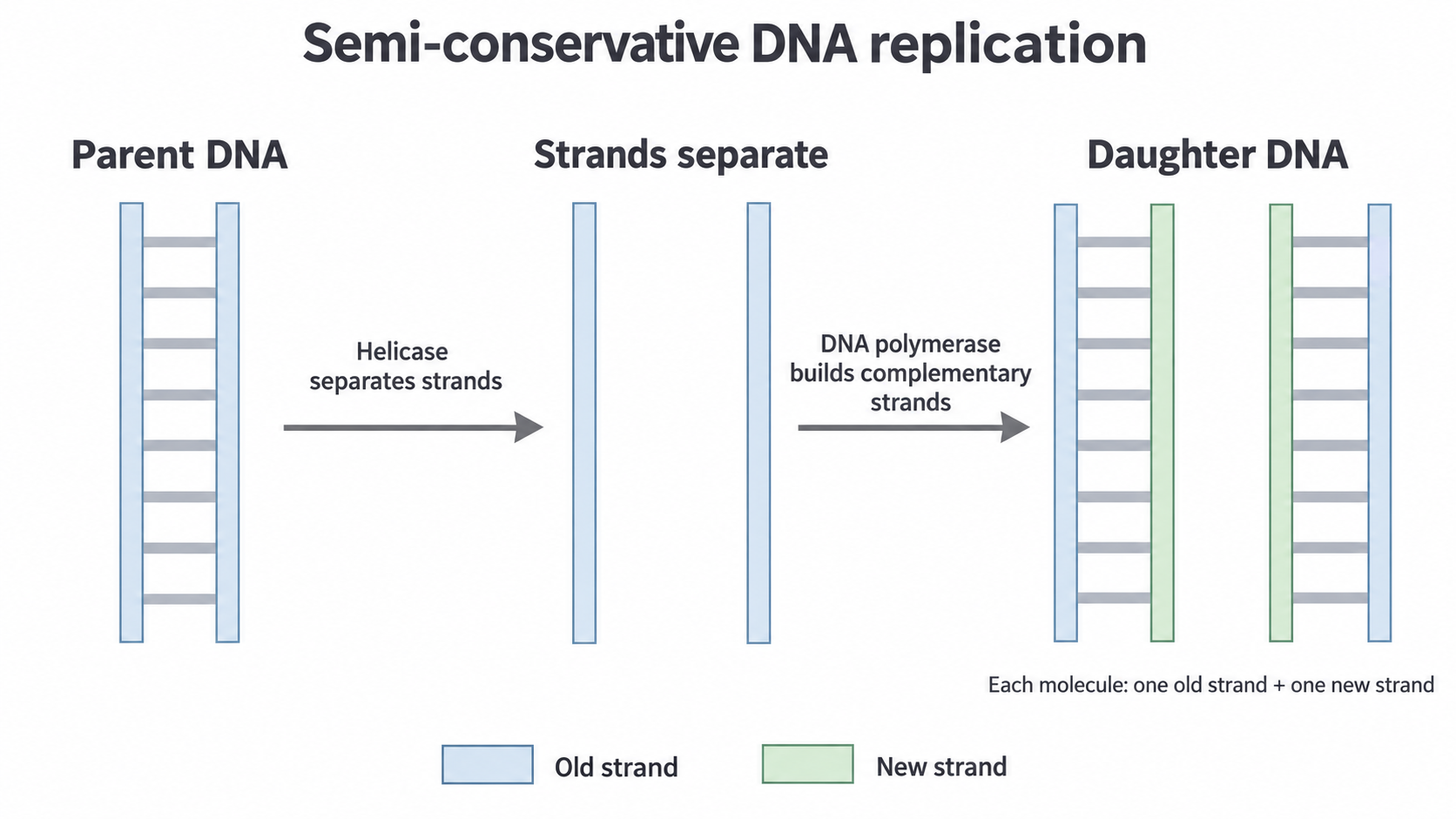
The ladders simplify the double helix. Blue represents an old strand and sage represents a new strand; each of the two daughter molecules has one of each.
Strand direction and synthesis
DNA polymerase extends a new DNA strand at its 3′ end, so strand direction matters when following replication.
The 5′ and 3′ labels refer to carbon positions in the deoxyribose sugars and identify the two different ends of a strand. The two strands in a duplex are antiparallel: one runs 5′ to 3′ in the direction in which its partner runs 3′ to 5′. This is a direction along a molecule, not a reference to the top or bottom of a page.
DNA polymerase adds an incoming nucleotide to the free 3′ hydroxyl group of an existing growing strand. Consequently, the new strand grows 5′ to 3′, while the template is read 3′ to 5′. A new strand is both complementary and antiparallel to its template. For example, if the template is written from left to right as 3′–A–C–G–T–5′, the aligned new strand is 5′–T–G–C–A–3′. Its growing 3′ end is on the right in this particular drawing.
Polymerase needs a starting strand end; it does not simply start a DNA chain from nothing. A short RNA primer, made by primase, supplies that starting 3′ end. The primer is later removed and replaced with DNA. This explains the starting condition for polymerase without changing the central result: the completed daughter molecule contains an old DNA strand and a new DNA strand.
At an advancing replication fork, the place where the strands are opening, one new strand can be extended continuously towards the fork. The other is made in short sections away from the fork as more template is exposed. Both kinds of synthesis still proceed 5′ to 3′. After primers are replaced, DNA ligase seals the remaining joins in the backbone between sections. Neither polymerase nor ligase is the enzyme that separates the original paired strands.
Track three separate things: helicase exposes templates; complementary base pairing specifies the sequence; DNA polymerase extends a connected new strand only at its 3′ end.
The two synthesis patterns arise from antiparallel templates and polymerase’s direction of extension. They do not produce one semi-conservative molecule and one wholly new molecule: each completed daughter duplex retains one old strand.
Competing replication models
Different models can all double the amount of DNA while making different predictions about where the old material will be found.
Knowing that DNA has been copied is therefore insufficient to decide how it was copied. The important question is whether parent material stays together, separates into intact strands, or becomes mixed in sections with new material.
| Model | What happens to the parent material? | Products after one replication |
|---|---|---|
| Conservative | The two parent strands remain together as the original duplex. | One wholly old duplex and one wholly new duplex. |
| Semi-conservative | The two parent strands separate, and each templates a new partner. | Two duplexes, each with one intact old strand and one new strand. |
| Dispersive | Old and new material are interspersed in sections within the daughter strands. | Two duplexes, each containing a mixture of old and new sections. |
To distinguish these predictions, the old material needs a detectable label. Nitrogen atoms occur in DNA bases. Isotopes are forms of an element with the same number of protons but different numbers of neutrons. The stable isotope ¹⁵N makes labelled DNA denser than DNA made using the lighter stable isotope ¹⁴N. These are density labels, not radioactive tracers.
Consider an idealised experiment starting with DNA whose two strands are heavy-labelled, then switching so all newly made strands contain light nitrogen. Call a fully heavy duplex HH, a fully light duplex LL, and a semi-conservative duplex with one heavy and one light strand HL, or hybrid DNA. “Hybrid” here describes isotope-labelled strands, not a cross between species.
After one replication, conservative copying predicts separate HH and LL populations. Semi-conservative copying predicts only HL. Dispersive copying also predicts molecules with an intermediate overall density, because old and new sections are mixed within each molecule. An intermediate-density band alone cannot reveal how the label is arranged inside each strand. A second round of replication provides a further test.
Meselson–Stahl evidence
Meselson and Stahl tested DNA replication in growing Escherichia coli bacteria in 1958 by following heavy nitrogen through successive generations.
They first grew bacteria for many generations using ¹⁵N-containing ammonium chloride as the nitrogen source, labelling their DNA. They then changed the nitrogen supply to predominantly ¹⁴N. In the original method, this shift was made by adding a tenfold excess of ¹⁴N-containing ammonium chloride to the growing culture and subsequently adding fresh light-nitrogen medium. This is commonly simplified as a transfer from heavy to light medium.
Samples were taken before the change and at intervals afterwards. Cells were chilled and lysed to release their contents. DNA in the lysates was centrifuged in a concentrated caesium chloride density gradient until it approached equilibrium. DNA forms a band where the surrounding solution has the same buoyant density as the DNA. Heavier-labelled DNA bands at a greater density, further from the rotor axis; lighter DNA bands at a lower density. The original experiment recorded the bands by ultraviolet absorption photographs and measured their profiles using a microdensitometer. It did not sequence the bases or directly film replication.
Heavy and light reference samples showed that the method could distinguish the two densities. Comparing samples at known generation times then connected changes in band pattern to replication rather than merely elapsed minutes.
| Time after the nitrogen shift | Main observation | Inference from the competing predictions |
|---|---|---|
| Before replication in light medium | Heavy DNA band. | Establishes the labelled starting population. |
| After one generation | One intermediate-density band; no separate heavy and light bands. | Refutes conservative replication, which predicts separate HH and LL. Both semi-conservative and dispersive models can still explain an intermediate band. |
| Around two generations | Intermediate and light bands in approximately equal amounts. | Supports semi-conservative replication: HL makes one HL and one LL. Refutes the standard dispersive prediction of a single band shifting towards the light density. |
| Later generations | The intermediate band stays at the same density while its share of the DNA decreases; light DNA becomes more abundant. | Old labelled strands are retained in a declining fraction of molecules, rather than the label becoming progressively diluted within every molecule. |
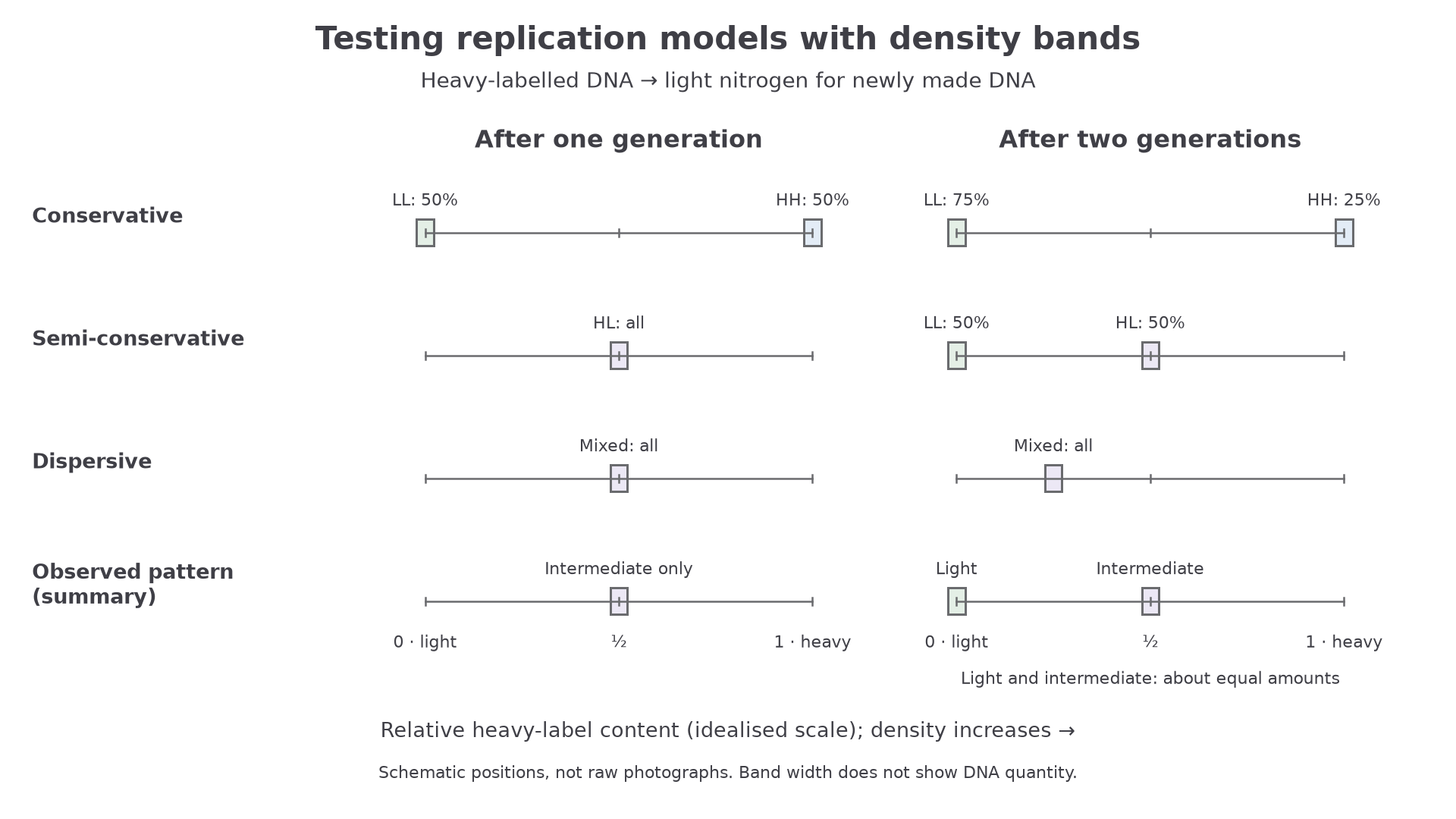
Original teaching schematic, not the experimental photographs. Density increases to the right. The horizontal scale expresses idealised heavy-label content: light at 0, half-labelled at ½ and heavy at 1. Bands show their positions; drawn width does not measure DNA quantity. The result row summarises the historical pattern.
The second-generation reasoning follows the fate of each hybrid molecule. Its heavy strand templates a new light strand, giving another HL molecule. Its light strand templates a new light strand, giving LL. Thus the hybrid band remains halfway between the heavy and light references, even when fewer molecules belong to that band. In the standard dispersive model, each molecule’s old material is diluted again, so all molecules would band together closer to the light reference.
The experiment supported the semi-conservative model through predictions that matched successive observations. It did not establish every enzyme’s role or every molecular detail of replication. The original authors also used heat denaturation to obtain separate heavy-labelled and light-labelled subunits from first-generation hybrid DNA; they were careful about identifying those subunits with the proposed DNA chains from these experiments alone. Modern strand structure and enzyme evidence supply the fuller mechanism taught above. The original paper preserves these methods, observations and qualifications.
Fractions across generations
Counting descendant molecules lets you predict band proportions as fractions, percentages and ratios.
For the following calculations, begin with one fully heavy HH molecule. Count only its equal-length descendants. After the switch, assume every newly made strand is fully light-labelled, every molecule replicates once per complete generation, and no old DNA is destroyed. These are idealised calculation conditions; the original culture was sampled at intervals and its label and nitrogen shift were not perfectly pure.
At generation 1, HH has made two HL molecules. At generation 2, each HL makes one HL and one LL, giving two HL and two LL overall. At generation 3, the two HL still make two HL plus two LL; the two existing LL each make two LL. The total is therefore two HL and six LL. The two original heavy strands persist, each in one hybrid molecule, while the total number of molecules doubles.
Here is the number of molecules in the category, is the total number of DNA molecules, is the fraction in that category, and is its percentage. Use molecule counts when asked for the proportion of molecules. Equal-length molecules make these count fractions correspond to DNA-amount fractions in this idealised model.
The successive counts give the following predictions for semi-conservative replication.
| Complete generations in light medium | Total molecules | HH | HL | LL |
|---|---|---|---|---|
| 0 | 1 | 1 (100%) | 0 (0%) | 0 (0%) |
| 1 | 2 | 0 (0%) | 2 (100%) | 0 (0%) |
| 2 | 4 | 0 (0%) | 2 (50%) | 2 (50%) |
| 3 | 8 | 0 (0%) | 2 (25%) | 6 (75%) |
For generation 3, the hybrid fraction is , or 25%. The light fraction is , or 75%. The hybrid:light ratio is . The percentages sum to 100%, and no fully heavy molecule remains after the first replication.
Keep “molecules containing a heavy strand” separate from “heavy strands as a fraction of all strands”. At generation 3, two of eight molecules contain a heavy strand, so 25% are hybrid. There are sixteen strands in those eight molecules, however, and only two are heavy: , or 12.5% of the strands. The denominator determines the answer.
Conservative replication would retain one HH molecule while making more LL molecules: after generation 3 it predicts one HH and seven LL, or 12.5% heavy molecules and 87.5% light molecules, with no hybrids. Standard dispersive replication predicts all molecules still contain some old material, but each contains a smaller heavy-labelled share. After three generations that share is one eighth, giving one band close to light, rather than separate light and fixed hybrid bands. Total old material can decline as a fraction in all three models, so its distribution among molecules is the decisive evidence.