8.4 - Synapses and acetylcholine
An action potential travels along a neurone, but neighbouring neurones are separate cells. At a chemical synapse, a released molecule carries information across the gap and changes the next cell's membrane potential. This lesson follows acetylcholine from its release to its removal, explaining why transmission has a direction and why a response does not always produce a new action potential.
A chemical junction
A chemical synapse converts an electrical change in one neurone into a chemical signal between cells.
Synapse
A junction at which one neurone communicates with another cell. At a chemical synapse, a neurotransmitter is released from the presynaptic cell and acts on receptors on the postsynaptic cell.
The presynaptic neurone sends the signal. Its axon ends in an enlarged synaptic terminal, also called a synaptic knob. The terminal contains synaptic vesicles: small membrane-bound sacs storing neurotransmitter ready for release. It also contains mitochondria, which supply ATP for processes such as maintaining ion gradients and recycling vesicle membranes. The terminal's surface facing the next cell is the presynaptic membrane.
The postsynaptic membrane belongs to the receiving cell, often on a dendrite or cell body of another neurone. A narrow extracellular gap, the synaptic cleft, separates the membranes. The two cells do not share continuous cytoplasm across this gap. An action potential therefore does not simply jump across as an electrical wave in the same membrane.
A neurotransmitter is a chemical messenger released by a neurone that binds to receptors on a target cell. Acetylcholine, abbreviated ACh, is one neurotransmitter; a synapse that releases it is cholinergic. Other synapses use other transmitters. The example here is an excitatory cholinergic synapse whose postsynaptic receptors directly open cation channels. It is a model of one type of synapse, not a claim that every neurotransmitter or every acetylcholine receptor acts in the same way.
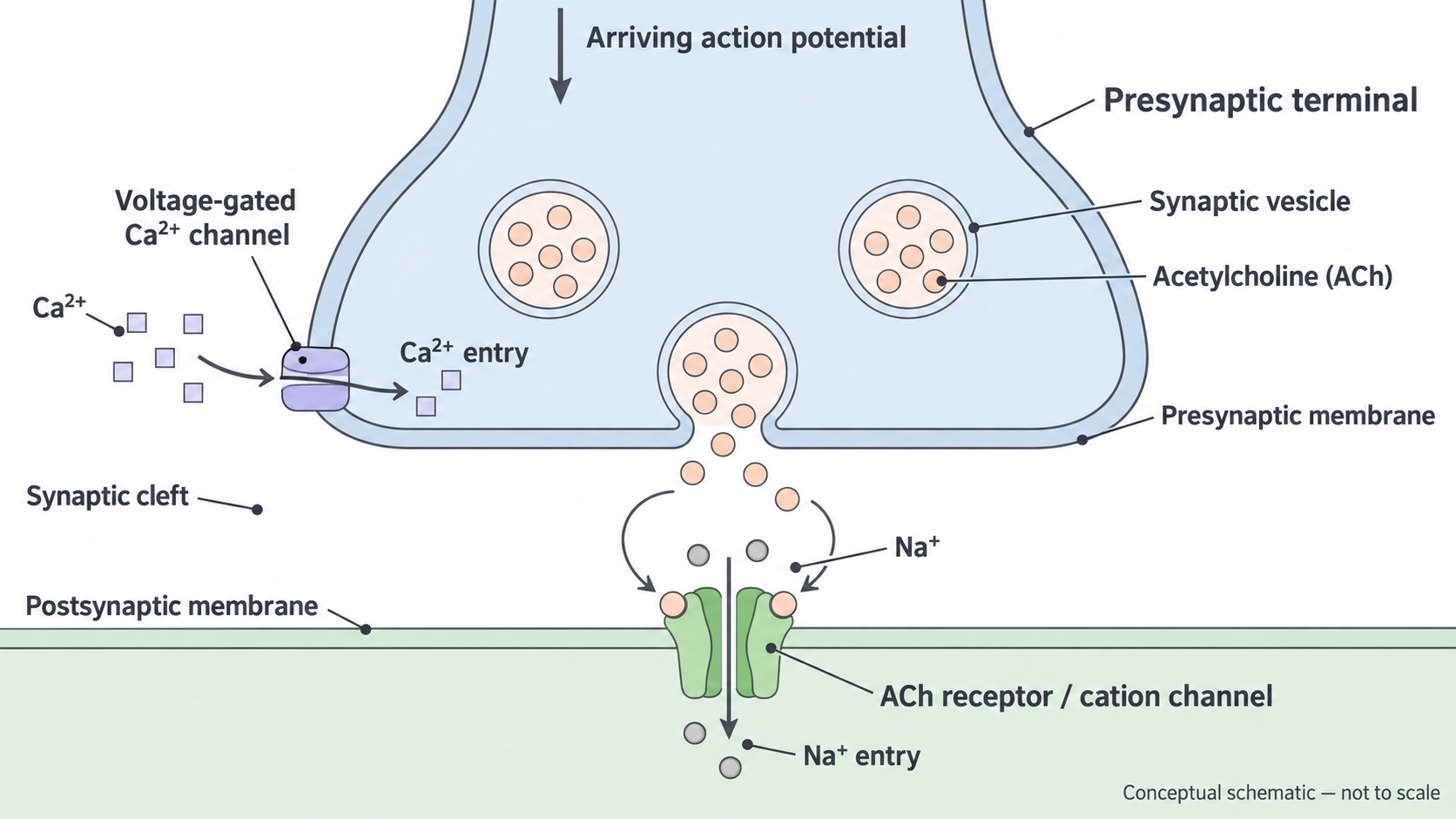
The presynaptic terminal releases ACh into the cleft; ACh binds outside the postsynaptic receptor-channel, while ions move through the open channel. This conceptual schematic is not to scale. The removal and recycling steps are explained later.
Calcium and vesicle release
The arrival of an action potential causes calcium entry into the presynaptic terminal, linking an electrical event to transmitter release.
As the action potential reaches the terminal, it depolarises the presynaptic membrane: the inside becomes less negative relative to the outside. This opens voltage-gated calcium channels in that membrane. Calcium ions, , enter the terminal down their electrochemical gradient. Their concentration is normally much greater outside the terminal than in its cytoplasm.
The rise in calcium concentration inside the terminal triggers vesicles at release sites to fuse with the presynaptic membrane. Their contents are released into the synaptic cleft by exocytosis. The vesicle membrane becomes continuous with the cell-surface membrane; the ACh molecules are released, rather than the whole vesicle being fired across the gap. The released ACh then diffuses through the cleft towards the postsynaptic membrane.
Keep the two ion roles separate. Sodium and potassium permeability changes allow the action potential to travel along the axon. Calcium entry at the terminal triggers transmitter release. Calcium does not carry the action potential across the cleft, and ACh is not released because it passes through a calcium channel.
The mechanism also predicts the order of failures. If the vesicle-fusion machinery failed while the arriving action potential and calcium channels remained functional, the terminal could still depolarise and admit calcium, yet release little or no ACh. Observing an arriving action potential is therefore not sufficient evidence that chemical transmission succeeded.
Receptors and threshold
Acetylcholine changes the next neurone's membrane potential by binding to a receptor, rather than by entering that neurone itself.
After diffusion across the cleft, ACh binds to a complementary binding site on a receptor protein in the postsynaptic membrane. In this excitatory example, the receptor is part of a ligand-gated cation channel: binding of a chemical ligand, here ACh, changes the protein's shape and opens its pore. A cation is a positively charged ion. This directly gated receptor type is a nicotinic ACh receptor. Its channel is opened by transmitter binding, whereas the presynaptic calcium channel is opened by a voltage change.
The open receptor-channel permits cation movement. At a resting postsynaptic membrane, sodium ions, , enter and the overall current is a net inward movement of positive charge. The inside becomes less negative, so the membrane depolarises. Nicotinic ACh receptor-channels are not exclusively sodium channels: they also conduct potassium, , and some types conduct calcium. Sodium entry is the important simplified link to depolarisation here; ACh itself remains outside the membrane at its receptor binding site.
Excitatory postsynaptic potential
A local, graded depolarisation of the postsynaptic membrane that makes the neurone more likely to reach the threshold for an action potential.
Graded means that the size of this local response can vary, for example with how many receptor-channels open. It is not itself an all-or-none action potential. The depolarisation spreads towards the neurone's action-potential initiation region. If the combined depolarisation there reaches threshold, voltage-gated sodium channels open sufficiently to initiate a new action potential, which then travels along that neurone's axon. If threshold is not reached, no new action potential is produced.
Continue this lesson.
You’re previewing NovaLearn without an account. Create a free account to read the rest.
Create free account