Required practical 8 - Electrochemical Cell EMF
This required practical shows how a redox reaction can be turned into a measurable voltage. You will build a cell from two half-cells, use a salt bridge to complete the circuit, and read the emf with a high-resistance voltmeter. The useful part of the setup is that each component has a clear job, so the reading can be used to compare metals or determine an unknown electrode potential.
What EMF Means In A Simple Cell
An electrochemical cell is built from two half-cells with different electrode potentials. When the half-cells are connected, electrons flow through the external wire from the more easily oxidised electrode to the electrode where reduction happens more readily.
Electrochemical cell
An electrochemical cell is a system in which a redox reaction generates a potential difference between two half-cells.
For example, in a zinc-copper cell, zinc is oxidised more easily than copper. Zinc atoms lose electrons:
Those electrons travel through the wire to the copper half-cell, where copper ions gain them:
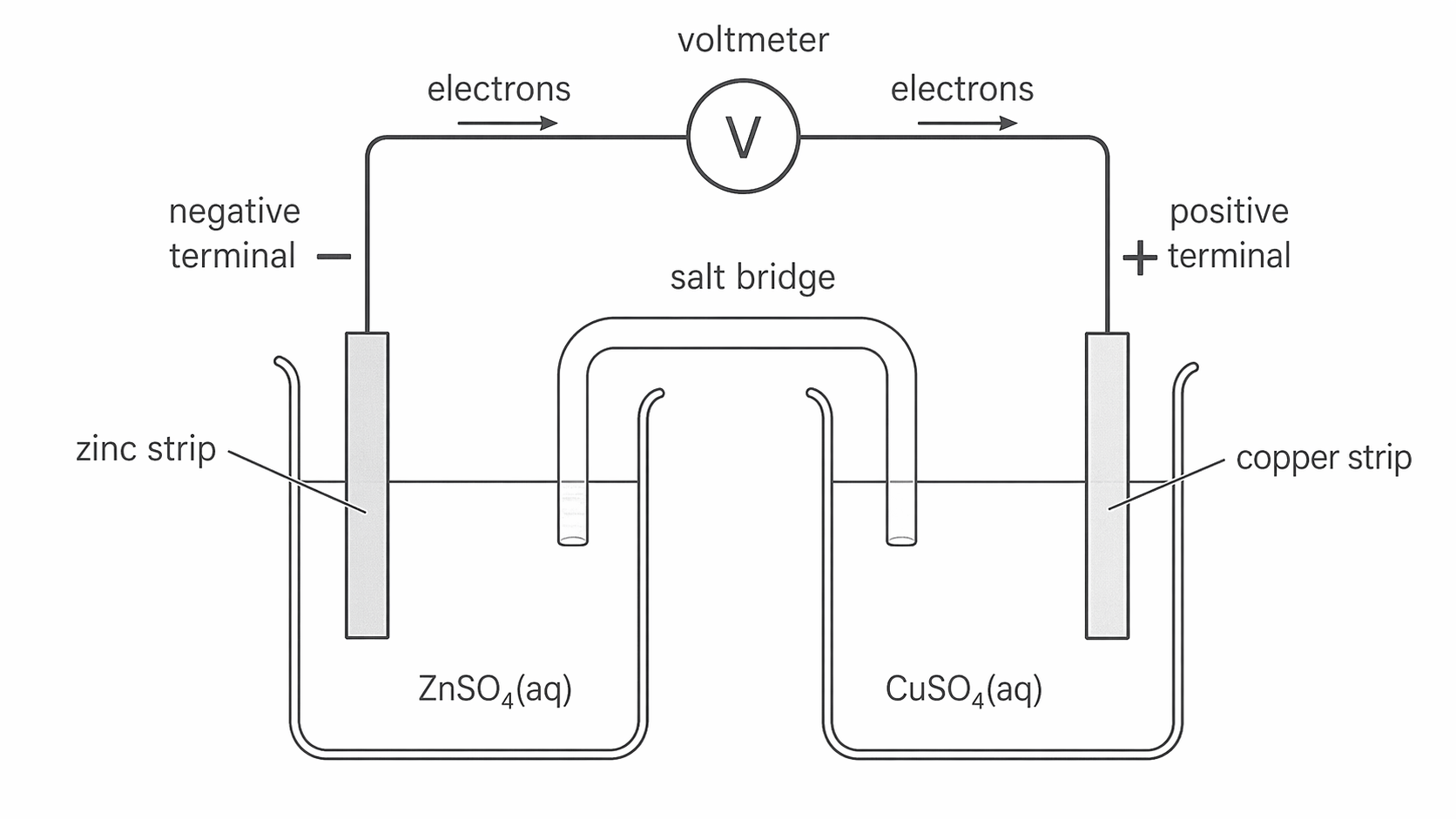
So the zinc electrode is the negative terminal and the copper electrode is the positive terminal. The voltmeter reading comes from the difference in the two half-cell potentials, not from how fast the reaction happens.
EMF
EMF is the maximum potential difference produced by a cell when no current is flowing.
In practice, a high-resistance voltmeter draws so little current that the measured voltage is a good approximation to the emf. A larger emf means a bigger difference between the electrode potentials of the two half-cells. The diagram below shows the standard zinc-copper arrangement used to measure this emf.
[DIAGRAM: asset_name: RP 08 - Measuring the EMF of an Electrochemical Cell - Diagram 1; asset_slug: RP 08 - Measuring the EMF of an Electrochemical Cell - Diagram 1; recommended_method: retained_png; description: Two separate beakers labelled ZnSO4(aq) and CuSO4(aq), with a zinc strip in the first and a copper strip in the second. A wire with a high-resistance voltmeter connects the metals, and a salt bridge links the two solutions. Show electrons flowing through the wire from zinc to copper, with the zinc electrode labelled as the negative terminal and the copper electrode labelled as the positive terminal.]
Setting Up The Cell So The Reading Is Reliable
Each half-cell must contain the correct electrode and a solution containing ions of that electrode material. For a zinc-copper cell, that means zinc in and copper in . If the solutions were mixed directly instead of being kept in separate half-cells, the redox reaction would happen in one container and you would not measure the emf properly through an external circuit.
Before connecting the cell, clean the metal strips with emery paper. This removes oxide coatings and dirt that would otherwise block good electrical contact between the metal surface and the solution. Degreasing the strips helps for the same reason.
The metal electrodes are then connected to a high-resistance voltmeter, and the two solutions are joined using a salt bridge or a strip of filter paper soaked in an inert electrolyte.
Salt bridge
A salt bridge is a connection containing mobile ions that completes the circuit by allowing ions to move between the half-cells without the solutions mixing directly.
The salt bridge matters because charge would otherwise build up in each half-cell. In the zinc half-cell, ions are produced, so that solution becomes more positively charged. In the copper half-cell, ions are removed from solution, so positive charge there falls. Ions from the salt bridge move to balance these changes and keep the reaction going.
The electrolyte in the salt bridge must be inert toward the ions in both half-cells. Nitrate salts are often chosen because nitrate ions usually do not react with the metal ions being studied. Platinum, by contrast, is used as an inert electrode in some half-cells that do not contain a metal conductor, not as the salt bridge itself.
For fair comparison between cells, keep the conditions controlled. Concentrations should be known, the temperature should be kept as constant as possible, and the salt bridge ends should both be fully immersed. If you want to compare a measured value with a standard electrode potential, the conditions should be as close as possible to standard conditions, including solutions and a temperature of . Any gas half-cell also requires a gas pressure of for standard conditions.
For a controlled concentration investigation, prepare metal-ion solutions accurately, for example 0.100, 0.500 and , and vary only one half-cell while the other stays fixed. Clean each metal surface, rinse between solutions, use fresh inert salt-bridge material to limit contamination, immerse both bridge ends and connect a high-resistance voltmeter. Keep temperature constant, wait for a stable reading, record its sign and which electrode is connected to the positive lead, and repeat. To investigate temperature instead, keep concentrations fixed and equilibrate the half-cells at measured temperatures before recording. A concentration or temperature trend is evidence about non-standard cells; it is not a new standard electrode potential.
Using The Reading To Compare Half-Cells
Once the voltmeter reading has settled, record both the value and which electrode is connected to the positive terminal. That sign information matters. If the display is negative, it usually means the leads are attached the opposite way round to the convention you expected, not that the chemistry has changed.
The positive terminal is the half-cell with the more positive electrode potential. Reduction happens there. The negative terminal is the half-cell that supplies electrons, so oxidation happens there.
Continue this lesson.
You’re previewing NovaLearn without an account. Create a free account to read the rest.
Create free account