3.3.3.1 - Nucleophilic Substitution
Halogenoalkanes are useful starting molecules because the carbon-halogen bond can be replaced by a different group. This lesson is about spotting why that carbon is vulnerable, following the electron pair in the mechanism, and then adapting the same core pattern for , , and . By the end, you should be able to outline the mechanisms and explain why changing the halogen changes the rate.
Why halogenoalkanes are attacked
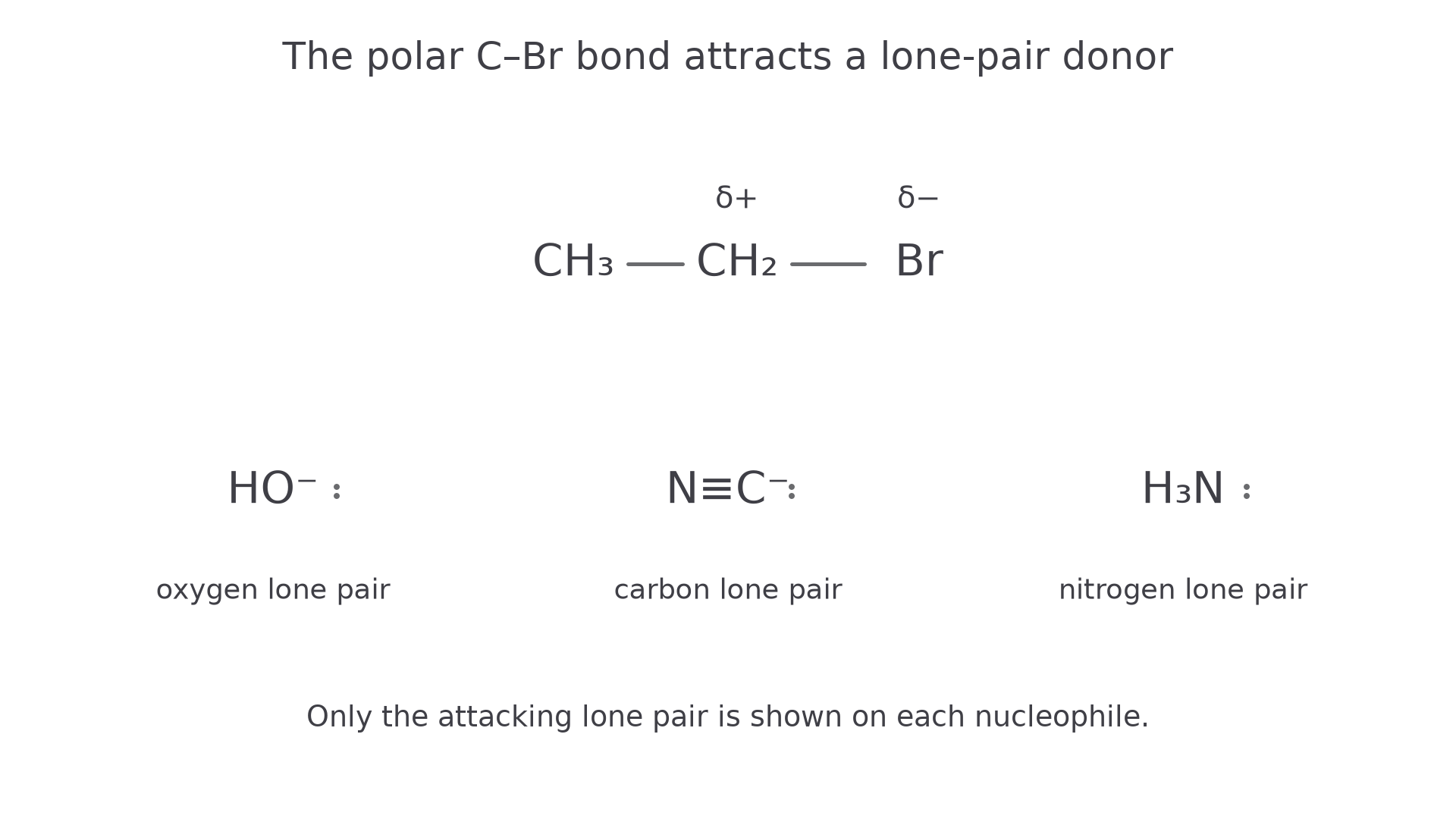
Halogenoalkanes contain a polar carbon-halogen bond because halogens are more electronegative than carbon. The shared electron pair is pulled towards the halogen, so the carbon becomes slightly positive, , and the halogen becomes slightly negative, . That carbon is electron deficient, so it attracts species that can donate electrons.
Nucleophile
A nucleophile is a species that donates a lone pair of electrons to an electron-deficient atom to form a covalent bond.
The three nucleophiles in this topic all have a lone pair ready to donate:
and are negatively charged, so they are strongly attracted to the carbon. is neutral, but the nitrogen atom still has a lone pair, so it can act as a nucleophile too.
When substitution happens, the halogen leaves with the bonding pair of electrons as a halide ion, . This is why halide ions are described as leaving groups.
The diagram below shows the polar bond in bromoethane and the three lone-pair donors that can attack the electron-deficient carbon.
[DIAGRAM: asset_name: 3.3.1 - Nucleophilic Substitution - Diagram 1; asset_slug: 3.3.1 - Nucleophilic Substitution - Diagram 1; recommended_method: retained_png; description: Bromoethane shown as H3C-CH2-Br, with the CH2 carbon labelled δ+ and Br labelled δ-; place :OH-, :C≡N-, and :NH3 nearby as the three lone-pair donors used in nucleophilic substitution.]
The core mechanism pattern
Substitution replaces the halogen while retaining the rest of the carbon framework.
Nucleophilic substitution
A reaction in which a nucleophile replaces a leaving group on a carbon atom.
For the primary halogenoalkane examples here, substitution by and follows the same one-step pattern:
- The nucleophile uses its lone pair to attack the carbon.
- At the same time, the carbon-halogen bond breaks.
- The halogen leaves as .
In a curly-arrow mechanism, one arrow starts at the nucleophile's lone pair and points to the carbon atom. The second starts at the C-X bond and points to the halogen. Curly arrows always show the movement of an electron pair.
With hydroxide ions, the halogen is replaced by , so an alcohol forms:
+ → +
Hydrolysis is carried out by heating with aqueous sodium or potassium hydroxide. Some ethanol can be added to help the poorly water-soluble halogenoalkane mix with the solution; hot predominantly ethanolic hydroxide instead favours elimination.
With cyanide ions, the halogen is replaced by , so a nitrile forms:
+ → +
Use ethanolic potassium cyanide and heat under reflux for this substitution. The attacking lone pair is on carbon in , giving a C–C bond and a nitrile; drawing attack through nitrogen gives a different connectivity. Cyanide is acutely toxic, and contact with acid can release toxic hydrogen cyanide. This synthesis belongs in a controlled laboratory, with the specified risk controls.
This is a very useful synthetic step because the carbon in the - group becomes part of the product. Cyanide substitution therefore lengthens the carbon chain by one carbon atom.
Worked example: starting with 1-bromopropane, , substitution by gives . The product has four carbons in total, so its name is butanenitrile.
The diagram below compares hydroxide and cyanide substitution side by side so the shared electron-flow pattern is easy to see.
[DIAGRAM: asset_name: 3.3.1 - Nucleophilic Substitution - Diagram 2; asset_slug: 3.3.1 - Nucleophilic Substitution - Diagram 2; recommended_method: retained_png; description: Side-by-side one-step nucleophilic substitution mechanisms for bromoethane. Left: :OH- attacking the δ+ carbon in H3C-CH2-Br, with one curly arrow from the oxygen lone pair to carbon and one from the C-Br bond to Br, giving H3C-CH2-OH + Br-. Right: the same electron-flow pattern for :C≡N- attacking through carbon to give H3C-CH2-C≡N + Br-.]
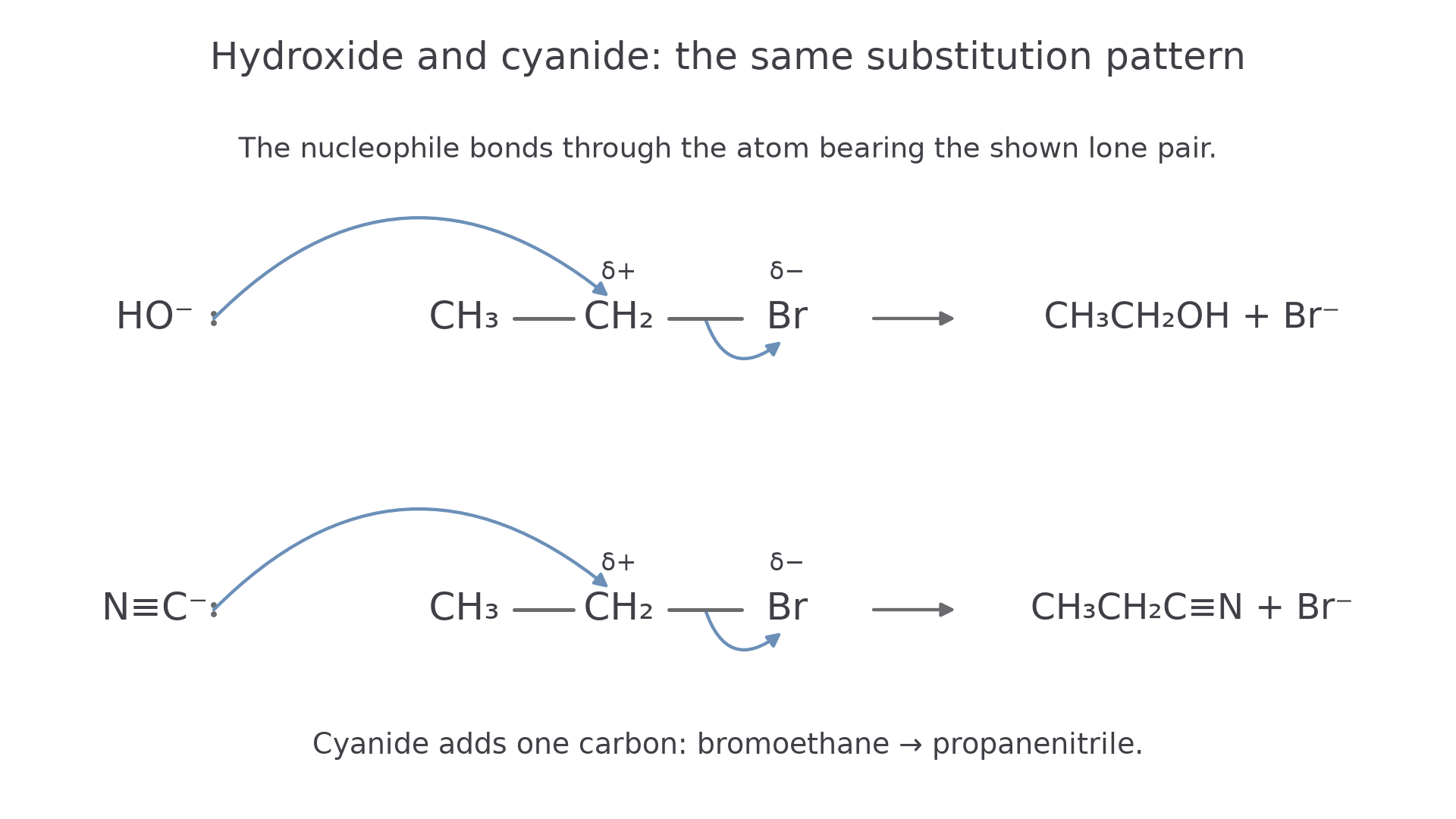
Once you understand that shared pattern, you do not need to memorise two unrelated mechanisms. The electron movement is the same; only the attacking nucleophile and the product change.
Why ammonia is slightly different
Ammonia starts in the same way: the lone pair on nitrogen attacks the carbon, and the C-X bond breaks. However, there is one extra step because ammonia is a neutral molecule rather than a negatively charged ion.
After the first step, the nitrogen has formed four bonds, so the immediate organic product is positively charged. For bromoethane, that intermediate is .
Continue this lesson.
You’re previewing NovaLearn without an account. Create a free account to read the rest.
Create free account