3.2.4 - Properties of Period 3 Elements and Their Oxides
Predict Period 3 oxide structure, melting point and acid–base behaviour, and write the equations and acid structures that explain the observations.
Reactions of the Elements
As you move from to , the elements become less metallic and their oxides change in both structure and acid-base behaviour. This specification point focuses on the reactions of and with water, and on the oxides of , , , , and .
Sodium reacts vigorously with cold water. It floats, fizzes, and often melts into a silvery ball because the reaction is strongly exothermic. The solution formed is sodium hydroxide, so the water quickly becomes strongly alkaline.
Magnesium is much less reactive with cold water. The reaction is slow because of its activation barrier and the protective surface layer, including sparingly soluble magnesium hydroxide. That means far fewer hydroxide ions enter solution than in the sodium reaction, so the pH is lower.
With steam, magnesium reacts much faster because the higher temperature helps break bonds and overcome activation energy. The product is now magnesium oxide rather than magnesium hydroxide.
All the Period 3 elements in this lesson react with oxygen to form oxides, but the ease of reaction and the products depend on the element.
| Element | What you need to know about reaction with oxygen | Oxide in this spec |
|---|---|---|
| Burns readily in air with a yellow flame | ||
| Burns with an intense white flame | ||
| Heated powder burns, but bulk is protected by a surface oxide layer | ||
| Needs strong heating before it reacts | ||
| Burns readily in excess oxygen to a white oxide | ||
| Burns with a blue flame mainly to ; forms on further oxidation under more forcing conditions | , |
Balanced equations:
The oxidation state of the Period 3 element increases in each of these reactions, so they are all oxidation processes for the element itself.
A practical comparison uses a small amount of each prepared oxide with a fixed volume of water, stirring and allowing the mixtures to reach the same temperature before testing pH. Use indicator with a colour chart, or a calibrated pH probe rinsed between samples. Record undissolved solid as well as pH: insolubility is different from neutrality. Magnesium can first be burnt in oxygen, using tongs and eye protection without looking directly at the bright flame; allow the oxide to cool before adding water. Hazardous non-metal oxides require the teacher's prepared samples or demonstration.
Bonding Controls Melting Point
The melting-point trend makes sense only when you split the oxides into three structural groups rather than trying to force one smooth explanation across the whole period.
From to , the oxides are giant lattices with strong electrostatic attraction between positive and negative ions. has a higher melting point than because is smaller and more highly charged than , so the attraction to is stronger. still has a very high melting point because it is a giant lattice too, although its bonding has noticeable covalent character, so it does not fit a simple "higher charge means automatically highest melting point" rule.
is different again. It is not ionic, but it still has a high melting point because it is a giant covalent structure. Melting it means breaking many strong covalent bonds throughout the network, which still needs a lot of energy.
After , the melting point drops sharply. , and are simple molecular substances. On melting, the covalent bonds inside each molecule stay intact; only intermolecular forces are overcome. That is why their melting points are far lower than those of the giant oxides.
The diagram below compares the melting points of the main Period 3 oxides and makes the structural break after easy to see.
[DIAGRAM: asset_name: 2.4 - Properties of Period 3 Elements and Their Oxides - Diagram 1; asset_slug: 2.4 - Properties of Period 3 Elements and Their Oxides - Diagram 1; recommended_method: retained_png; description: Exam-clean bar chart of melting points for Na2O, MgO, Al2O3, SiO2, P4O10, SO3, and SO2, with the y-axis labelled melting point in degrees C. Plot approximate values 1132, 2852, 2072, 1713, 340, 17, and -73, and add a clear divider after SiO2 so Na2O to SiO2 are grouped as giant structures while P4O10 to SO2 are grouped as molecular oxides. Make the sharp drop after SiO2 visually unmistakable.]
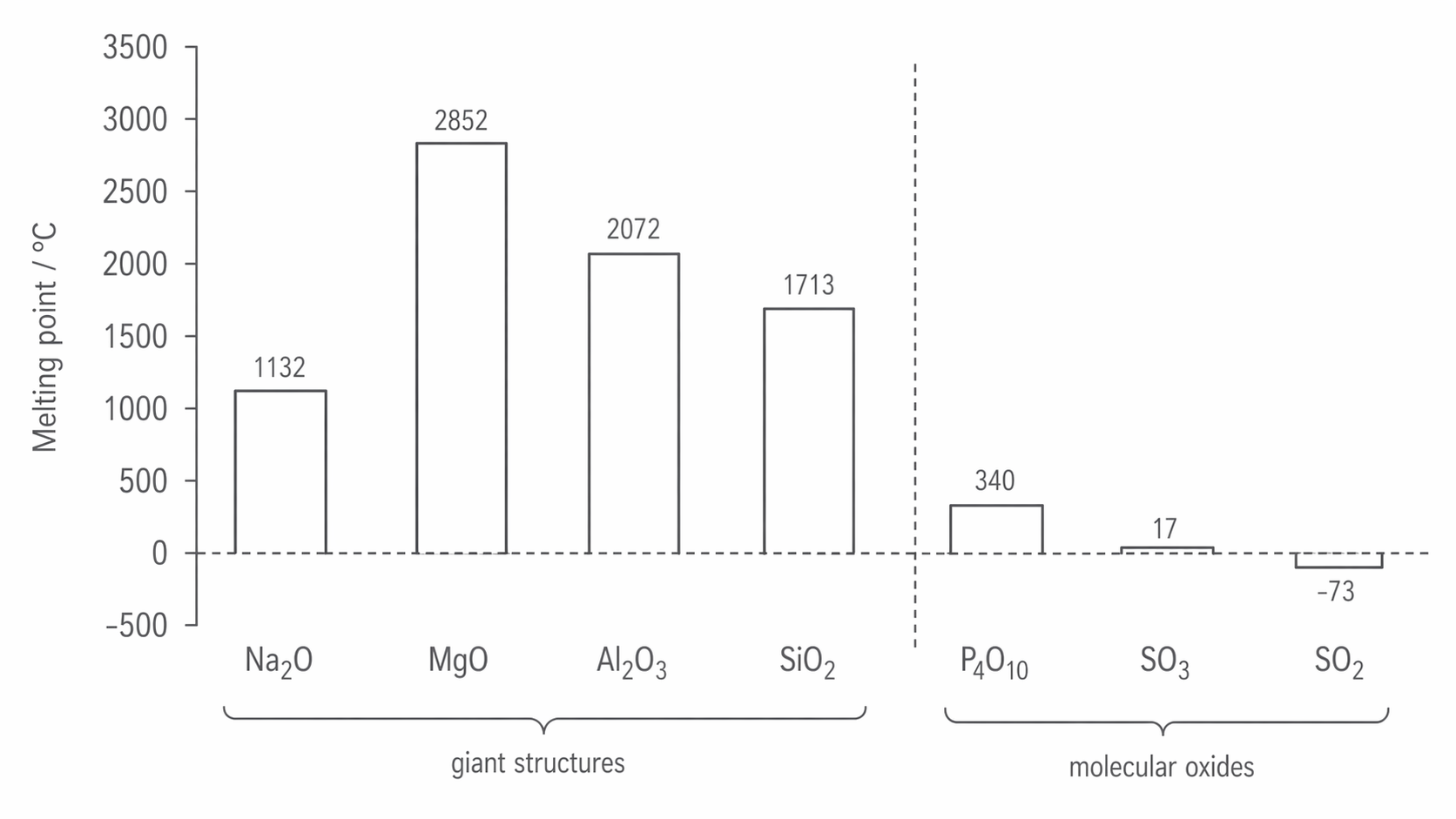
Within the molecular oxides, has the highest melting point because its molecules are larger and have more electrons, so London forces are stronger. has stronger intermolecular forces than , so melts at a higher temperature than . A safe order to learn is , with the really big drop coming after .
A useful shortcut here is this: giant structure usually means high melting point; molecular structure usually means low melting point. Then refine the explanation by naming the relevant force or bond.
From Basic to Acidic in Water
Any numerical pH values below are illustrative laboratory values, not constants of an oxide. Actual pH depends on concentration, solubility and the amount added; without quantitative data, predict acidic, neutral or alkaline behaviour and relative alkalinity.
When the oxides react with water, the trend across the period is from alkaline solutions to acidic ones. The key idea is whether the oxide behaves as a source of ions, resists water completely, or reacts to form an acid.
reacts very vigorously with water to give a strongly alkaline solution. In water, it effectively produces hydroxide ions:
The pH values below are illustrative: actual pH depends on the amount of oxide and water, concentration and temperature.
Approximate pH: .
also reacts with water, but the solution is much less alkaline because is only sparingly soluble. The chemistry is still basic, but fewer ions enter solution.
Approximate pH: .
and do not react with water under normal conditions. In , the lattice is too strong and has some covalent character, so water cannot simply pull the ions apart. In , the giant covalent network is too strong for water to attack. So both leave water roughly neutral.
, and are acidic oxides. They react with water to form acids, which then release ions into solution.
Approximate pH: about .
Approximate pH: .
Approximate pH: .
| Oxide | Bonding / structure | Behaviour with water | Typical pH |
|---|---|---|---|
| giant ionic | forms | ||
| giant ionic | forms sparingly soluble | ||
| giant lattice with covalent character | no reaction | about | |
| giant covalent | no reaction | about | |
| molecular covalent | forms | about | |
| molecular covalent | forms | ||
| molecular covalent | forms |
The overall trend is therefore not "every oxide reacts less and less". It is more precise than that: ionic oxides on the left behave as bases, the middle oxides resist water, and the molecular oxides on the right form acids.
Continue this lesson.
You’re previewing NovaLearn without an account. Create a free account to read the rest.
Create free account