3.2.1.2 - Physical Properties of Period 3 Elements
Explain the trends in atomic radius, first ionisation energy and melting point across Period 3 by linking each property to electron arrangement or structure and bonding.
Atomic radius across Period 3
The first pattern to understand is atomic size. Across Period 3, atoms generally get smaller from sodium to chlorine, even though each atom has more particles than the one before it. That sounds odd at first, so the explanation has to focus on where the extra electrons are going and how strongly the nucleus is pulling.
Comparing atomic radii
Atomic radius is a measure of atomic size. A covalent radius is half the distance between the nuclei of two bonded atoms of the same element. Compare radii defined consistently: argon normally has a van der Waals radius rather than a covalent radius, so mixing the two would give a misleading trend.
Because the extra electrons are added to the same main energy level, there is no extra shell created as you go from to . The amount of shielding from the inner shells stays broadly similar, but the nuclear charge increases because each atom has one more proton than the last. That stronger nuclear attraction pulls the outer electrons closer to the nucleus, so the atomic radius decreases.
The diagram below shows the steady fall in atomic radius from to and reminds you that the extra electrons are all being added to the third shell.
[DIAGRAM: asset_name: 2.1.2 - Physical Properties of Period 3 Elements - Diagram 1; asset_slug: 2.1.2 - Physical Properties of Period 3 Elements - Diagram 1; recommended_method: retained_png; description: Line graph of atomic radius across Period 3 from Na to Cl, showing a steady decrease from left to right. Above the graph, show Bohr-style shell sketches for Na, Mg, Al, Si, P, S, and Cl with three shells throughout and outer-electron counts increasing from 2,8,1 to 2,8,7, to emphasise that electrons are added to shell 3 across the period. Include a note that Ar is usually omitted from covalent-radius data.]
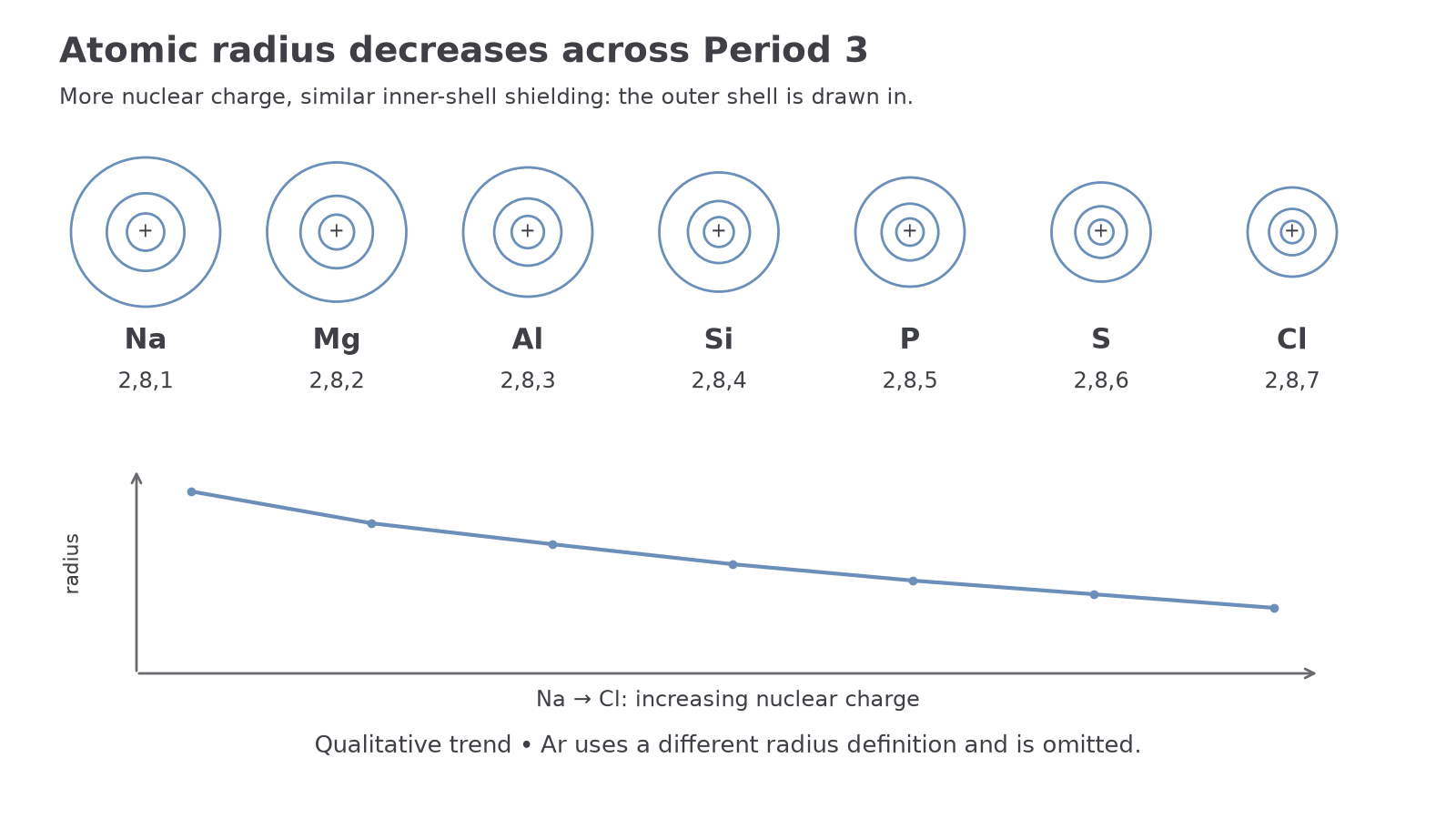
The pattern becomes much clearer if you follow this chain: more protons -> similar shielding -> stronger attraction between nucleus and outer electrons -> smaller atom. A very common mistake is to say "there are more electrons, so the atom is bigger". That would only be convincing if a new shell were added. Across a period, the rising nuclear charge has the bigger effect.
Argon needs a brief note here. The radius trend is usually shown using covalent radii, so the clean sequence is discussed from to . The core explanation is still the same: across the period, effective nuclear attraction on the outer shell increases.
First ionisation energy and its exceptions
First ionisation energy asks the same attraction question from a different angle. Instead of asking "How big is the atom?", it asks "How difficult is it to remove the outer electron?" If the outer electron is held more strongly, the first ionisation energy will be higher.
First ionisation energy
The energy needed to remove one electron from each atom in one mole of gaseous atoms to form one mole of gaseous 1+ ions.
For an element X, the process is . Across Period 3, the first ionisation energy generally increases from to because the nuclear charge increases while the electron removed is still in the third shell. That means the outer electron experiences a stronger attraction and takes more energy to remove.
The diagram below shows the overall rise in first ionisation energy across Period 3 and highlights the two small dips that need explanation.
[DIAGRAM: asset_name: 2.1.2 - Physical Properties of Period 3 Elements - Diagram 2; asset_slug: 2.1.2 - Physical Properties of Period 3 Elements - Diagram 2; recommended_method: retained_png; description: Line graph of first ionisation energy from Na to Ar showing an overall rise, with a visible dip from Mg to Al and another dip from P to S. Add one inset comparing Mg 3s2 with Al 3s2 3p1, showing the 3p level slightly higher in energy than 3s, and a second inset comparing P 3p3 with S 3p4, showing electron pairing in sulfur.]
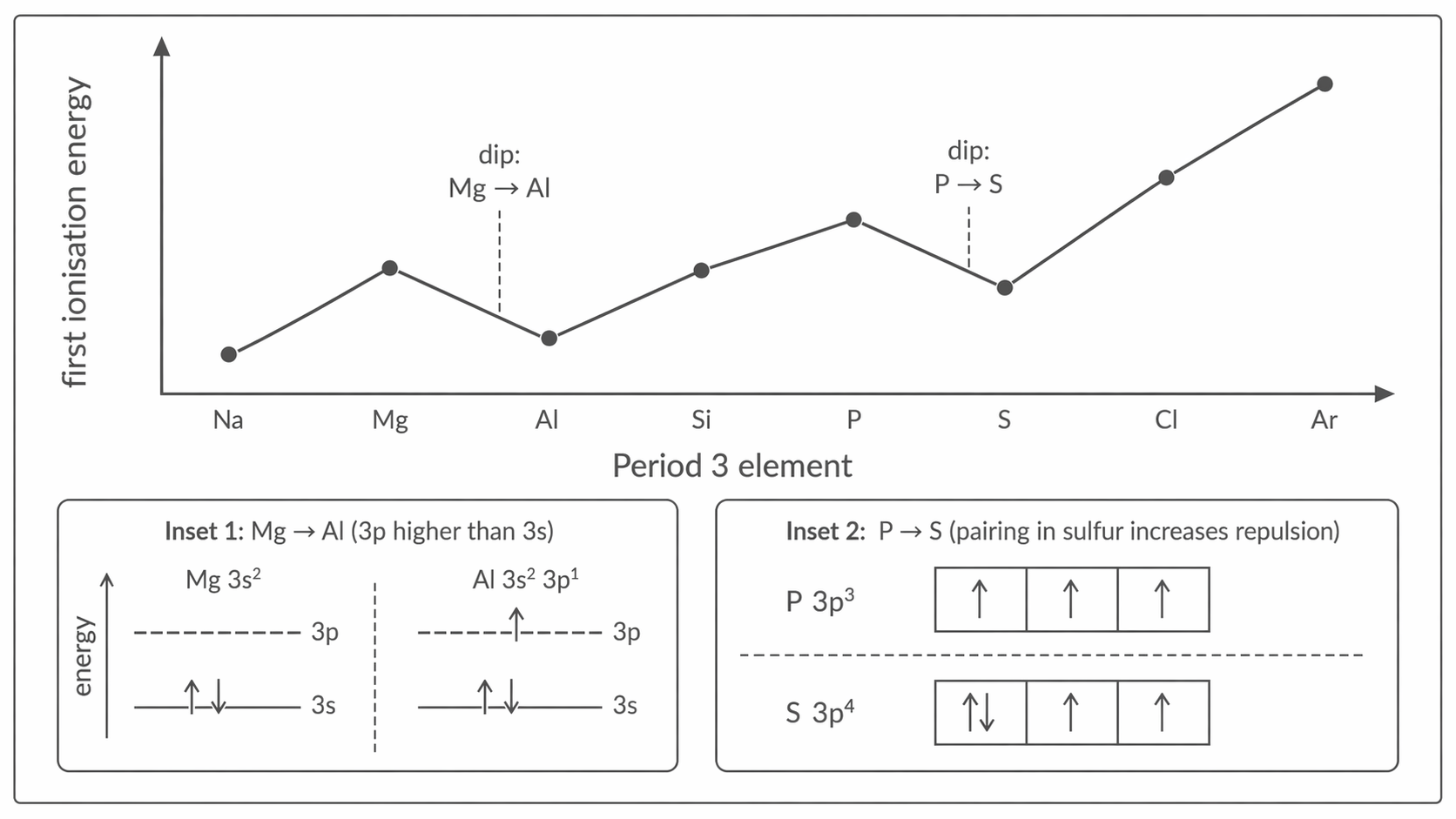
However, the graph is not perfectly smooth, and these exceptions matter because they show what really controls ionisation energy. The first dip is from magnesium to aluminium. Magnesium loses a 3s electron, but aluminium loses a 3p electron. A 3p electron is slightly higher in energy and slightly more shielded than a 3s electron, so it is easier to remove. That is why aluminium has a lower first ionisation energy than you might expect from the overall trend.
The second dip is from phosphorus to sulfur. Phosphorus has a arrangement, with one electron in each 3p orbital. Sulfur is , so one 3p orbital contains a pair of electrons. Repulsion between two electrons in the same orbital makes one of them easier to remove, so sulfur has a slightly lower first ionisation energy than phosphorus.
Continue this lesson.
You’re previewing NovaLearn without an account. Create a free account to read the rest.
Create free account