3.1.11.1 - Electrode Potentials and Cells
Electrode potentials let us compare how strongly different species attract or release electrons. Once those values are measured under standard conditions, we can arrange them in an electrochemical series, calculate the emf of a cell, and predict whether a simple redox reaction will go forwards. This lesson ties together the measurement idea, the cell notation, and the reasoning that links an table to a real redox equation.
Half-cells and the IUPAC half-equation convention
When a metal is dipped into a solution containing its own ions, a dynamic equilibrium is set up at the metal surface. Some metal atoms lose electrons and enter solution as ions, while some ions gain electrons and are deposited back onto the metal.
For zinc, that equilibrium can be written as:
This arrangement is called a half-cell. A single half-cell has a tendency to push electrons into an external circuit or pull electrons from it, but that tendency cannot be measured on its own. We only ever measure a potential difference between two electrodes.
Electrode potential
The electrode potential of a half-cell is a measure of its tendency to gain electrons, found by comparing it with another electrode.
By IUPAC convention, electrode potentials are listed using reduction half-equations, with electrons on the left-hand side. That means the table version of the zinc half-equation is not the oxidation you would see when zinc is actually dissolving in a cell. It is written as:
That convention matters because every value in the electrochemical series is attached to a reduction half-equation. In a working cell, one of the two half-equations will usually have to be reversed to show oxidation, but you still use the tabulated values as reduction potentials.
The diagram below shows that a half-cell is really a dynamic equilibrium at the metal surface.
[DIAGRAM: asset_name: 1.11.1 - Electrode Potentials and Cells - Diagram 1; asset_slug: 1.11.1 - Electrode Potentials and Cells - Diagram 1; recommended_method: matplotlib_exact_plot; description: Zinc metal and Zn2+ solution interface with dissolution and deposition directions, balanced two-electron equations and separate electron path within metal.]
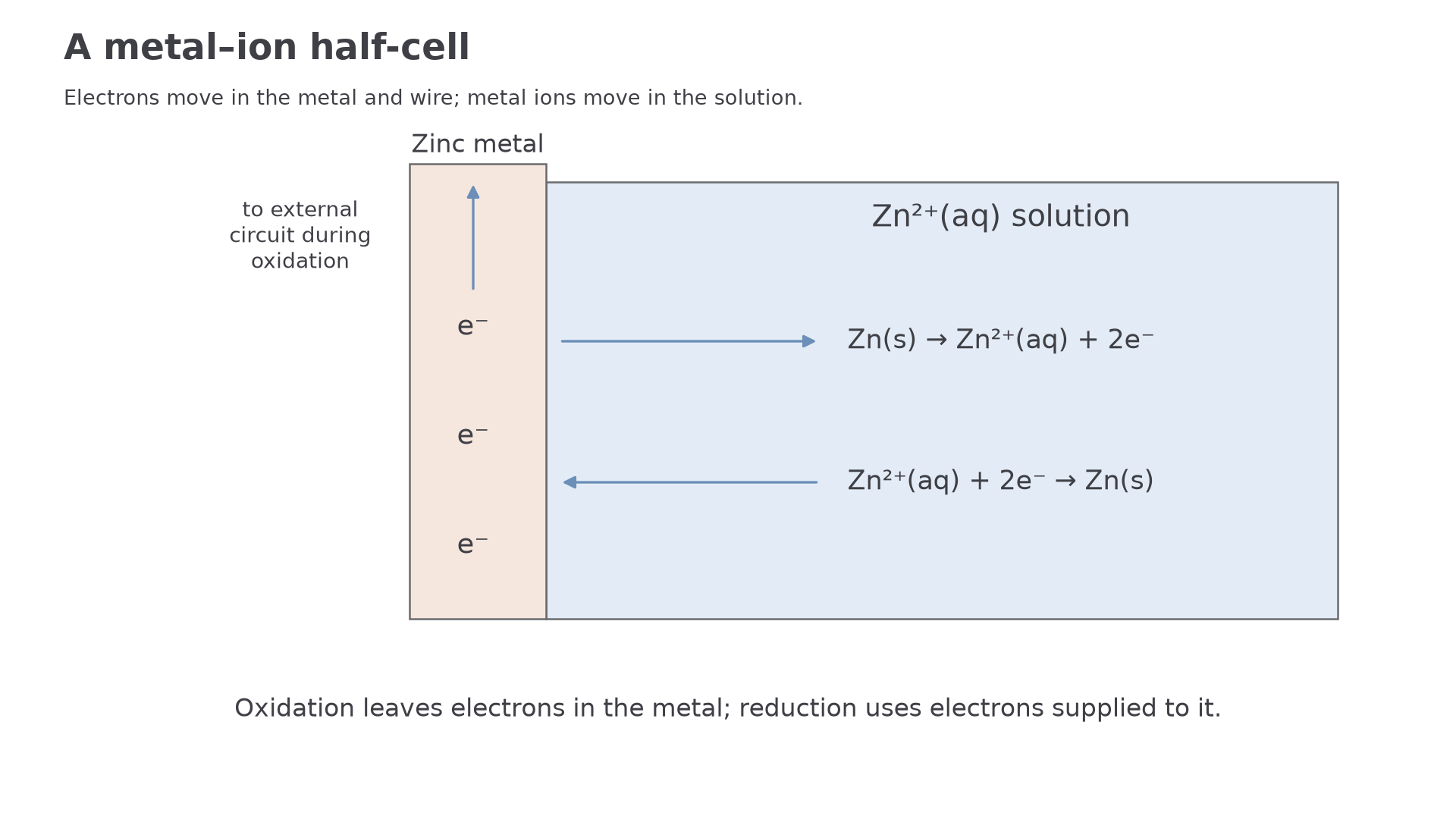
A common source of confusion here is mixing up the table form and the actual cell reaction. A safe rule is: write half-equations from the data book or table as reductions first, then decide later which one must be reversed.
Measuring E° using the standard hydrogen electrode
Because absolute electrode potentials cannot be measured directly, chemists compare each half-cell with a reference electrode. The reference chosen is the standard hydrogen electrode, usually shortened to SHE.
Standard Electrode Potential, E°
The standard electrode potential, , is the emf of the cell formed by connecting that half-cell to the standard hydrogen electrode under standard conditions, with the hydrogen electrode as the reference on the left.
The standard hydrogen electrode is assigned a value of . It uses hydrogen gas bubbled over an inert platinum electrode in a solution of at and . Platinum is used because it conducts electricity and provides a surface for the hydrogen equilibrium to be established quickly, but it does not take part chemically.
When the SHE is connected to another half-cell, the two solutions are joined by a salt bridge containing ions that do not react with either half-cell.
Salt bridge
A salt bridge contains mobile ions that complete the circuit by moving between the half-cells to maintain charge balance without reacting with the cell contents.
Its function is easier to see in a working cell. If oxidation produces extra positive ions in one half-cell, anions from the salt bridge move into that half-cell. If reduction removes positive ions from the other half-cell, cations from the salt bridge move in there. Without that ion movement, charge would build up, electron flow through the wire would stop, and the cell would no longer operate.
The diagram below shows the standard hydrogen electrode connected to an unknown half-cell under standard conditions.
[DIAGRAM: asset_name: 1.11.1 - Electrode Potentials and Cells - Diagram 2; asset_slug: 1.11.1 - Electrode Potentials and Cells - Diagram 2; recommended_method: matplotlib_exact_plot; description: Standard hydrogen electrode alone: inward hydrogen gas feed bubbles over inert platinum immersed in acid; 298 K,100 kPa and H+ concentration1 mol dm^-3; assigned potential0 V.]
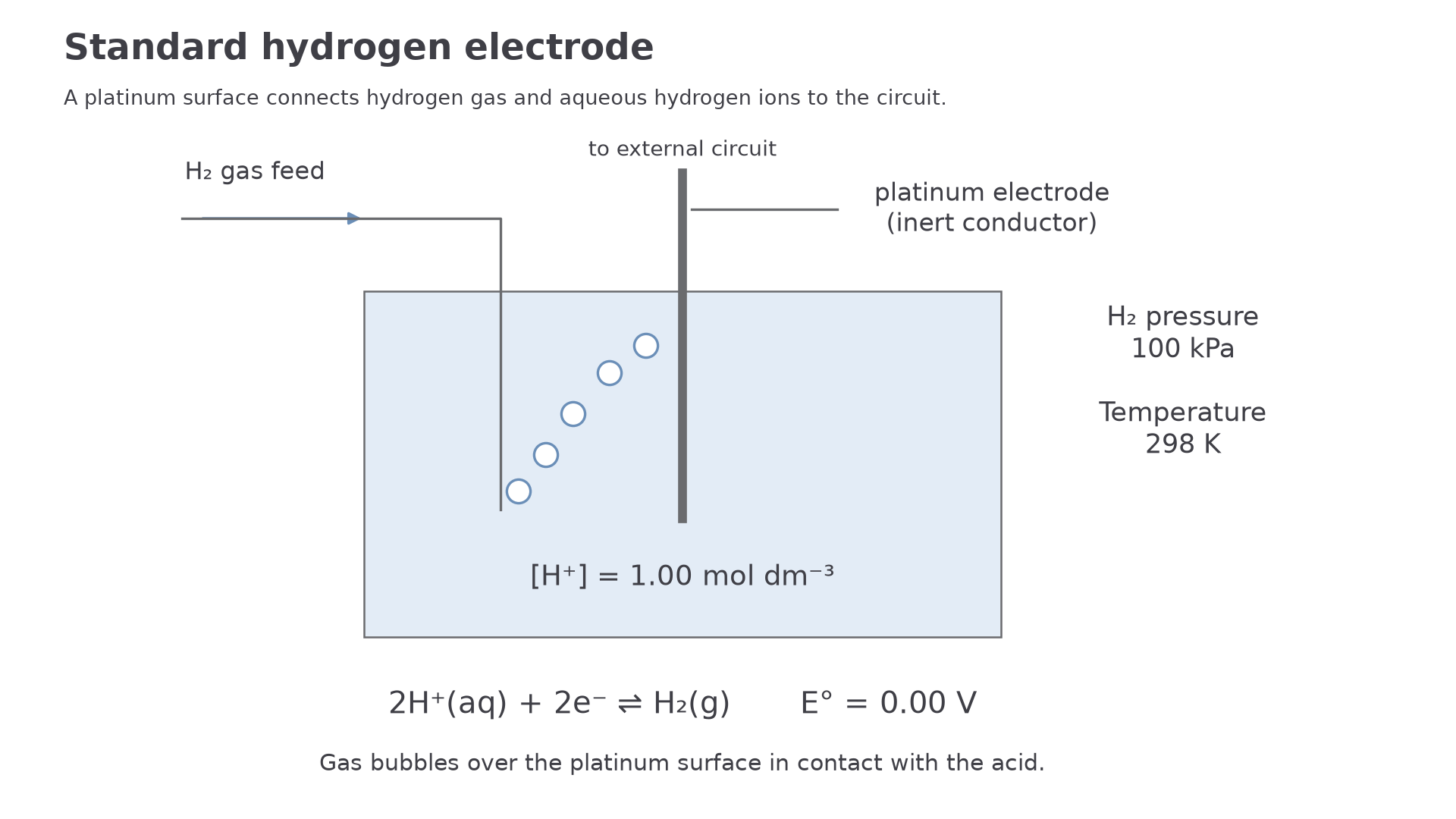
If the second half-cell is more likely than hydrogen to lose electrons, it becomes the negative electrode when connected to the SHE. If it is more likely than hydrogen to gain electrons, it becomes the positive electrode. That measured potential difference is the half-cell's standard electrode potential.
The conditions matter because electrode potential depends on the position of the half-cell equilibrium. Change the concentration of ions, the pressure of a gas, or the temperature, and the equilibrium position changes, so the measured potential changes too. That is why values can only be compared fairly when they have all been measured at , , and for aqueous ions. You do not need the Nernst equation for this course; the key idea is simply that different conditions give different electrode potentials.
Here is the measurement logic in a concrete example. Suppose an unknown half-cell is connected to the SHE under standard conditions, and the voltmeter shows with the SHE as the positive electrode. The conventional representation is:
Because the SHE is on the right, . So:
which gives:
So this unknown half-cell is more easily oxidised than hydrogen. If the voltmeter were replaced by a wire, electrons would flow from to the SHE.
It is worth separating "standard electrode potential" from "electrode potential". If the conditions are not standard, you should not call the value .
Electrochemical series, cell notation, and cell emf
Once many values have been measured, they can be arranged in an electrochemical series. Tables may list potentials in either order; compare their numerical values rather than their positions on the page.
A more negative means the reduction shown in the table is less favourable, so the species on the right-hand side of that half-equation is more willing to be oxidised. That is why zinc metal is a better reducing agent than copper metal. A more positive means the reduction is more favourable, so the species on the left-hand side of the reduction half-equation is a better oxidising agent.
Continue this lesson.
You’re previewing NovaLearn without an account. Create a free account to read the rest.
Create free account