3.3.11.3 - Nucleophilic Properties (Amines)
This lesson is about what the lone pair on nitrogen lets ammonia and amines do. You will see how that lone pair allows them to attack electron-poor carbon atoms in two different situations: halogenoalkanes, where the result is nucleophilic substitution, and acyl chlorides or acid anhydrides, where the result is nucleophilic addition-elimination. By the end, you should be able to follow the product pattern, explain why mixtures form, and outline the required mechanisms.
Why ammonia and amines are nucleophiles
Ammonia, , and amines all contain a lone pair of electrons on the nitrogen atom. That lone pair can be donated to an electron-deficient atom to form a new covalent bond. In this topic, the electron-deficient atom is usually a carbon atom.
Nucleophile
A nucleophile is an electron pair donor.
In halogenoalkanes, the carbon bonded to the halogen is because the halogen is more electronegative and pulls electron density away from that carbon. In acyl chlorides and acid anhydrides, the carbonyl carbon is because the bond is strongly polar. In both cases, nitrogen can use its lone pair to attack that carbon.
This gives one simple idea that links the whole lesson: a lone pair on nitrogen attacks a carbon. What changes is what leaves afterwards, and that is why one reaction is called substitution while the other is called addition-elimination.
One subtle but important point is that ammonia, primary amines, secondary amines, and tertiary amines all still have a lone pair on nitrogen, so they can all act as nucleophiles. A quaternary ammonium ion does not have a lone pair, so once that has formed the sequence stops there.
Nucleophilic substitution with halogenoalkanes
When ammonia reacts with a halogenoalkane, the nitrogen lone pair attacks the carbon attached to the halogen. At the same time, the bond breaks and the halide ion leaves. The halogen has been replaced by a nitrogen-containing group, so this is a nucleophilic substitution reaction.
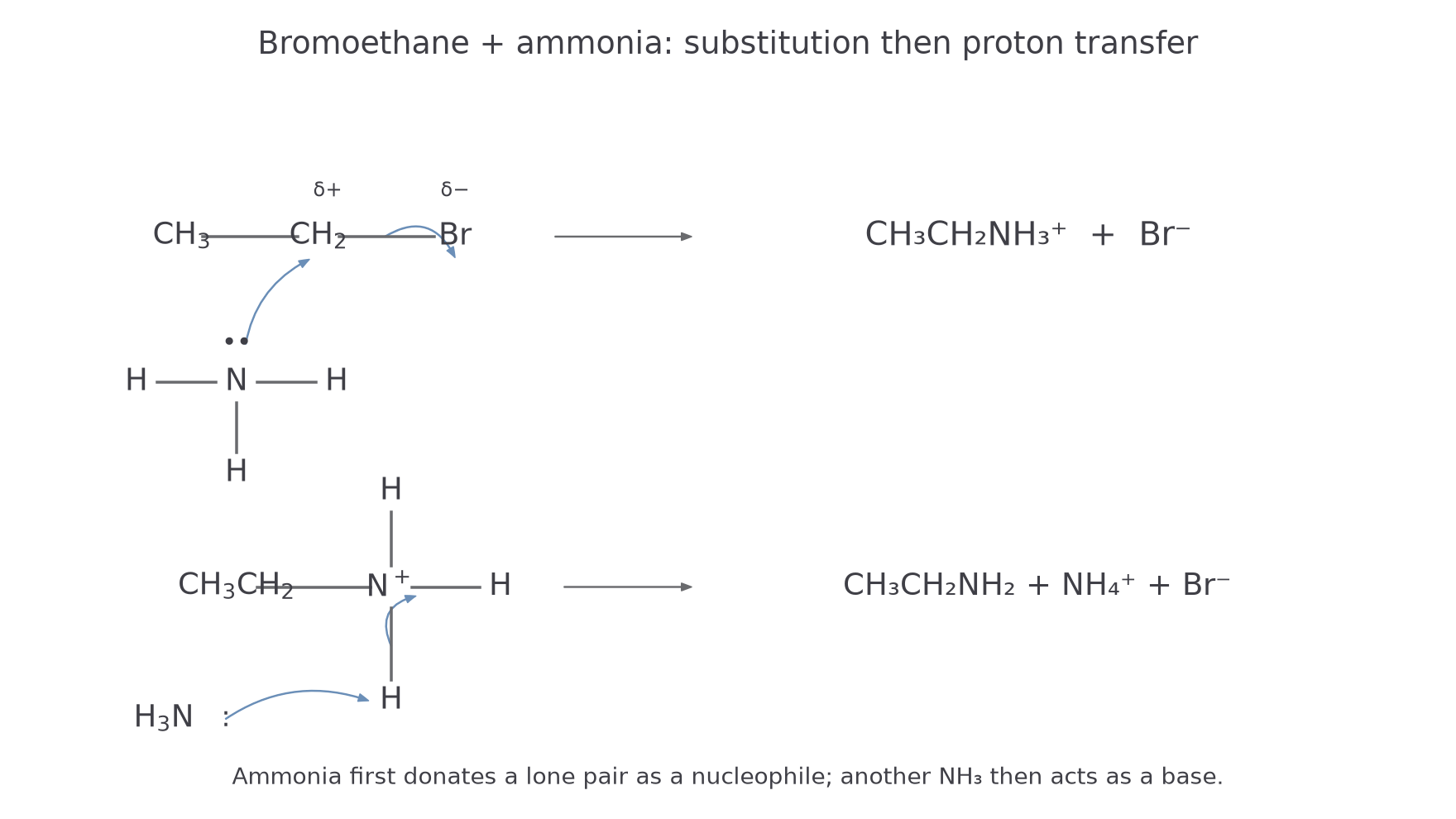
Using bromoethane as an example, the first step is:
The product at this stage is an alkylammonium ion, not yet a neutral amine. A second ammonia molecule acts as a base and removes a proton:
Together, those steps explain why the overall reaction is often written as:
The diagram below shows the two-stage mechanism for bromoethane reacting with ammonia, including the initial substitution step and the later deprotonation by a second ammonia molecule.
[DIAGRAM: asset_name: 3.11.3 - Nucleophilic Properties (Amines) - Diagram 1; asset_slug: 3.11.3 - Nucleophilic Properties (Amines) - Diagram 1; recommended_method: code_generated; description: Bromoethane plus ammonia nucleophilic substitution and deprotonation with explicit nitrogen valence four in ammonium, bond-origin curly arrows and Br−.]
The story does not stop at the primary amine. The ethylamine formed still has a lone pair on nitrogen, so it can attack another halogenoalkane molecule. That gives a secondary amine. The same pattern can then produce a tertiary amine and finally a quaternary ammonium salt:
Mechanistically, each new step follows the same pattern: the nitrogen lone pair attacks the carbon in another halogenoalkane, the halide leaves, and a proton is then removed unless the final product is already the quaternary ammonium ion.
This is why halogenoalkanes reacting with ammonia often give a mixture of products. Each product amine is itself a nucleophile, so further substitution keeps happening unless the reaction conditions strongly favour the earliest step.
If the aim is to make as much primary amine as possible, use excess ammonia. That makes collisions between the halogenoalkane and ammonia more likely than collisions between the halogenoalkane and the amine product, so it reduces further substitution. It does not eliminate the problem completely, but it shifts the mixture towards the primary amine.
The final product in the sequence is different from the earlier ones. A quaternary ammonium salt has four groups bonded to nitrogen, so nitrogen carries a positive charge and has no lone pair left to donate. That is why the substitution sequence ends at that stage.
When drawing each substitution, put the arrow tail on the N lone pair and its head at the carbon bonded to halogen. Put the other tail on the C–halogen bond and its head at halogen, which leaves as a halide ion. Show nitrogen with four bonds and + charge in the alkylammonium intermediate. In deprotonation, the base lone pair points to H and the N–H bond pair returns to N. For the last step, , no N–H bond exists and no proton is lost.
Quaternary ammonium salts as cationic surfactants
Some quaternary ammonium salts are useful products in their own right rather than unwanted end points. This is especially true when one or more of the groups attached to nitrogen is a long hydrocarbon chain.
Quaternary ammonium salt
A quaternary ammonium salt contains a positively charged nitrogen atom bonded to four carbon-containing groups, together with a negative counter-ion such as or .
These compounds are used as cationic surfactants. "Cationic" tells you that the head of the molecule is positively charged. "Surfactant" tells you that the molecule is good at acting at a surface because it contains both a charged region and a hydrocarbon region with different attractions.
On wet hair and wet fabric, surfaces can carry negative charges. The positive ammonium head is attracted to those surfaces, so the ions stick to them. Their hydrocarbon chains then help form a thin coating over the surface. That reduces the build-up of static electricity and helps the surface feel smoother, which is why quaternary ammonium salts are used in hair conditioners and fabric conditioners.
Conditioner chemistry depends on structure. A quaternary ammonium ion can cling to a negatively charged wet surface because of its positive head group, while its long hydrocarbon chain helps create a smooth coating, so the same molecule acts both as a cation and as a surfactant.
Continue this lesson.
You’re previewing NovaLearn without an account. Create a free account to read the rest.
Create free account