3.1.8.2 - Entropy and Gibbs Free Energy
Enthalpy tells us whether a reaction transfers energy to or from the surroundings, but it does not fully decide whether a change is feasible. To explain why some endothermic changes can still happen, and why some exothermic changes are only feasible in certain conditions, we need entropy as well. In this lesson, you will build the full picture: what entropy means, how to calculate reaction entropy changes, and how to use to judge feasibility and find the temperature at which feasibility changes.
Why enthalpy is not enough
If were the whole story, every exothermic change would be feasible and every endothermic change would not be. Chemistry is more subtle than that. A system also tends to move toward a more dispersed, less ordered arrangement of particles and energy.
Entropy
Entropy is a measure of the dispersal of particles and energy in a system, often described at A-level as the degree of disorder.
The bigger the spread of particles and energy, the higher the entropy. That is why gases usually have much larger entropy values than liquids, and liquids have larger entropy values than solids. Heating a substance also increases entropy because particles have more energy and can occupy a wider range of positions and motions.
The diagram below shows the particle arrangements in a solid, liquid, and gas, with the largest increase in entropy happening on boiling.
[DIAGRAM: asset_name: 1.8.2 - Gibbs Free-Energy Change, Delta G, and Entropy Change, Delta S - Diagram 1; asset_slug: 1.8.2 - Gibbs Free-Energy Change, Delta G, and Entropy Change, Delta S - Diagram 1; recommended_method: matplotlib_exact_plot; description: Twelve non-overlapping particles in each solid, liquid and gas panel; ordered versus irregular arrangements and explicit not-to-scale note.]
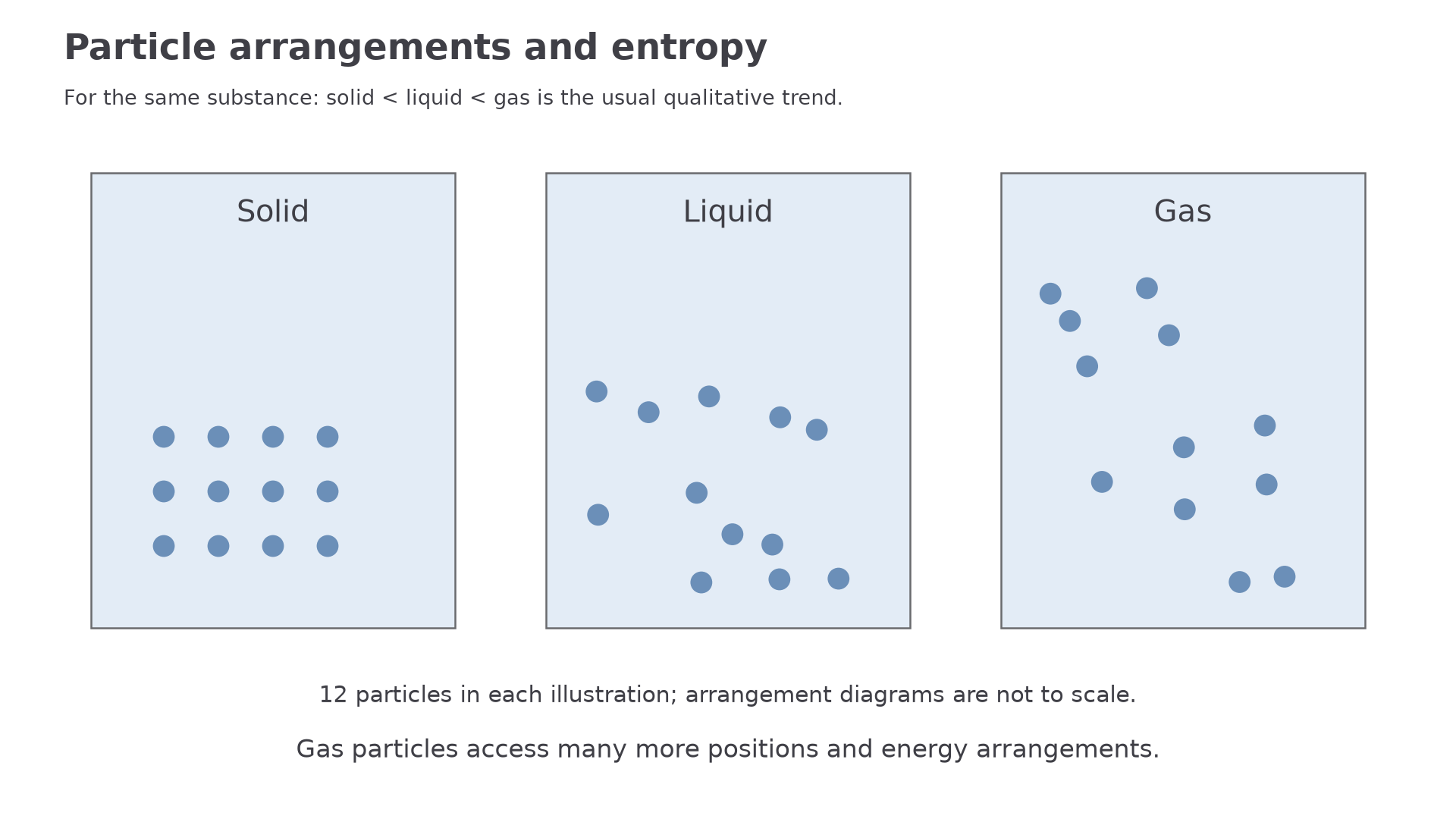
Physical changes show this clearly. When ice melts, the particles gain freedom of movement, so entropy increases. When liquid water becomes steam, the increase is even larger because gas particles are much more widely separated and randomly arranged. Chemical changes can also increase or decrease entropy. Reactions that produce more moles of gas often have a positive , while reactions that remove gas molecules from the system often have a negative .
One important idea is that a feasible reaction does not have to have a positive reaction entropy change. A reaction can still be feasible with a negative if the enthalpy term is favorable enough. That is exactly why we need Gibbs free energy.
Calculating entropy changes from absolute entropy values
Chemists can calculate the entropy change for a reaction from tabulated absolute entropy values. These are usually given in under standard conditions. Unlike enthalpies of formation, the entropy values of elements in their standard states are not zero, so you must use the data values exactly as given.
For a reaction:
Entropy change of reaction
- multiply each by its coefficient; units ; elements do not have zero entropy
The method is always the same:
- Add the entropy values for all products, taking account of stoichiometric coefficients.
- Add the entropy values for all reactants.
- Subtract reactants from products.
- Give the answer with a sign and units.
Worked example:
Using values of , , and respectively:
- sum of product entropies
- sum of reactant entropies
The answer is positive because the reaction forms a gas from a solid, so the particles become much more dispersed.
When you predict the sign before calculating, you are less likely to lose a sign error. More gas particles usually means is positive. Fewer gas particles usually means is negative.
Using Gibbs free energy to judge feasibility
Entropy helps, but enthalpy still matters. Gibbs free energy combines both effects:
Gibbs free-energy change
- in K; and in ; convert from to (÷ 1000)
- a reaction is feasible when
Here, must be in kelvin. and are usually in , while is often given in . That means you usually need to convert into by dividing by before substituting into the equation.
Feasible reaction
A reaction is feasible when it is thermodynamically possible under the stated conditions. Here, a reaction is feasible when is zero or negative.
Continue this lesson.
You’re previewing NovaLearn without an account. Create a free account to read the rest.
Create free account