3.3.1.3 - Isomerism
Isomerism matters because one molecular formula can describe more than one compound, and those compounds can behave very differently. In this lesson, you will separate structural isomerism from stereoisomerism, learn the three named types of structural isomer, and then use restricted rotation and CIP rules to decide whether an alkene is E or Z.
Same formula, different arrangement
Start with the idea that does not change: isomers have the same molecular formula. What changes is how the atoms are arranged.
Structural isomer
Compounds with the same molecular formula but different structural formulae.
If the atoms are joined in a different order, the compounds are structural isomers. For example, and both have the molecular formula , but the carbon skeleton is arranged differently.
Some compounds, however, keep the same structural formula and still form different isomers. In that case, the difference is not which atoms are bonded to which, but how the groups are arranged in space. That idea leads to stereoisomerism, which we will meet after the three structural-isomer types.
The diagram below puts that contrast side by side: the left-hand pair changes connectivity, whereas the right-hand pair keeps the same connectivity and changes only the arrangement around the bond.
[DIAGRAM: asset_name: 3.1.3 - Isomerism - Diagram 1; asset_slug: 3.1.3 - Isomerism - Diagram 1; recommended_method: retained_png; description: Two-panel comparison of isomer types. Left panel labelled Structural isomerism: CH3CH2CH2CH3 and CH3CH(CH3)CH3 with the shared note "same molecular formula C4H10" and the label "different structural formulae". Right panel labelled Stereoisomerism: two versions of but-2-ene with the same connectivity CH3-CH=CH-CH3, one with both CH3 groups on the same side of the C=C and one with the CH3 groups on opposite sides, labelled "same structural formula, different arrangement in space".]
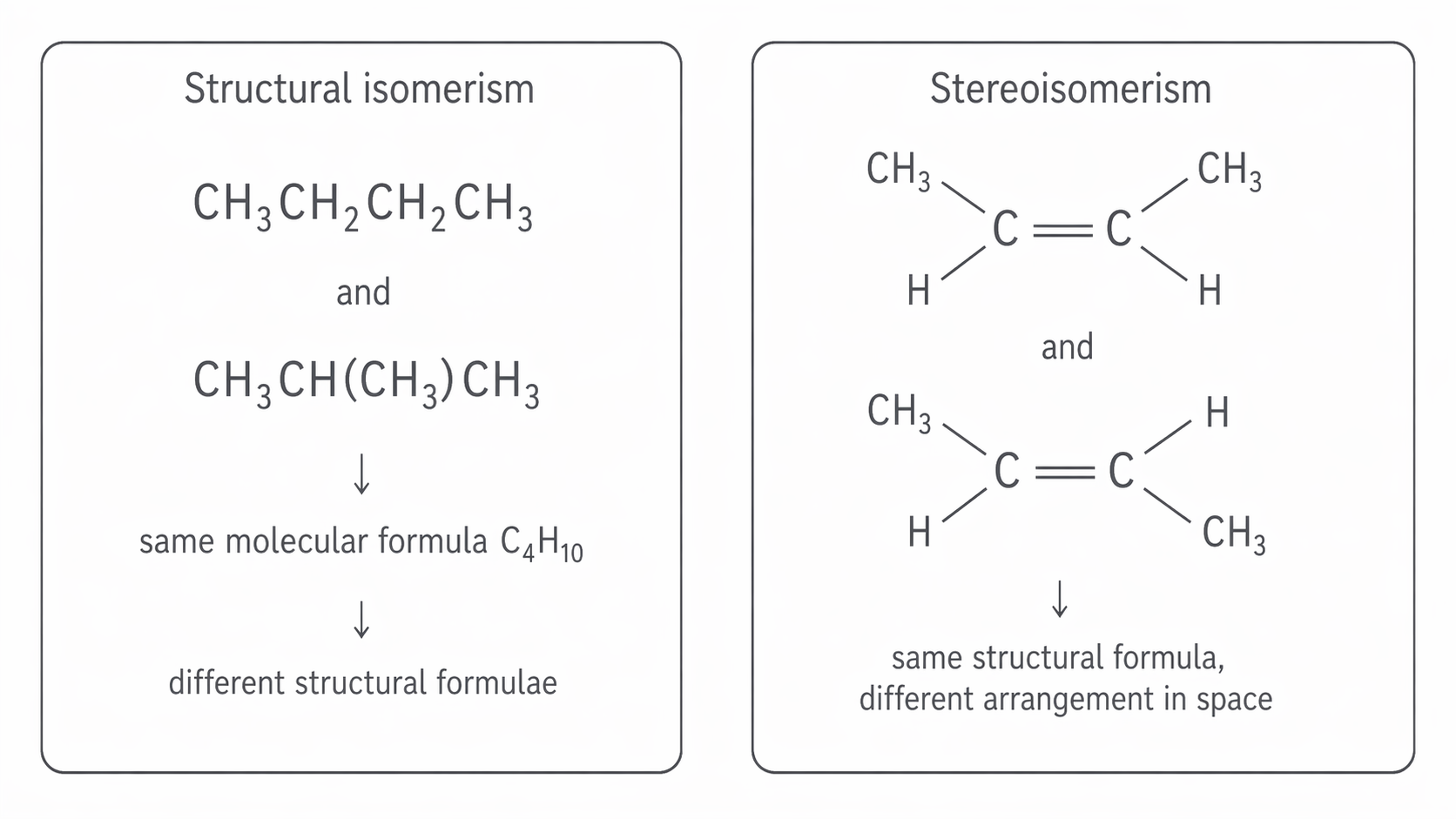
A useful first check is therefore: has the bonding pattern changed, or only the 3D arrangement? If the bonding pattern changes, think structural isomer. If the bonding pattern stays the same, think stereoisomer.
The three types of structural isomer
There are three named kinds of structural isomerism: chain isomerism, position isomerism, and functional group isomerism. The trick is to notice exactly what has changed while the molecular formula stays fixed.
Chain isomerism means the carbon skeleton is different. A straight-chain molecule and a branched molecule can still share the same molecular formula. For , is butane, whereas is 2-methylpropane.
Position isomerism means the carbon skeleton and functional group stay the same, but the functional group, substituent, or multiple bond is in a different position. For , and are position isomers because the bromine atom is attached at different points on the same three-carbon chain.
Functional group isomerism means the atoms are arranged so that the compounds belong to different homologous series. For , is ethanol, but is methoxymethane. Same molecular formula, different functional groups.
To generate structural isomers systematically, keep the molecular formula fixed and change only one feature at a time:
- change the carbon skeleton for chain isomers
- keep the skeleton but move the group for position isomers
- rearrange the atoms so the functional group changes for functional group isomers
The diagram below compares the three named types with one clear pair for each, so you can see exactly what changes while the molecular formula stays fixed.
[DIAGRAM: asset_name: 3.1.3 - Isomerism - Diagram 2; asset_slug: 3.1.3 - Isomerism - Diagram 2; recommended_method: retained_png; description: Three labelled rows comparing the named types of structural isomerism. Row 1, chain isomerism: butane CH3CH2CH2CH3 and 2-methylpropane CH3CH(CH3)CH3. Row 2, position isomerism: 1-bromopropane CH3CH2CH2Br and 2-bromopropane CH3CHBrCH3. Row 3, functional group isomerism: ethanol CH3CH2OH and methoxymethane CH3OCH3. Include the note "same molecular formula, different structures".]
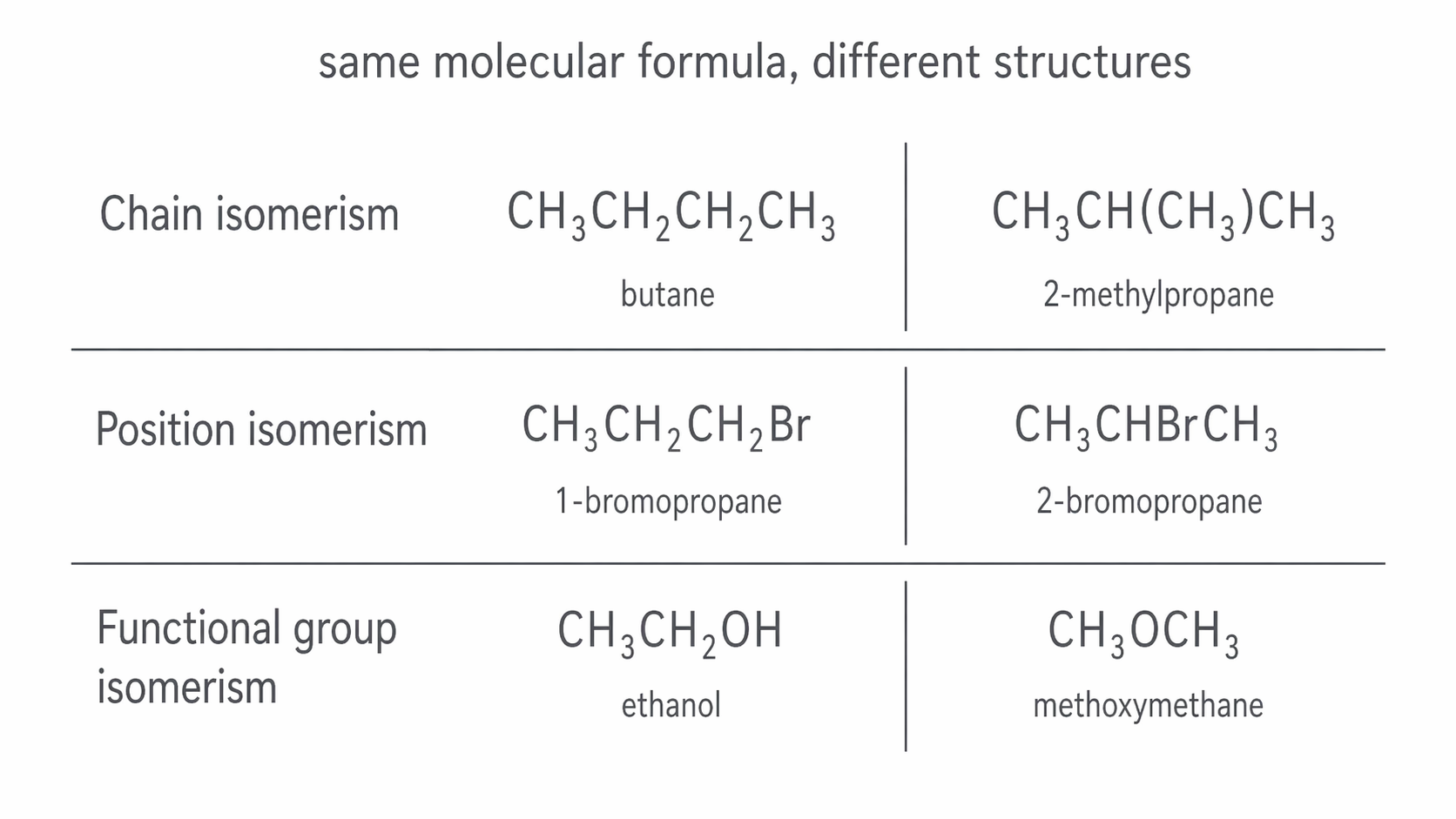
This classification step is worth getting fluent at because it helps you see exactly what has changed in an organic structure.
Stereoisomerism and restricted rotation
Stereoisomers preserve which atoms are bonded together, but differ in spatial arrangement.
Stereoisomer
Compounds with the same structural formula but a different arrangement of atoms in space.
For stereoisomers, the atoms are connected in the same order, so the difference is purely spatial. In this topic, the stereoisomerism you need is E-Z isomerism.
E-Z isomerism happens because there is restricted rotation about a carbon-carbon double bond. A single bond can rotate freely, so two drawings produced just by rotation are still the same molecule. A bond is different because the pi bond would have to be broken before free rotation could happen. The atoms attached directly to the double bond therefore stay in a fixed planar arrangement.
That restricted rotation is necessary, but it is not enough on its own. Each carbon in the must also be attached to two different groups. If one carbon has two identical groups, there is no meaningful way to make two different spatial arrangements.
Continue this lesson.
You’re previewing NovaLearn without an account. Create a free account to read the rest.
Create free account