3.3.9.1 - Carboxylic Acids and Esters
Carboxylic acids and esters are closely linked, because one can be turned into the other. This lesson focuses on how to recognise their structures, why carboxylic acids behave as weak acids, how esters are made and hydrolysed, and how the same chemistry explains fats, soaps, and biodiesel.
Recognising the functional groups
Carboxylic acids and esters are both organic compounds that contain oxygen, but they do not have the same functional group. Getting the structure right matters, because the structure tells you how the substance reacts.
Carboxylic acid
An organic compound that contains the - functional group. In aqueous solution it can donate a proton, so it behaves as an acid.
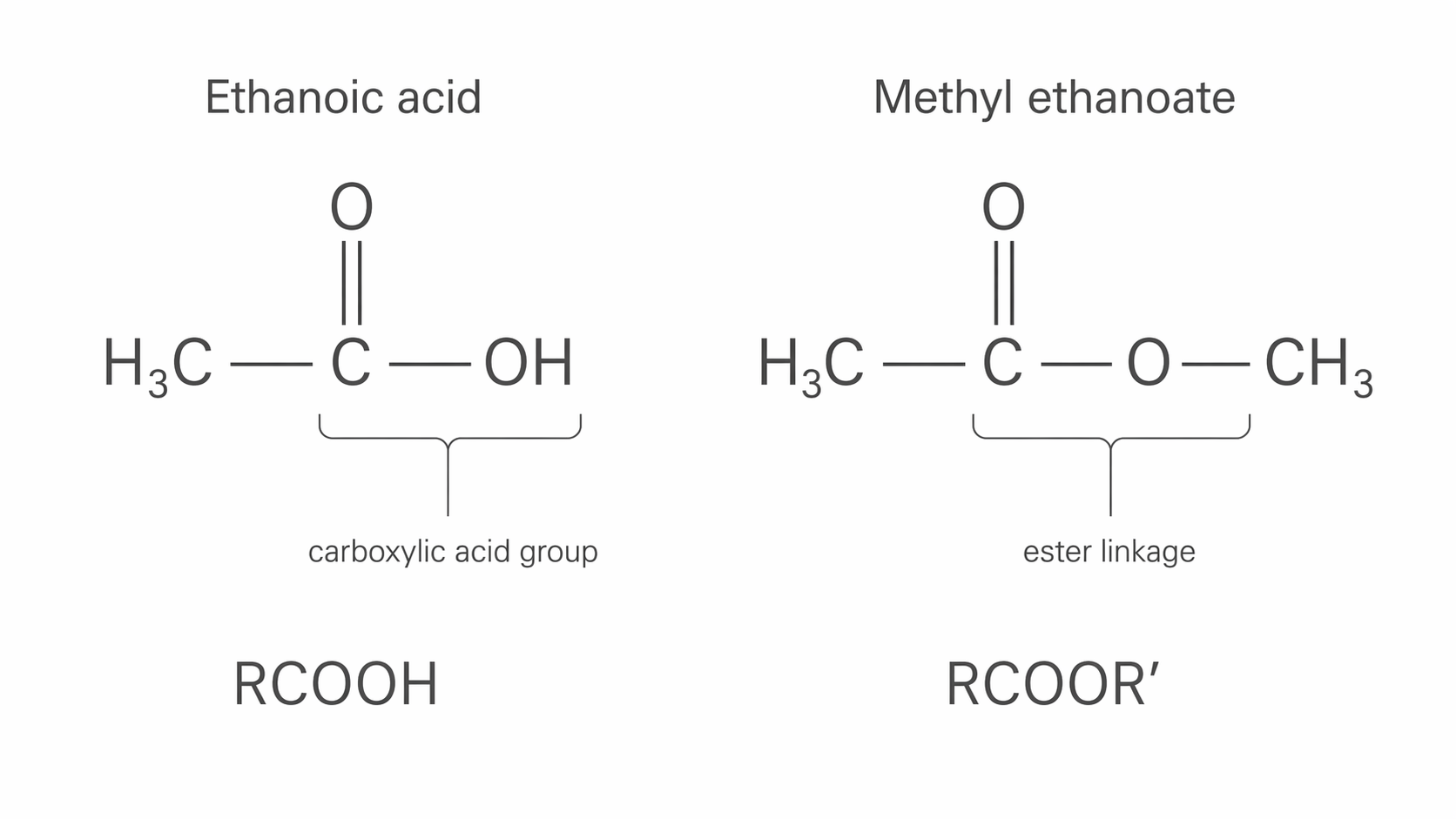
In a carboxylic acid, the same carbon atom is bonded to a double-bonded oxygen and to an - group. The general structure is , where R may be hydrogen or a hydrocarbon group. Ethanoic acid, , is the simplest familiar example.
Ester
An organic compound containing a group whose single-bond oxygen is attached to a carbon group, usually formed when a carboxylic acid reacts with an alcohol. The group attached to the carbonyl carbon may be hydrogen, as in methanoate esters.
The general structure of an ester is . One side comes from the carboxylic acid, and the group attached to the single-bond oxygen comes from the alcohol. For example, is methyl ethanoate. A quick way to distinguish the two functional groups is this: carboxylic acids end with -, while esters have in the middle of the molecule. The diagram below compares ethanoic acid with methyl ethanoate and highlights exactly where the functional groups differ.
[DIAGRAM: asset_name: 3.9.1 - Carboxylic Acids and Esters - Diagram 1; asset_slug: 3.9.1 - Carboxylic Acids and Esters - Diagram 1; recommended_method: retained_png; description: Side-by-side displayed formulae of ethanoic acid H3C-C(=O)-OH and methyl ethanoate H3C-C(=O)-O-CH3. Label the -COOH section in ethanoic acid as the carboxylic acid group and the -COO- section in methyl ethanoate as the ester linkage. Under the two structures, show the general formulae RCOOH and RCOOR'.]
This same ester linkage appears in larger biological molecules too. Vegetable oils and animal fats are not special exceptions; they are still esters, just much larger ones.
A plasticiser makes a polymer softer or more flexible by reducing the effective attractions between neighbouring polymer chains so they can slide more readily. An ester has polar bonds, but a large ester plasticiser can also have extensive hydrocarbon regions. Those regions form London forces with oils and fats, so such a plasticiser can dissolve preferentially in fatty material. Do not infer that a large molecule is highly water-soluble simply because it contains an ester group.
Why carboxylic acids are weak acids
When a carboxylic acid dissolves in water, only a small fraction of its molecules release a proton. That is why they are described as weak acids rather than strong acids.
Weak acid
An acid that only partially dissociates in water, so the equilibrium lies mainly to the side of the undissociated acid molecules.
For a carboxylic acid, the equilibrium can be written as:
⇌ (aq) + (aq)
The ion formed is called a carboxylate ion. A useful way to think about this is that once the proton has left, the negative charge is shared across the two oxygen atoms, which makes the carboxylate ion reasonably stable. That helps the acid release , but only partially, so the acid is weak.
Carboxylic acids still show a clear acid reaction with carbonates. They form a carboxylate salt, water, and carbon dioxide. With sodium carbonate, ethanoic acid reacts as:
2 + → 2 + +
The visible observation is effervescence as is released. This is a useful distinction from alcohols, which contain - but do not behave as acids in this way.
Weak and dilute describe different things. A weak acid is about partial dissociation; a dilute acid is about low concentration.
At equal concentration, hydrochloric acid initially reacts faster with carbonate because it supplies a higher concentration of . Equal volumes of equally concentrated monoprotic acids nevertheless produce the same final amount of with excess carbonate: as protons are consumed, more ethanoic acid dissociates. Acid strength changes the initial rate, not the total number of acid molecules available.
Making esters from carboxylic acids and alcohols
Esters are made when a carboxylic acid reacts with an alcohol in the presence of an acid catalyst. This reaction is called esterification.
In general:
carboxylic acid + alcohol ⇌ ester + water
For example:
+ ⇌ +
Here, ethanoic acid reacts with ethanol to form ethyl ethanoate and water. The acid catalyst speeds up the reaction but is not used up. Because the reaction is reversible, the product mixture contains both reactants and products unless conditions are chosen to push the equilibrium further toward the ester.
The structure of the ester also explains its name. The alkyl part comes from the alcohol, and the -oate part comes from the carboxylic acid. That is why ethanol plus ethanoic acid gives ethyl ethanoate.
Esters are useful because many are volatile, have pleasant smells, or dissolve other organic substances well. That is why they are commonly used in:
- solvents
- plasticisers
- perfumes
- food flavourings
Plasticisers are often ester molecules added to polymers such as PVC. The ester molecules fit between long polymer chains and help the chains slide past one another more easily, making the plastic softer and more flexible.
Those uses are not random facts to memorise. They come directly from the typical physical properties of esters: many are liquids, many evaporate fairly easily, and many have distinctive smells.
For a preparative esterification, warm the alcohol and carboxylic acid with a small amount of concentrated sulfuric acid under reflux. The vertical, open condenser returns volatile material; use electric heating or a water bath where appropriate, because organic vapours are flammable. An excess of one reactant can increase equilibrium yield; a catalyst alone does not change the equilibrium yield.
Continue this lesson.
You’re previewing NovaLearn without an account. Create a free account to read the rest.
Create free account