3.3.13.5 - Action of Anticancer Drugs
Cisplatin is a coordination complex that shows how chemistry can be used to treat disease. In this lesson, you will see why its exact shape matters, how it reacts with DNA, and why the same chemistry that helps kill cancer cells can also damage healthy tissue. That balance between benefit and harm is a major part of how society judges powerful drugs.
What cisplatin is and why its shape matters
Cisplatin is a platinum(II) complex with the formula . The platinum ion is surrounded by four ligands in a square-planar arrangement: two ammonia ligands and two chloride ligands.
Cis isomer
A cis isomer is a geometric isomer in which two identical ligands are next to each other rather than opposite each other.
For this drug, that geometry matters. In cisplatin, the two chloride ligands are adjacent, so after reaction they can be replaced in positions that are close together. That allows the platinum to form bonds to two nearby sites on DNA. The trans isomer has those positions opposite each other, so it does not bind DNA in the same helpful way.
The diagram below compares the square-planar arrangements of cisplatin and transplatin.
[DIAGRAM: asset_name: 3.13.5 - Action of Anticancer Drugs - Diagram 1; asset_slug: 3.13.5 - Action of Anticancer Drugs - Diagram 1; recommended_method: retained_png; description: Two side-by-side square-planar Pt(NH3)2Cl2 complexes. Left: cisplatin, with NH3 at the top and right and Cl at the left and bottom so the identical ligands are adjacent, labelled "cis". Right: transplatin, with NH3 at the top and bottom and Cl at the left and right so the identical ligands are opposite, labelled "trans".]
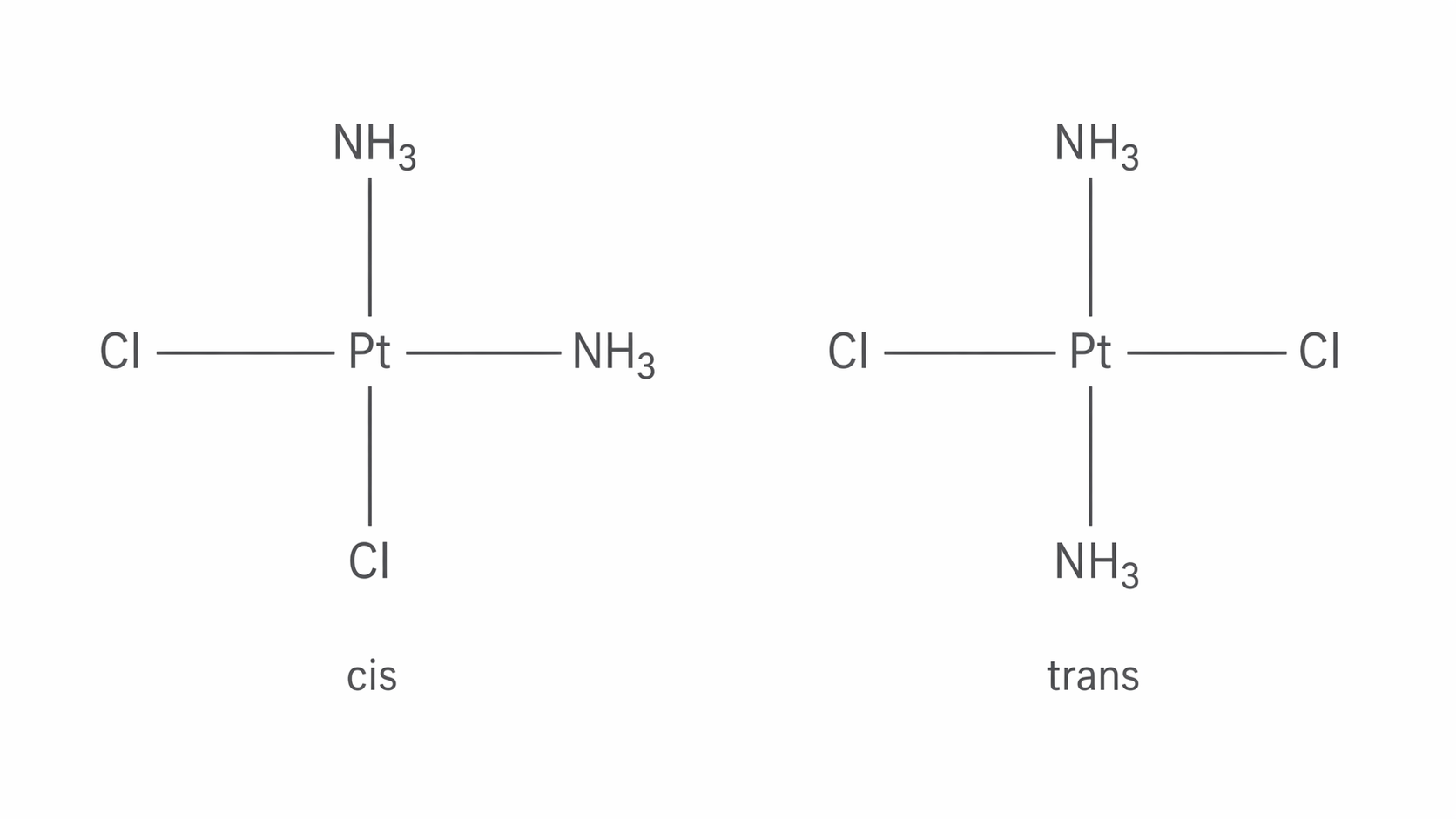
The key idea is not simply that cisplatin contains platinum, but that its three-dimensional arrangement lets it attach to neighbouring parts of a DNA strand. If that arrangement is wrong, the drug is much less effective.
How cisplatin reacts with DNA
DNA contains bases with nitrogen atoms that have lone pairs of electrons. Guanine is especially important here because a nitrogen atom on guanine can act as a ligand and donate a lone pair to the platinum centre.
Ligand substitution reaction
A ligand substitution reaction is one in which one ligand in a complex ion or molecule is replaced by another ligand.
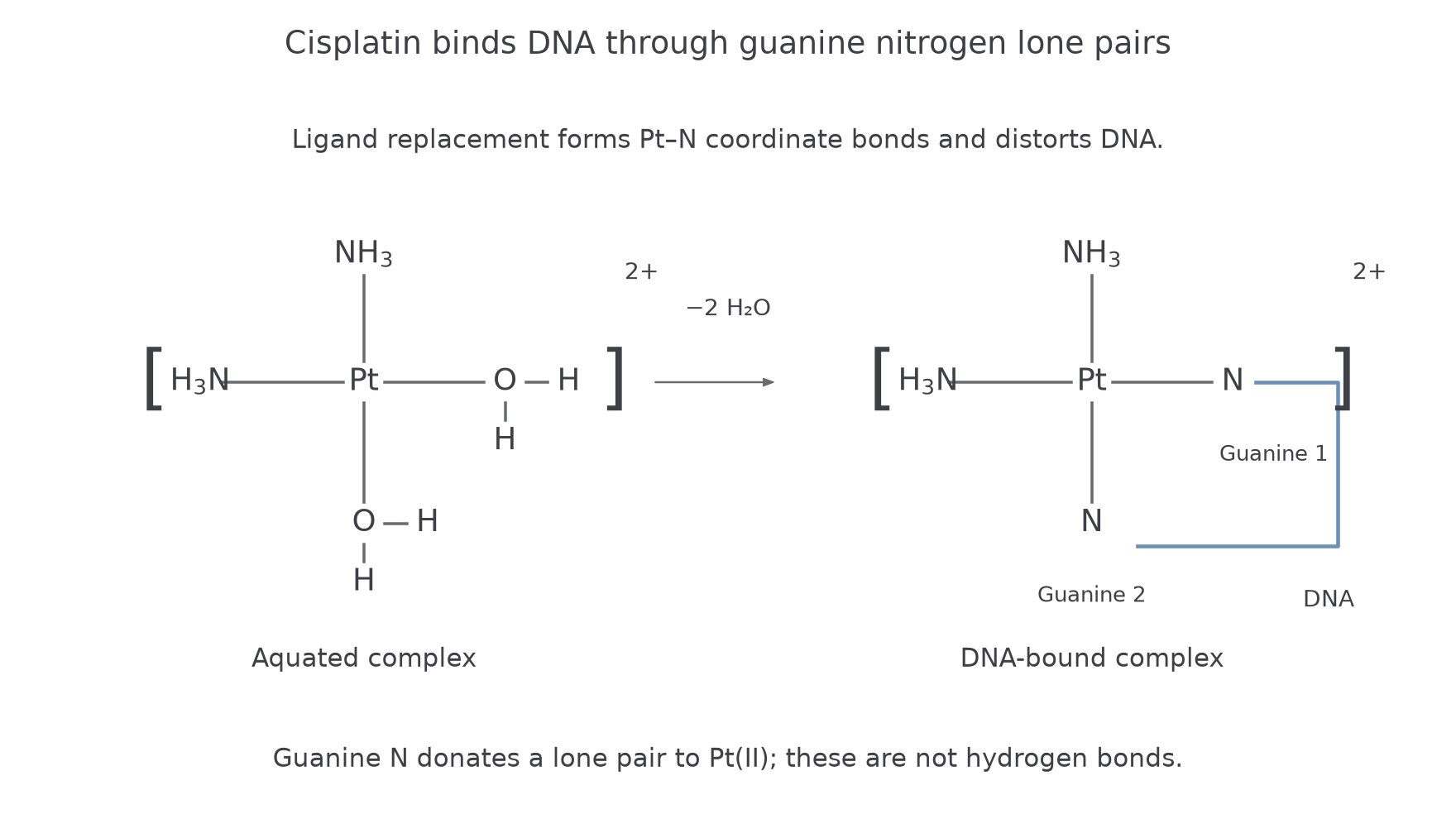
Inside the cell, cisplatin first becomes more reactive because its chloride ligands can be replaced by water molecules. Those water ligands are then displaced by nitrogen atoms on guanine. The nitrogen donates a lone pair to platinum, forming a coordinate bond.
So the sequence is:
- cisplatin enters the cell
- chloride ligands are replaced by water
- guanine nitrogen atoms replace the water ligands
- platinum becomes attached directly to DNA
This is still the same core chemistry you already know from transition-metal complexes: ligand substitution. The biological importance comes from what the new ligand happens to be. Here, the ligand is part of DNA itself.
The diagram below shows aquated cisplatin reacting with two adjacent guanine bases so that platinum becomes attached directly to DNA.
[DIAGRAM: asset_name: 3.13.5 - Action of Anticancer Drugs - Diagram 2; asset_slug: 3.13.5 - Action of Anticancer Drugs - Diagram 2; recommended_method: code_generated; description: Square-planar aquated Pt(II) complex and DNA-bound complex with adjacent Pt–N guanine bonds, +2 complex charge and water elimination.]
A useful first activation step is aquation:
Continue this lesson.
You’re previewing NovaLearn without an account. Create a free account to read the rest.
Create free account